
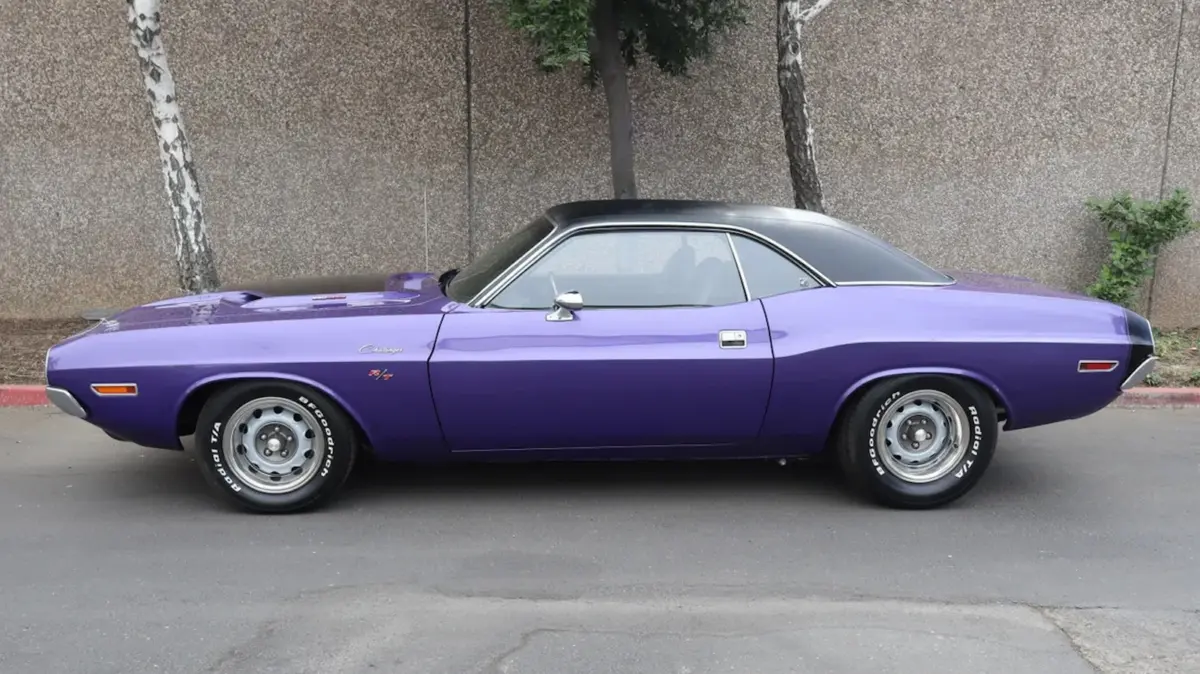
It wasn’t all that long ago that a different, clean, and striking Plum Crazy 1970 Dodge Charger caught the attention of automotive enthusiasts on the used market. That rare Mopar machine generated considerable interest among classic car collectors who appreciate the bold, unmistakable high-impact paint colors that defined an era of American muscle. Now, automotive fans who lean toward slightly more compact proportions and iconic pony car styling are in luck, as a 1970 Dodge Challenger R/T from the exact same model year and finished in that same iconic, head-turning shade of purple has become available for purchase. Apparently, a deep affection for purple Mopars runs strong in certain circles, and this latest find is bound to turn heads wherever it cruises.
Spotted recently on Hemmings Classifieds, the vehicle in question is a 1970 Dodge Challenger R/T showing 96,199 miles on its odometer. Located in Sacramento, California, and offered for sale through Ryle’s Rides, the dealership has attached a price tag of $69,995 to the vintage coupe. For classic car buyers looking for a driver-quality piece of American automotive history that still commands respect at local car shows and weekend cruises, this particular Challenger presents an interesting proposition.
A close look at the vehicle reveals a history that deviates slightly from strict numbers-matching factory specifications, yet carries an appeal that many performance enthusiasts will immediately understand and appreciate. According to the factory fender tag affixed to the car, this specific Challenger R/T rolled off the assembly line originally powered by a 383-cubic-inch Magnum V8 engine, which would have been paired to a four-speed manual gearbox. However, somewhere along the way during its multi-decade existence, a previous owner decided to elevate the car’s performance capabilities even further. In place of the factory 383, somebody dropped in a larger 440-cubic-inch big-block V8 sourced from a 1969 model year vehicle.
This engine swap brings an extra layer of muscle to the classic coupe. The 440-cubic-inch motor is equipped with a modern aluminum intake manifold, a four-barrel carburetor to feed the hungry big-block, and striking chrome valve covers that dress up the engine bay nicely. To ensure that the upgraded powerplant maintains safe operating temperatures whether idling in summer traffic or stretching its legs out on the open highway, the car has also been fitted with an upgraded aluminum radiator.
Fortunately for purists who value the tactile engagement of shifting their own gears, the four-speed manual gearbox remains intact in the drivetrain layout. True to the classic Mopar performance aesthetic, the manual shifter is topped with an iconic pistol-grip handle, offering that unmistakable, mechanical feel that defined Chrysler performance cars of the era.
Visually, the car embraces its aggressive R/T heritage with a series of classic exterior appointments. A contrasting black vinyl roof stretches across the top of the cabin, perfectly complementing the matching black center stripe laid across the hood. R/T badging adorns the exterior sheet metal, leaving no doubt about the car’s performance pedigree, while a set of classic Rallye-style wheels wrapped in meaty BFGoodrich Radial T/A white-letter tires fill out the wheel wells. Inside the cabin, occupants are treated to supportive bucket seats facing a classic wood-rim steering wheel, anchoring the vintage driving experience.
Worth 70 grand?
To understand the place this car occupies in automotive history, it helps to look back at the context of its birth. The year 1970 marked the inaugural model year for the Dodge Challenger. Because it arrived slightly later than some of its cross-town rivals, it was actually one of the later additions to the booming muscle and pony car craze of the late 1960s and early 1970s. Despite its delayed entry into the segment, the Challenger made a massive splash. It bore a notable resemblance to the existing Plymouth Barracuda, a familial resemblance that made complete sense given that both iconic performance coupes were built on Chrysler Corporation’s famous E-Body platform.
Back in the day when these cars were fresh on showroom floors, a standard Challenger carried a modest base price of $2,850, whereas stepping up to the more potent and aggressive R/T trim required a slightly larger investment of $3,266. When those historical figures are adjusted for inflation using a standard calculator, they translate to roughly $25,000 and $28,000 in today’s money, respectively.
Looking at modern automotive pricing provides yet another fascinating point of reference for how much the automotive landscape has shifted over the decades. The modern spiritual and functional equivalent of this vehicle—a brand-new two-door 2027 Dodge Charger Scat Pack—commands a starting price of around $50,000 for the base trim level, and that figure does not even factor in destination charges or optional equipment. For further perspective on the current state of the automotive market, even the absolute cheapest compact economy car that Kia sells in 2026 demands a starting price of $27,075.
Weighing those current market realities against the scarcity, emotional appeal, and mechanical grunt of a classic big-block E-Body Mopar, asking roughly $70,000 for a used but exceptionally clean and well-presented 1970 Dodge Challenger R/T begins to feel entirely reasonable. In fact, for enthusiasts who have watched the values of pristine muscle cars skyrocket over the past twenty years, this Plum Crazy cruiser might not be quite as crazy as it initially sounds.