
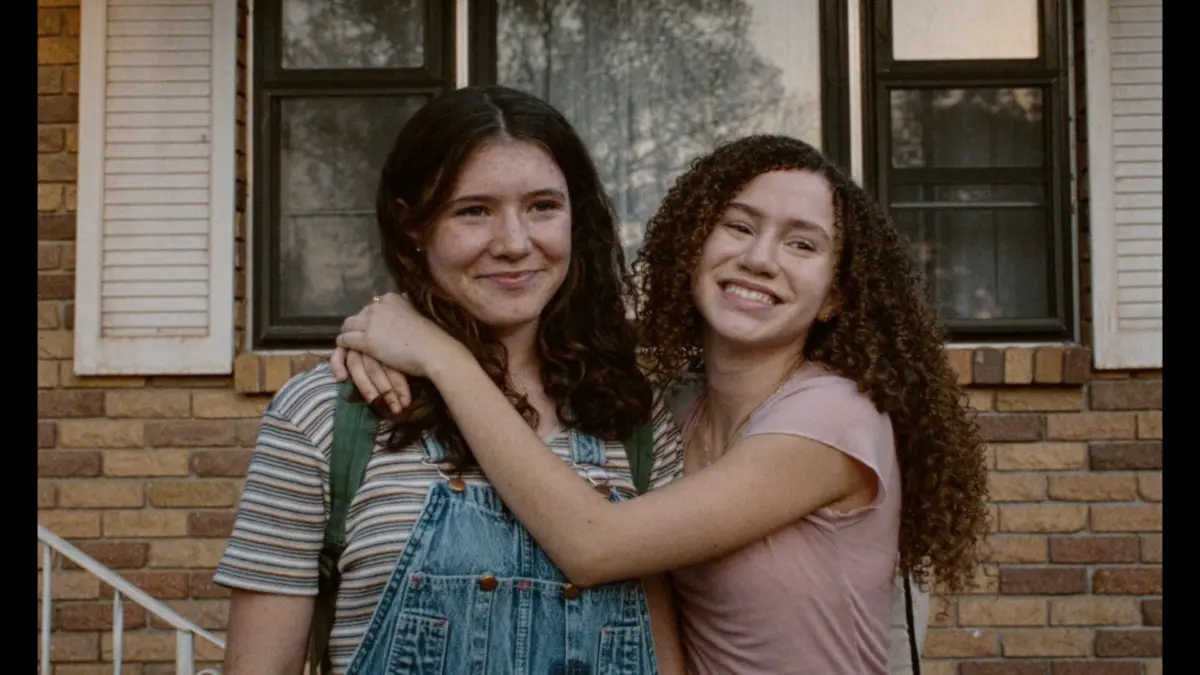
The making of the film Mouse gave a group of mothers in Arkansas a very unexpected, yet poignant, reason to have held onto their daughters’ prom dresses for over two decades. As the production team prepared for the film’s crucial school-dance sequence, costume designer Meg Grace realized that capturing the specific, non-curated aesthetic of the early 2000s required more than just a trip to a modern vintage store. She turned to the community, issuing a call on Facebook for prom gowns worn between 2000 and 2003. The response was overwhelming; in the week leading up to the shoot, members of her team spent their days driving across town, filling a van with the discarded finery of a bygone era. Altogether, they gathered dozens of dresses, each one a relic of a specific moment in teenage history. For Grace, seeing these pieces finally worn by the actors was a surreal experience. “It felt like a time warp,” she says, describing the sensation of watching the past inhabit the present.
That flicker of genuine, sometimes uncomfortable recognition is the heartbeat of Mouse, the latest film from directing duo Kelly O’Sullivan and Alex Thompson. Following their acclaimed work on Ghostlight, the filmmakers set this new project firmly in 2002, in O’Sullivan’s own hometown of North Little Rock, Arkansas. The story centers on Minnie, played by Katherine Mallen Kupferer, a teenager who has spent her formative years comfortably, if somewhat invisibly, in the shadow of her charismatic best friend, Callie, portrayed by Chloe Coleman.

The narrative is set in motion by a tragedy: the sudden death of Callie. In the wake of this loss, Minnie finds herself gravitating toward the people and places that once anchored her friend’s life. Specifically, she becomes drawn to Callie’s poised, enigmatic mother, Helen, played by Sophie Okonedo. The home that Helen maintains—a space Minnie had long preferred to her own—becomes a sanctuary. However, as the bond between the grieving teenager and the bereaved mother deepens, it becomes increasingly complicated, tangled in threads of genuine affection, unprocessed grief, and the universal, painful teenage longing to shed one’s own skin and become someone else entirely.
Mouse is remarkably attuned to the ways in which teenage dissatisfaction manifests. It is a film that understands how a young person’s unhappiness can latch onto almost anything: the persistent irritation of imperfect skin, the perceived chaos of a cluttered living room, or even the specific, grating cadence of a mother’s voice. In this film, the costumes and interior design serve a purpose far greater than simple period decoration. They do not just evoke the era; they act as a mirror for Minnie’s internal state, revealing how she sees herself and the idealized life she desperately wishes were hers.

For O’Sullivan, the priority was to ensure that the setting felt authentically embedded in the lives of the characters rather than presenting a cartoonish, nostalgic version of the early 2000s. Achieving this required a deep dive into the practical reality of how trends filtered down to teenagers in a place like Arkansas at the time. “Arkansas wouldn’t be on the cutting edge of fashion in 2002,” O’Sullivan observes. The goal was to avoid the polished, high-definition aesthetic often associated with modern period pieces, favoring instead the slower, more disjointed reality of life before the internet became the primary arbiter of style.
Meg Grace, who grew up in Arkansas during the same period, recalls the limitations of her own teenage wardrobe. The shopping landscape was defined by JCPenney, Sears, Walmart, Big Lots, and Kmart. “We might have all wanted to look like what we saw on TV, but what did you actually have access to?” she asks. The experience was often one of delayed gratification, where a teenager might wait months, perhaps until Christmas, to acquire a single coveted item of clothing. “That might be the one thing in your closet that’s really stylish, and then you make it work with everything else,” Grace explains. To conduct her research, she scoured O’Sullivan’s old yearbooks and pressed friends to share their personal archives, including early, grainy digital camera photographs. “None of us knew how to put an outfit together,” Grace admits with a smile. The challenge was to construct looks that appeared as though they were assembled by a teenager with limited resources and a style sensibility that was still very much in its infancy.

Much of the film’s wardrobe was sourced from estate sales and secondhand shops throughout Arkansas. Among the more discerning finds were the cargo capris—a garment that was ubiquitous in the early 2000s but has been largely bypassed by the current, more curated Y2K fashion revival. O’Sullivan recalled the look with immediate clarity: “With the polo—I was like, ‘I wore this.’” The film also captures the specific, awkward artifice of school dances, where teenagers were often transformed by elaborate, gravity-defying updos. O’Sullivan remembers these moments as being akin to seeing peers turned into “40-year-old princesses of a weird country.”
Production designer Linda Lee approached the interiors with a similar mandate: to create a sense of familiarity without falling into the trap of caricature. This involved allowing different eras of home life to coexist within the same space. “The calendar might tell you that you’re in the 2000s, but your home doesn’t actually change that quickly,” Lee points out. To reflect this, Minnie’s house was designed with a heavy reliance on 1970s and 1980s aesthetics—bold, contrasting colors and heavy textures—which felt lived-in and somewhat chaotic. In contrast, Helen’s home was designed to be more understated, layering 1980s and 1990s elements with newer, more intentional additions that signaled a different socioeconomic status.

The contrast between the two households extends well beyond the color palettes of the wallpaper. Minnie’s mother, Barbara—played by Tara Mallen, who is the real-life mother of the lead actress—is a single parent and a veterinarian whose immense capacity for empathy often leads her to take in strays. The house is perpetually filled with rescue animals, a testament to her character’s kindness that leaves little room for the kind of rigid domestic polish Minnie finds so seductive elsewhere. Helen’s spacious, quiet home, with its promise of freshly cooked dinners and order, represents an alluring, if perhaps illusory, alternative to the reality of Minnie’s life.
To flesh out the bedrooms of the two girls, Lee cut up vintage issues of Seventeen and J-14 magazine found on eBay, re-creating the precise, haphazard wall collages that defined teenage spaces before the advent of Pinterest. There were other essential touchstones to secure, as well. O’Sullivan remembers the moment Lee triumphantly announced, “We have secured the lava lamp,” a small but vital detail that grounded the set in its era.

The film’s 2002 setting is perhaps most vital in how it approaches the portrayal of grief. “I don’t know how to write teenagers now, quite honestly,” O’Sullivan admits. “The way that we grieve has changed so much, culturally, with social media.” While the story is fiction, it draws heavily on the director’s personal experience of losing a friend in a car accident at the end of her own junior year in 2001. In the world of Mouse, which remains largely offline, information does not travel with the instantaneous, overwhelming speed of the modern digital age. News arrives at its own, often agonizing, pace. Public displays of grief, which today might involve a curated photo carousel or a heartfelt digital tribute, were, in 2002, matters of physical action and presence.
Cell phones appear in the film, but they are not the all-consuming, universal extensions of the self that they are today. A Sidekick makes an appearance, and Callie carries a chunky, distinctively early-2000s Nokia. “Indestructible phones,” Lee says, while O’Sullivan adds, “Could play Snake for hours.” For contemporary teenage viewers, these seemingly ordinary objects can be a source of genuine confusion. O’Sullivan recalls a conversation with a young neighbor who, after seeing the film, asked, “Wait, your mom could pick up another phone in the house and hear your conversation?” O’Sullivan had to confirm that this was indeed the reality of the time—a total lack of privacy that was, as she notes while shaking her head, “the source of a lot of stress.” By leaning into these specific, sometimes uncomfortable, and often forgotten details, Mouse succeeds in capturing the disorientation of adolescence, proving that while the technology changes, the ache of growing up remains constant.