
The Headlines: A Viral Attempt to Move a Masterpiece
In a display of digital-era absurdity turned physical reality, hundreds of people converged on Chicago’s Millennium Park this past Sunday, united by a singular, viral objective: “Push the Bean.” The target of their collective effort was Anish Kapoor’s iconic 2004 sculpture, Cloud Gate. The massive, 110-ton stainless steel landmark, which has become synonymous with the Chicago skyline, was the subject of an online movement suggesting that a man was trapped inside the sculpture and needed to be freed by nudging the structure seven inches to the left.
The scene was one of spectacle and irony. As participants pressed their hands against the cool, mirrored surface of the sculpture, they were met with the immovable reality of 110 tons of steel. While the crowd chanted, their efforts were hampered by a modern paradox: most participants were using only one hand to push, while the other held a smartphone aloft to document the event. The irony of the moment—that the act of capturing the experience for social media likely hindered the physical possibility of moving the work—was not lost on onlookers.
Despite the enthusiasm of the crowd, local authorities have long since grown weary of the persistent myth. Chicago City Council member Brendan Reilly has repeatedly issued statements clarifying that there is no individual trapped within the sculpture. The legend, which has taken on a life of its own in online forums, has led to a barrage of inquiries directed at the alderman’s office, prompting him to explicitly ask the public to cease contacting his staff regarding the safety of a non-existent prisoner. For now, the Bean remains exactly where it has been for two decades, serving as a mirror to the city and, occasionally, to the peculiarities of internet culture.
In Memoriam: Honoring Industry Titans
The art world is mourning the loss of two significant figures who helped shape the trajectory of contemporary practice and the legal frameworks of the creative estate. Michael Ward Stout, a formidable attorney and the longtime executor of the Robert Mapplethorpe Foundation, has died at the age of 83. Stout was a central figure in the art market, providing legal guidance to some of the most influential artists and estates of the 20th century. Beyond his work with Mapplethorpe, Stout represented the estate of Salvador Dalí and Jean-Michel Basquiat, and served as counsel for the renowned dealer Barbara Gladstone. His career was defined by his meticulous handling of artist licensing, exhibition rights, and the complex contractual architecture that keeps the legacies of major artists alive in the commercial and institutional spheres.
Concurrent with the loss of Stout, the art world also bids farewell to the French video and conceptual artist Fred Forest. Known for his pioneering work in “sociological art” and “Net art,” Forest passed away at the age of 93. His death was announced in a manner entirely consistent with his conceptual approach to life and art: a message released by his son, Adrien, which contained a posthumous statement written by the artist himself. “Thanks to the affectionate complicity of my son Adrien, I have the pleasure of announcing my own death,” the statement read. “Lying in this hole dug in the earth at Anserville [north of Paris], I will now have all the time to reflect calmly on what I will be doing tomorrow, my friends…” Forest’s legacy is firmly cemented in the history of the Centre Pompidou, which honored him with major retrospectives in 2017 and 2024, recognizing his early contributions to the medium of video and his theoretical explorations of media networks.
The Digest: Recoveries, Thefts, and Institutional Challenges
Beyond these losses, the international art landscape continues to navigate a complex array of institutional developments. In a triumph for provenance research and cultural heritage, two oil studies by the Flemish master Peter Paul Rubens have resurfaced. Missing for over eight decades, the sketches have been reunited with three other works by the artist at the Ducal Museum in Gotha, Germany. The works had been part of the museum’s collection for centuries before they vanished during the turmoil of the mid-20th century, and their return marks a significant moment for the institution.
However, the news is not all restorative. French law enforcement has recently made a breakthrough in a series of high-profile cultural thefts, arresting four individuals in connection with burglaries at the Musée Lalique and the Archaeology Centre in Montans. The incidents, which occurred in July, involved the loss of rare jewelry and ancient coins, sparking a multi-agency investigation into the security vulnerabilities of regional museums.
In New York, the financial instability of the gallery sector has come into sharp focus with the ongoing legal woes of The Hole. The Bowery-based gallery is currently facing eviction proceedings, with court filings indicating that it owes $102,823 in back rent and associated late fees. The litigation also includes allegations that the gallery failed to compensate artists and staff, marking a difficult chapter for a space that has long been a fixture of the contemporary art scene.
Meanwhile, in the sphere of public art and monumentality, political tensions have spilled over into the streets of Washington, D.C. Over 50 protesters recently gathered to voice their opposition to a planned triumphal arch project associated with President Trump, reflecting broader societal debates regarding the intersection of architecture, political ideology, and public space.
In the Midwest, the Grand Rapids Art Museum is hosting a poignant and necessary exhibition centered on the theme of incarceration. The survey features works by and about individuals who have experienced the American prison system. Among the highlights is a 1,000-piece ceramic installation by the late Julie Green, which depicts the final meal choices of inmates on death row. The exhibition also showcases the quilted works of Gary Tyler, an artist who was wrongly convicted as a teenager and spent decades in prison before his exoneration. The show provides a somber reflection on the human experience within the penal system, utilizing art to bridge the gap between abstract policy and individual lives.
The Kicker: The Mona Lisa’s Lonely Future
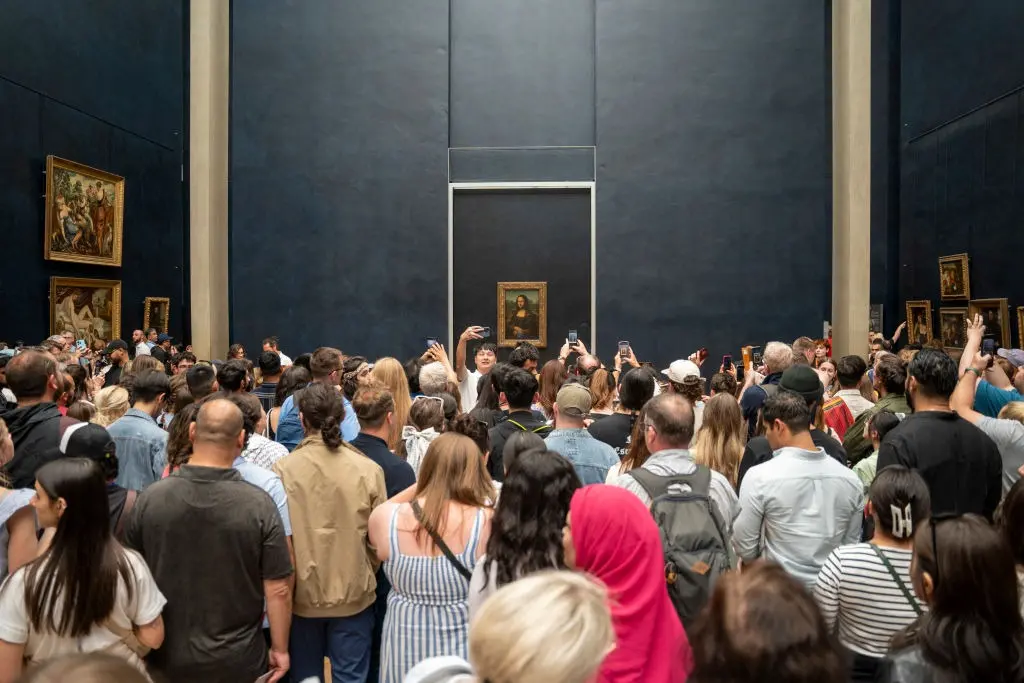
As the Louvre prepares for an ambitious, multi-billion-dollar renovation project, a peculiar debate has emerged regarding the future of its most famous resident. Museum president Christophe Leribault has been actively fundraising for the massive overhaul, a plan that includes a controversial proposal to relocate the Mona Lisa to a dedicated, solitary gallery.
While the move is intended to mitigate the intense overcrowding that plagues the current room—where thousands of visitors daily struggle to catch a glimpse of Leonardo da Vinci’s masterpiece—the prospect has met with some resistance, even from within the museum’s leadership. Leribault recently expressed his reservations to the Wall Street Journal, noting that while the move is a practical necessity for crowd control, he finds the idea “sad.” His concern is that isolating the portrait will sever the thematic and art-historical connection between the Mona Lisa and the other Da Vinci paintings currently hanging in her company. For now, the plan remains in the development stage. Visitors to the Louvre can continue to view the painting in its current, bustling environment, surrounded by fellow Da Vinci works and a constant stream of tourists documenting their encounter with the world’s most famous smile. Whether that smile will eventually be relegated to a room of its own remains a question for the museum’s future, balancing the demands of modern tourism against the historical integrity of the collection.