
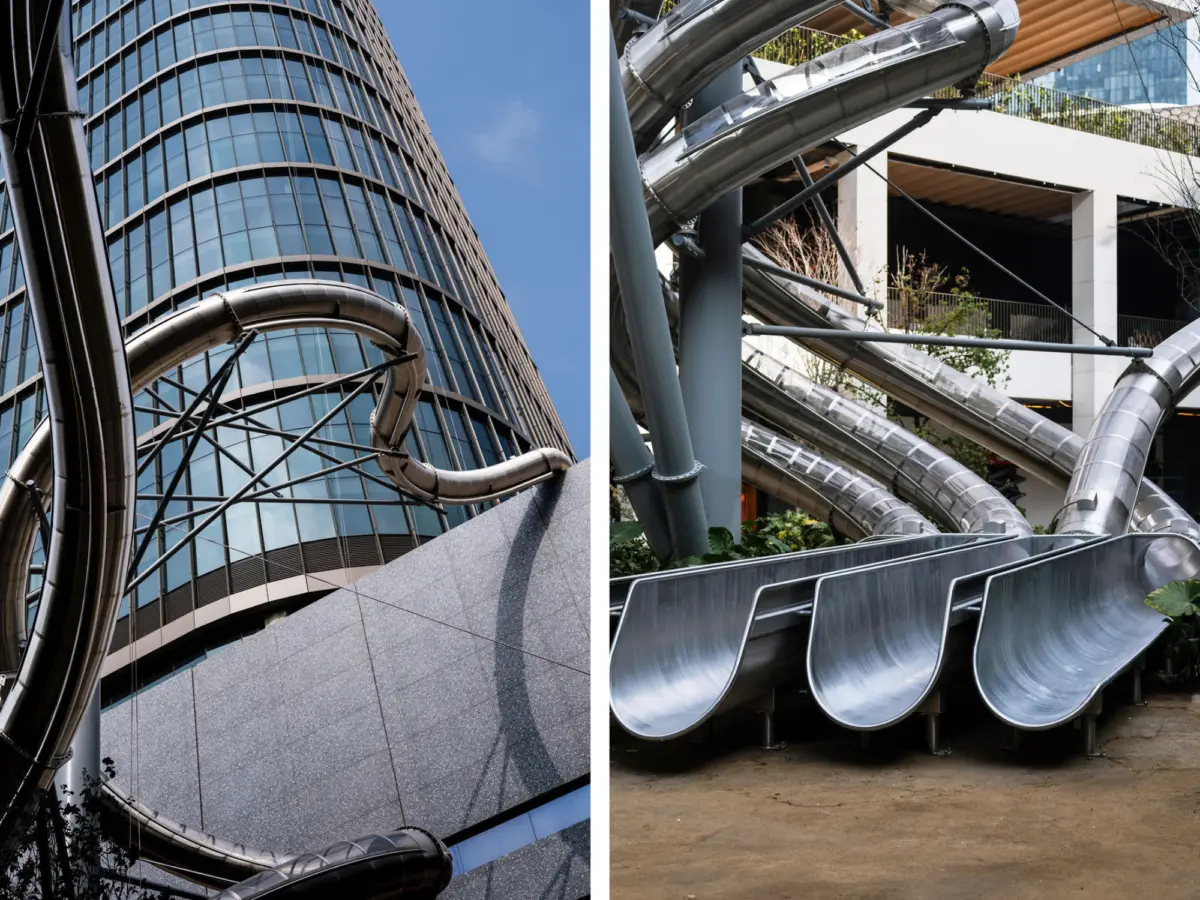
In an ambitious fusion of contemporary art, architectural engineering, and urban play, Belgian artist Carsten Höller has unveiled his latest major project: a series of monumental, spiraling silver slides installed at the Arte Abierto space within the Antara shopping center in Mexico City. Titled Mexico City Slides (2026), the installation serves as a permanent, interactive feature of the upscale open-air complex, inviting visitors to experience the architecture of the site from an entirely new—and exhilarating—perspective.
The installation, commissioned through a collaboration between Arte Abierto and the renowned Sordo Madaleno Arquitectos, marks a significant addition to Mexico City’s public art landscape. Spanning the vast, multifaceted environment of Antara, the slides are integrated directly into the fabric of the shopping, dining, and office complex. Far from being a mere decorative sculpture, the work is designed to be fully functional, transforming the daily transit of office workers, shoppers, and tourists into a momentary act of physical spontaneity.
An Engineering Marvel of Scale and Interaction
The sheer scale of Mexico City Slides is indicative of Höller’s signature approach to public art, which often prioritizes immersive, physical engagement over passive observation. The installation consists of four distinct spiral slides that vary significantly in dimension, ranging from 39 feet to 125 feet in height and between 102 and 295 feet in length.
These structures are positioned to intersect with various key nodes of the Antara complex. Entry points for the slides are strategically located to capture the diverse demographics that frequent the area, including access points near family-style restaurants, the local Google offices, the Rosewood Hotel, and the dedicated Arte Abierto Art Space. By converging at a single, unified exit point, the slides act as a centralizing force, drawing individuals from disparate parts of the bustling commercial center into a shared, singular experience.
The design team, in tandem with Höller, has ensured that the installation remains visible from almost every angle of Antara’s gardens, plazas, and pedestrian promenades. This visibility is central to the work’s intent; it is meant to serve as a constant, looming invitation to abandon the rigid norms of a typical workday or shopping trip.
The Philosophy of the "Equalizer"
Carsten Höller has long been preoccupied with the concept of the "liminal space"—the threshold between one state of being and another. With Mexico City Slides, he characterizes his intent as creating an "equalizer" for the public. In a space where social hierarchies are often reinforced by the nature of the surroundings—such as high-end retail environments or corporate office towers—the slides act as a democratizing agent. Once a participant enters the chute, their status as a corporate executive, a shopper, or a tourist is momentarily suspended in favor of the universal, involuntary physical sensation of sliding.
Höller has frequently described his slide projects as catalysts for what he terms a "voluptuous panic upon an otherwise lucid mind." This phrase captures the specific psychological shift he aims to induce: a brief, intense departure from the logical, structured, and often monotonous nature of urban life. By introducing an element of controlled vertigo and speed, the artist hopes to disrupt the "lucid" state of the modern city-goer.
The artist’s long-standing hypothesis regarding these works is perhaps best captured in his 2015 interview with The Guardian, in which he famously asserted that it is "impossible to travel down a slide without smiling." This physiological response—a sudden, unbidden expression of joy—is precisely what Höller seeks to harvest from his audience. By embedding this experience within a high-traffic, professional, and commercial district, he forces a collision between the mundane requirements of urban productivity and the primal, childlike impulse for play.
A Global Legacy of Vertical Transit
The Mexico City Slides project is the latest iteration of an ongoing, global work-in-progress that Höller began developing in 1998. Over the past three decades, the artist has sought to redefine the way the public interacts with architectural environments by introducing these gravity-based transit systems.
His fascination with the slide as a medium for social intervention has seen iterations appear in some of the world’s most prestigious cultural and architectural institutions. Notable predecessors to the Mexico City installation include Test Site (2006) at the Tate Modern in London, which saw massive, snaking tubes installed in the museum’s Turbine Hall, fundamentally altering the way visitors navigated the vast gallery space.
In 2011, he unveiled the Victoria Slide at the New Museum in New York, followed by the Vitra Slide Tower (2014) at the Vitra Campus in Weil am Rhein, Germany. Each of these projects was specifically tailored to its host environment, reflecting Höller’s commitment to site-specificity. The Florence Experiment Slides (2018) at the historic Palazzo Strozzi in Florence provided a stark contrast between the city’s Renaissance architecture and the sleek, futuristic aesthetics of the slide, while the DAC Slide (2020) at the Danish Architecture Centre in Copenhagen further refined the integration of these structures into modern urban planning.
Redefining Public Space in Mexico City
The choice of Antara as the location for the 2026 project highlights the evolving role of public space in Mexico City. By partnering with Sordo Madaleno Arquitectos, Höller has been able to weave his art into the structural DNA of a contemporary urban center. This is not merely an object placed in a square; it is a piece of infrastructure that participates in the movement of people.
As visitors and workers at Antara navigate the transition between the office buildings, the hotel, and the public art space, the slides stand as a reminder that the environment is malleable. The installation challenges the traditional boundaries between art, architecture, and public utility, suggesting that our built environments should be designed to foster not just efficiency, but also moments of unexpected, visceral delight.
With the permanent installation now open, Arte Abierto expects the slides to become a landmark feature of the Polanco district. As the public continues to engage with the spiraling silver tubes, the Mexico City Slides will continue to serve as a testament to Höller’s enduring conviction: that in the midst of the most rigid urban structures, there remains a vital need for the simple, transformative power of a slide.