
History books often cherish romantic narratives, particularly the one in which Lee Iacocca, universally celebrated as the father of the Mustang, single-handedly birthed an entirely
new category of American automobiles known as the pony car. While Iacocca certainly deserves immense credit for shepherding the most popular and commercially successful vehicle of that breed into reality, the conceptual framework of the pony car had been actively brewing in design studios and engineering departments years before the first-generation Mustang Mk1 ever rolled onto a showroom floor. Although not all of these early machines strictly fit the modern definition of a pony car, a fascinating array of concepts, prototypes, and sporty production coupés were already flirting heavily with the idea of an enthusiast-grade compact car for the masses.
This historical nuance does not diminish Iacocca’s recognized genius. He may not have invented the underlying concept of a compact sports coupe, but he undoubtedly read the cultural and market room far better than any of his corporate counterparts. In fact, several of the automotive experiments featured during this prolific pre-Mustang era directly influenced Iacocca to assemble the specialized team of engineers tasked with bringing the Mustang to life. From early Ford-based compact sports cars like the Budd XT-Bird Concept and the Ford Falcon Futura Sport to rear-engine engineering exercises like the Chevrolet Corvair Monza Turbo, these pre-Mustang models gradually warmed the American public to the viability and excitement of the pony car idea.
1962 Budd XT-Bird Concept
Lee Iacocca was far from the first automotive visionary to toy with the notion of a compact sports car tailored for the everyday buyer. Edward Gowan Budd, recognized as one of the most important engineers and entrepreneurs of the early twentieth century, had already been dabbling with the concept of an accessible 2+2 sports car. More importantly, he went so far as to pitch a fully working prototype of his XT-Bird directly to Iacocca, an encounter that likely planted the foundational pony-car seed within the future Ford executive’s mind.
The proposed vehicle was constructed using the foundation of a 1961 Ford Falcon unibody architecture paired with a heavily modified body shell salvaged from a 1955 to 1957 Ford Thunderbird. This clever engineering approach allowed Budd’s firm, Budd-American Motors, to stretch the classic Thunderbird’s 102-inch wheelbase by an additional 7.5 inches, successfully transforming it from a traditional two-seater into a functional 2+2 layout. While the resulting rear seats were undeniably tight and largely impractical for long journeys, the 2+2 configuration quickly became an indelible hallmark of the pony car segment, allowing enthusiastic buyers to transport friends and family alike.
Under the hood, the XT-Bird Concept was equipped with a 170-cubic-inch, or 2.8-liter, inline-six-cylinder engine. While it lacked the thunderous displacement of a V8, Budd enhanced its output by bolting on a supercharger, ensuring it offered performance adequate for the period. Although precise factory power figures were never officially disclosed, historical records indicate that the vehicle utilized a three-speed manual transmission.
Despite its historical significance in prompting Ford to explore the compact sports car space, the XT-Bird Concept ultimately struggled aesthetically. Its clumsy attempt to modernize the iconic rear fins and headlight housings of the classic Thunderbird resulted in a design that felt relatively bland and forgettable to contemporary observers.
1962 Budd XR-400 Concept
When Ford ultimately declined Budd’s XT-Bird proposal, the ambitious engineer was undeterred, quickly setting to work on a second attempt at defining the early pony car. Unveiled just months after his initial pitch, the XR-400 Concept represented another fully functional, production-ready sporty convertible designed to capture the public imagination.
This time around, Budd utilized a Rambler Ambassador chassis and pitched the concept directly to the American Motors Corporation. He developed a comprehensive commercial plan, estimating that bringing the vehicle to market would require a remarkably low $4.1 million. Because the XR-400 Concept leveraged an existing AMC platform, tooling and production costs would have been significantly reduced compared to engineering an entirely new vehicle from a clean sheet of paper. Had AMC management chosen to greenlight the XR-400, the vehicle would have easily beaten both the Plymouth Barracuda and the Ford Mustang to showroom floors, completely rewriting the history of the American pony car and potentially saving AMC from its eventual financial decline and corporate buyout. Instead, AMC surrendered its critical head start, ultimately finding itself playing a frantic game of catch-up with the rest of the industry when it introduced the Javelin for the 1968 model year.
The XR-400 boasted proportions far sportier than the earlier XT-Bird, successfully incorporating AMC’s potent 327-cubic-inch, or 5.36-liter, V8 engine into the layout. Budd mounted the heavy engine lower within the chassis to optimize handling dynamics, shortened the Ambassador’s floor pan by 14.3 inches, and shifted the passenger cabin rearward by 16.24 inches to achieve classic sports car proportions. Maintaining a 2+2 seating arrangement, the XR-400 Concept stood as a textbook example of a pony car convertible, arriving two full years before automotive journalists officially coined the terminology.
1962 Ford Mustang I Concept
While independent coachbuilders and engineers were busy pitching ideas, Ford was concurrently developing its own radical compact sports car. The mid-engine Mustang I Concept possessed the potential to completely alter the trajectory of the famous nameplate. Featuring an aggressive, wedge-shaped exterior profile, pop-up headlights, a strict two-seat cabin layout, and a remarkably tight 90-inch wheelbase, the Mustang I served as a direct stylistic and mechanical antithesis to Ford’s contemporary mainstream lineup, which included the Falcon, Fairlane, Galaxie, and Thunderbird.
Although the Mustang I famously never made the transition from auto show circuit to mass production, it successfully spearheaded the internal development of America’s definitive pony car. Crucially, the prototype was a fully functioning sports car in every sense. Power was supplied by a compact 1.5-liter V4 engine that generated up to 100 gross horsepower in specialized race trim. Thanks to an advanced space-frame chassis and lightweight aluminum body panels, the vehicle tipped the scales at an astonishingly featherlight 1,544 pounds. This race-car-level mass enabled the tiny machine to reach a top speed of 115 miles per hour, an impressive feat for such a modest motor, while its engine willingly spun up to a high-revving 7,500 rpm.
Handling prowess served as the primary motivation behind Ford’s exploration of a mid-engine configuration. Unlike subsequent front-engine pony cars, the Mustang I remained remarkably stable and balanced when pushed through corners, exhibiting virtually zero body roll. This composure was aided by an integrated structural roll bar that significantly stiffened the chassis. Ford maintained such immense confidence in the vehicle’s dynamic capabilities that it organized a major publicity stunt during the United States Grand Prix at Watkins Glen Raceway in New York. With legendary Formula One driver Dan Gurney behind the steering wheel, the Mustang I Concept proceeded to lap the challenging circuit at speeds nearly matching contemporary Formula One racing machines.
1963 Ford Mustang II Concept
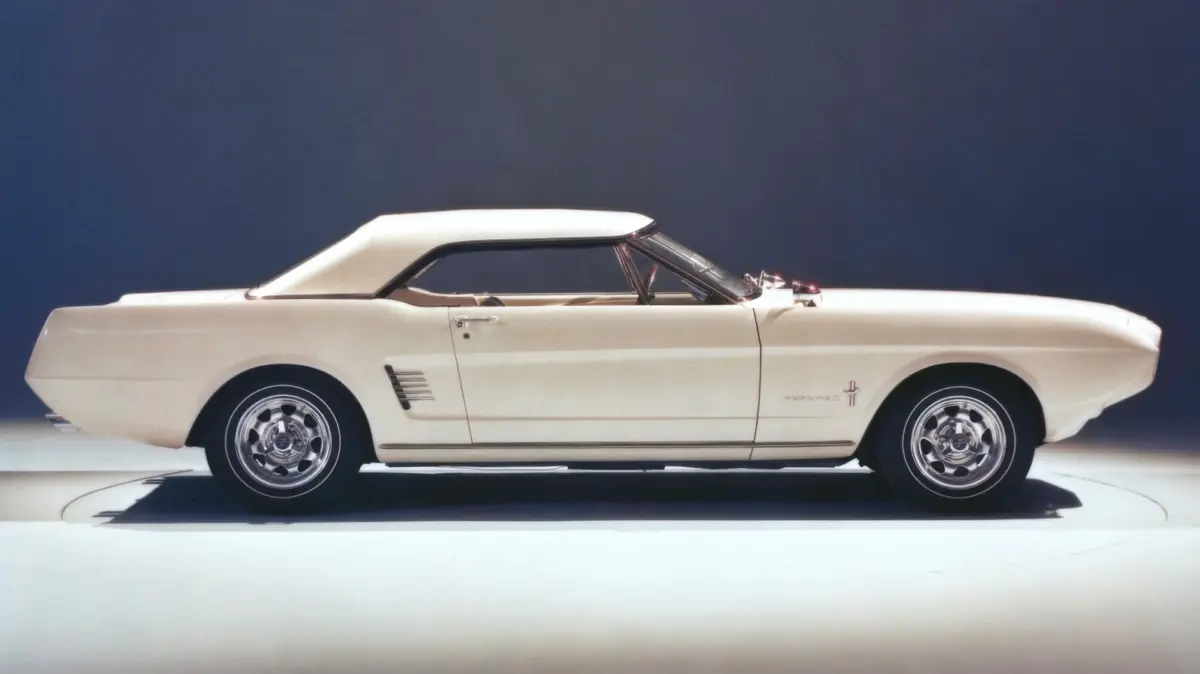
If the Mustang I Concept introduced the legendary galloping horse emblem to the world, it was the subsequent Mustang II Concept that provided a remarkably accurate preview of the final production vehicle. Displaying a classic pony car silhouette defined by a long hood, a relatively short rear deck, a chopped roofline, and distinctive tri-bar taillights, the prototype bore a striking resemblance to the production Mustang Mk1. While it measured five inches longer than the car that ultimately reached dealerships—giving it an arguably sleeker, more stretched profile—the fundamental architectural blueprint of the Mustang was unmistakably present.
The similarities extended far beyond superficial styling. Like the production model destined for showrooms, the Mustang II Concept was constructed atop a modified Ford Falcon unibody chassis and utilized an authentic performance powertrain: a high-performance 289-cubic-inch, or 4.7-liter, V8 engine mated to a four-speed manual transmission. In keeping with the spirit of the earlier mid-engine concept, this iteration was also presented as a convertible, though it featured a removable fiberglass hardtop for added versatility. True to the emerging pony car formula, the cabin incorporated a 2+2 seating layout, alongside forward-looking technological touches such as an electric trunk release mechanism.
Painted in a stark white finish accented by bold blue racing stripes, the Mustang II Concept made its public debut at Watkins Glen alongside its predecessor. While Ford opted not to demonstrate its capabilities on the active racetrack this time around, the company ensured spectators could easily appreciate the mechanical soundtrack by packing the valve lifters with wax, producing a distinctive, race-car-like big-cam exhaust note.
1962 to 1964 Chevrolet Corvair Monza Spyder Turbo
The Chevrolet Corvair was originally conceived as a revolutionary compact car designed to mount a serious challenge against the Volkswagen Beetle. Featuring a rear-mounted, air-cooled flat-six engine, diverse body styles, and a surprisingly spacious interior, the Corvair proved to be a controversial and ultimately ill-fated commercial venture for General Motors. However, its engineering path yielded one of the most fascinating sports cars of the 1960s: the Corvair Monza Spyder Turbo.
As the vehicle that officially introduced mainstream turbocharging to everyday automotive consumers, the Corvair stood as the mechanical opposite of the front-engine, water-cooled V8 layout that would eventually define the Ford Mustang. Yet, its market success and enthusiast appeal exerted profound pressure on Lee Iacocca, compelling him to establish the secret "Fairlane Committee"—a clandestine group of executives and engineers tasked with determining that Ford desperately required an attractive, youthful sports car despite enjoying strong compact-car sales with the Falcon. In terms of overall character and market positioning, the Corvair Monza Spyder Turbo served as a primary point of inspiration for that committee.
Strictly speaking, the Corvair Monza Spyder Turbo was not a traditional pony car, with some automotive historians drawing closer parallels to the rear-engine Porsche 911 Turbo that arrived more than a decade later. Nevertheless, it was a dedicated enthusiast machine equipped with four interior seats, matching the functional capacity of any recognized pony car. Its 2.4-liter turbocharged flat-six engine produced a healthy 150 horsepower, sufficient to propel the car from zero to sixty miles per hour in 10.3 seconds, though it famously suffered from noticeable turbo lag. Chevrolet later addressed performance criticisms in 1965 by introducing the upgraded Corvair Corsa, which featured a larger 2.7-liter engine churning out 180 horsepower and dropping the zero-to-sixty sprint to 7.8 seconds. Enthusiast-grade amenities included a standard four-speed manual transmission, a comprehensive instrument cluster featuring a tachometer, and supportive bucket seats.
1963 to 1965 Ford Falcon Futura Sprint
If one were to strip away the distinctive, sculpted bodywork from an early 1964½ Ford Mustang, the underlying machinery would reveal an automobile essentially identical to a Ford Falcon Futura. Launched as a direct corporate answer to Chevrolet’s Corvair Monza, the Falcon Futura—particularly when ordered in the sporty Sprint specification—provided buyers with an early taste of the high-performance direction Ford intended for its compact platforms.
The Futura Sport and Sprint trims shared the vast majority of their mechanical components with the upcoming Mustang, coming factory-equipped with Ford’s 164-horsepower, 260-cubic-inch Challenger V8 engine and a four-speed manual transmission. While this output fell considerably short of the most aggressive factory editions of the Mustang, such as the legendary 306-horsepower Shelby GT350, it proved more than adequate to serve as a high-performance stopgap before the definitive pony cars captured the market’s attention. Weighing in at a relatively modest 3,011 pounds, the V8 engine propelled the Futura to sixty miles per hour in a respectable 9.5 seconds.
To signal its serious intentions toward enthusiast drivers, Ford outfitted the Falcon Futura Sprint with a heavy-duty suspension system, a dashboard tachometer, front bucket seats, and a specialized steering wheel. While buyers of standard Falcon models could occasionally select the V8 engine as an option, they missed out on the comprehensive package of handling and interior upgrades included with the Sprint.
Despite incorporating nearly all the functional attributes of a future pony car, minus the specialized sports styling, the Falcon Futura remained a relatively low-volume proposition for the company. Ford managed to sell 15,081 units during its initial production run, comprising 10,479 two-door hardtops and 4,602 convertibles. Although Ford kept the Futura Sprint in production through 1965, sales dwindled rapidly once the Mustang reached full commercial momentum. In fact, consumer demand became so lopsided that Ford ultimately sold eleven Mustangs for every single Falcon produced, even though the Mustang commanded a higher retail price.
1962 to 1964 Studebaker Lark Daytona R1/R2
Studebaker is rarely the first manufacturer that comes to mind when discussing the origins of the American pony car, yet the historic independent automaker created one of the ultimate pre-pony sleepers with the Lark Daytona. From its compact dimensions to the potent powerplants available in its high-performance R1 and R2 configurations, the Lark Daytona possessed virtually every requisite ingredient for the pony car classification.
Based upon the humble, compact Lark passenger car, the sporty Daytona coupé variant featured pillarless side glass and an unusual, upright design language. In terms of exterior styling, it bore little resemblance to the classic proportions that would come to define official pony cars. However, beneath its unassuming sheet metal lay a muscular 289-cubic-inch V8 engine available in both naturally aspirated R1 and supercharged R2 specifications.
The naturally aspirated motor produced a stout 240 horsepower, rendering it powerful enough to comfortably outperform contemporary rivals like the Corvair Monza Spyder Turbo and the Falcon Futura, achieving a zero-to-sixty sprint in the low seven-second range when paired with an optional four-speed manual transmission. Meanwhile, the supercharged R2 variant churned out an impressive 289 horsepower, dropping the zero-to-sixty acceleration time below seven seconds. The Lark Daytona was also offered with three-speed manual and automatic transmissions, as well as a smaller 2.8-liter inline-six engine.
In many respects, the Lark Daytona punched well above its weight class during the pre-pony-car era. Unfortunately, Studebaker was unable to outrun its mounting corporate misfortunes. Flying high on technical ambition, the company even launched a dedicated Corvette competitor known as the Avanti in 1963. Utilizing a radically aerodynamic fiberglass body shell built upon a modified Lark chassis, the supercharged V8-powered Avanti was capable of achieving a breathtaking top speed of 178.5 miles per hour in its highest state of tune.
1963 to 1966 Plymouth Valiant Signet 200
The Plymouth Valiant played a pivotal role in keeping the Plymouth division solvent following dismal sales figures during the 1962 model year. Within that lineup, the sporty Signet 200 variant served as the direct mechanical backbone for the world’s first widely recognized production pony car, the 1964 Plymouth Barracuda. Because the Valiant and the early Barracuda shared the vast majority of their underlying engineering, it is historically accurate to view the Signet as a pre-Ford Mustang pony car in spirit.
The foundational blueprint was already established. The Valiant Signet 200 was offered as a two-door hardtop coupé or convertible specifically targeted at driving enthusiasts, featuring front vinyl bucket seats, exterior chrome trim accents, and—beginning in 1964—an optional 273-cubic-inch, or 4.5-liter, V8 engine. Initially, this V8 powerplant produced 180 horsepower, but for the 1965 model year, Plymouth increased the compression ratio and replaced the standard two-barrel carburetor with a four-barrel setup, elevating output to 235 horsepower. This engine could be paired with an optional Hurst four-speed manual transmission, though the majority of models left dealerships equipped with standard three-speed manual or automatic gearboxes.
The baseline engine offering was a 170-cubic-inch Slant-Six producing a modest 101 horsepower. To further emphasize the vehicle’s sporty aspirations, Plymouth briefly offered a lighter all-aluminum 225-cubic-inch Slant-Six rated at 145 horsepower, though persistent reliability issues prompted a swift return to a traditional cast-iron block. Despite these sporty intentions, the Valiant Signet 200 was never made available from the factory with front disc brakes or heavy-duty suspension packages—upgrades that only became standard industry practice once true pony cars dominated the market.
Dodge offered a closely related vehicle sharing the same A-body platform, known as the Dart. However, the Dart possessed a noticeably less compact footprint, stretching approximately ten inches longer and carrying a heavier curb weight. Like its Plymouth sibling, the Dart remained available with the 225-cubic-inch Slant-Six and the 273-cubic-inch V8 engines.
1964 to 1966 Plymouth Barracuda
While the Ford Mustang ultimately achieved the most enduring historical legacy and commercial dominance, the 1964 Plymouth Barracuda beat its legendary rival to the marketplace by a mere sixteen days, officially securing its title as the world’s first production pony car. Nevertheless, the Barracuda was not developed as an entirely clean-sheet design; rather, it was introduced as a striking fastback body style derived directly from the existing Valiant Signet 200.
The Barracuda shared its core platform, interior architecture, and engine options with Plymouth’s compact sedan, even retaining Valiant badging on early production models. Despite these shared underpinnings, the Barracuda presented a significantly more dynamic aesthetic, highlighted by an expansive, wraparound rear glass greenhouse that lent the vehicle a sweeping, sporty profile.
In terms of raw mechanical performance, however, little initially separated the Barracuda from its humble sibling. Matching the Valiant Signet 200, the introductory Barracuda could be specified with the 170-cubic-inch and 225-cubic-inch Slant-Six engines, alongside the 273-cubic-inch V8 producing up to 235 horsepower in its optional Commando configuration. Enthusiasts ordering the V8 could select a Hurst four-speed manual transmission, while Chrysler’s TorqueFlite three-speed automatic remained widely available.
While the Valiant Signet 200 offered identical powertrain choices, beginning in 1965 the Barracuda began receiving the dedicated engineering hardware expected of a true pony car. Through the introduction of the Formula S performance package, the Barracuda gained upgraded suspension components and wider tires designed to sharpen cornering agility, alongside a dedicated dashboard tachometer.
These rolling chassis improvements allowed the Barracuda to compete more effectively against the surging popularity of the Ford Mustang. Even so, Ford’s offering remained the more comprehensively engineered and well-rounded market proposition. The Mustang could be ordered with a high-output 289-cubic-inch V8 generating up to 271 horsepower, factory front disc brakes, and a vastly more comprehensive handling package comprising heavy-duty springs, specialized shock absorbers, and thick stabilizer bars.