
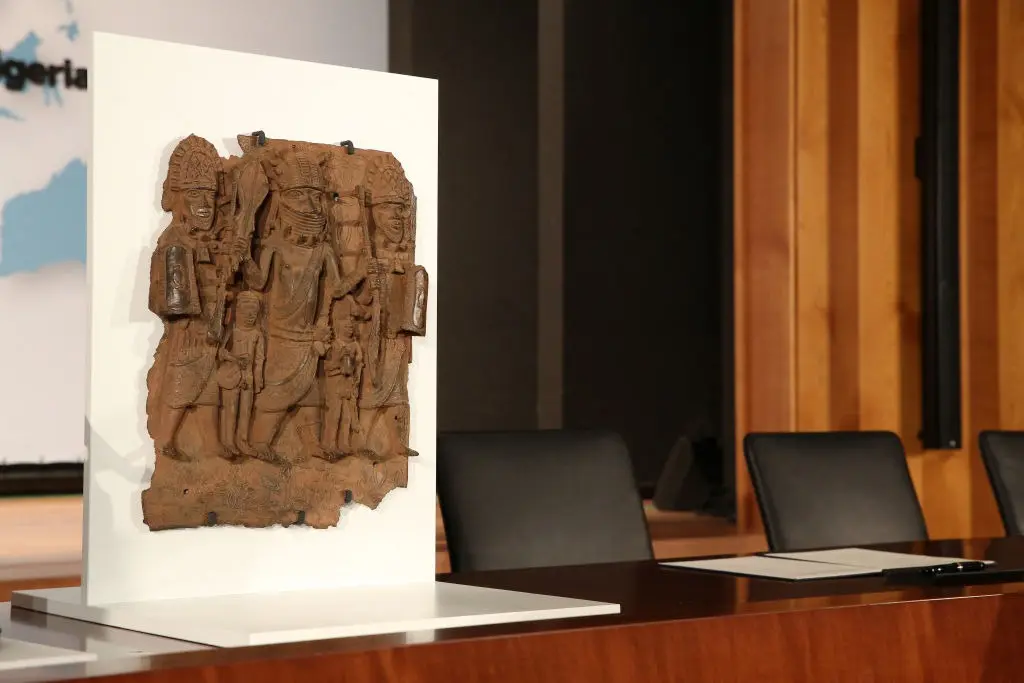
In a significant move toward reconciling with its colonial-era acquisitions, the Swedish government has officially initiated the repatriation of 40 sacred artifacts to the Kingdom of Benin in Nigeria. This transfer represents one of the most substantial returns of the globally recognized Benin Bronzes, a collection of thousands of royal and religious sculptures, ivory carvings, and ceremonial items that were forcibly removed from West Africa over a century ago.
The arrival of these items is expected to be marked today in Lagos, where a delegation from the Benin Palace is slated to formally receive the objects. For Oba Ewuare II, the current monarch of Benin, this moment is the culmination of a lifelong commitment to restoring his nation’s cultural identity. Since his ascension to the throne, Oba Ewuare II has become a formidable advocate for the return of his ancestral treasures, pressuring museums and private collectors across the globe to acknowledge the provenance of their holdings and return them to their rightful custodians.
A Legacy of Advocacy and Historical Correction
Reflecting on the significance of this repatriation, Oba Ewuare II emphasized that the effort is not merely a modern pursuit, but a multi-generational mission. "We have been trying, through my grandfather’s efforts, to bring back our artifacts," the monarch said in a formal statement. "My grandfather succeeded, my father succeeded more, and I think now history is obvious to everybody. We are doing our best to triple and triple all those efforts of our forefathers."
The "Benin Bronzes" are not merely art in the Western sense; they are a vital repository of the history, cosmology, and political legitimacy of the Kingdom of Benin. The loss of these items in 1897 remains a deep scar in Nigerian history. During a British military "punitive expedition" to the region—a campaign characterized by widespread destruction and the systemic looting of the royal palace—roughly 5,000 distinct objects were seized. In the aftermath, these treasures were dispersed through illicit channels, finding their way into the inventories of prestigious museums and private collections in Europe and North America.
For decades, the presence of these items in foreign institutions has served as a lightning rod for debates regarding the ethics of ethnographic collections. The conversation has increasingly shifted from a focus on the "universal" value of global art collections to a more critical examination of how those collections were assembled. Critics and activists have long argued that the continued possession of these objects by Western institutions perpetuates a colonial power dynamic, stripping formerly colonized nations of their physical history and preventing local communities from engaging with their own heritage.
A Global Shift in Cultural Policy
The repatriation of these 40 items by Sweden is part of a broader, accelerating trend of decolonization within the museum sector. In recent years, public sentiment has moved decisively in favor of restitution. Institutions in the United States, as well as major cultural centers in Germany, the Netherlands, and Switzerland, have begun to systematically audit their holdings and initiate the return of Benin Bronzes to Nigeria.
These institutions are increasingly acknowledging that the provenance of many ethnographic objects is tied directly to violence, coercion, and the systemic exploitation of local populations during the 19th and early 20th centuries. The Swedish decision to return these items aligns the nation with a growing international consensus that cultural property must be returned when it was obtained under conditions of conflict or without the informed consent of the originating cultures.
Expanding Restitution: The Kallawaya Heritage
The Swedish government’s commitment to returning cultural property extends beyond the African continent. In an announcement coinciding with the Benin repatriation, Swedish officials confirmed the return of 77 objects belonging to the Kallawaya people to the Archaeological Museum in La Paz, Bolivia. This collection includes sensitive human remains that had been held by the World Culture Museum in Sweden.
The return of the Kallawaya remains is particularly poignant, as it involves ancestral remains that were removed from Bolivia illegally. These items had been maintained in the Swedish museum’s collection for years before the government moved to rectify the situation. The official transfer of ownership was first announced in 2023, following an extensive review of the museum’s inventory and the ethical implications of holding such remains.
The repatriation process for the Kallawaya artifacts involves more than just a logistical handover; it represents an acknowledgement of the rights of indigenous communities to control the fate of their ancestors and their cultural objects. For the Kallawaya, the return of these items is a matter of profound spiritual and cultural significance, marking a closure to a period of displacement and an opportunity for the items to be re-integrated into their rightful social and religious context in Bolivia.
The Broader Implications of Repatriation
The dual repatriation of the Benin Bronzes and the Kallawaya artifacts underscores a fundamental change in the relationship between the global North and the global South. For many years, the debate was dominated by the argument that Western museums provided the best environment for the preservation and study of global art. However, as nations like Nigeria and Bolivia have invested in their own infrastructure and called for the return of their heritage, that narrative has lost its persuasive power.
The return of these items is not merely an act of administrative correction; it is a recognition of the inherent right of nations to possess the physical manifestations of their history. As Oba Ewuare II noted, the process is now driven by a clearer understanding of history that is "obvious to everybody." The successful advocacy of the Benin Palace and the subsequent cooperation of the Swedish government serve as a model for how complex provenance issues can be resolved through diplomatic engagement and a commitment to historical truth.
As these 40 Benin Bronzes arrive in Lagos and the Kallawaya objects prepare for their return to La Paz, the international community continues to watch how other institutions will respond to similar claims. With each repatriation, the archive of global colonial acquisition is slowly being dismantled, and the objects that were once symbols of conquest are being transformed back into symbols of cultural continuity and national pride. The Swedish government’s actions this week serve as a significant milestone in this ongoing movement, reinforcing the principle that the path to reconciliation requires the tangible return of the items that define the identities of those from whom they were taken.