
In the four years that have passed since designer Daniel Herranz first graced the runway at Mexico Fashion Week with his debut collection, Sentimiento, his brand, Zurce, has undergone a profound transformation. What began as a label defined largely by its intimate relationship with knitwear has matured into a sophisticated, multifaceted wardrobe. Today, Zurce is recognized for its ability to balance everyday utility with an avant-garde sensibility, characterized by an unexpected manipulation of fabrics, structural silhouettes, and challenging proportions. This evolution marks a significant milestone for Herranz, who has spent the last several seasons meticulously carving out a distinct brand identity within the competitive landscape of the Mexican fashion industry.
For a young brand, the search for a singular voice is a foundational task—an integral part of establishing longevity and resonance in a market saturated with global trends. Herranz has chosen a uniquely intellectual path to ground his creative process: he has turned to the world of literature. By drawing inspiration from books that have left a permanent mark on his personal history, he has created a conceptual through-line that connects his collections to a deeper, narrative-driven aesthetic. This literary approach began with an exploration of Prosper Mérimée’s classic novella Carmen, followed by an ambitious homage to the surreal, haunting landscape of Juan Rulfo’s Pedro Páramo.
For his latest collection, Herranz looked toward a work that is perhaps the most visually and psychologically evocative of his literary series: Lewis Carroll’s Alice’s Adventures in Wonderland. For the designer, the choice was deeply personal, bridging the gap between his professional life and his childhood memories. “It was the first book my grandmother gave me when I was around seven,” Herranz recalled. “Revisiting the text, interpreting it in a different way, and bringing it into what we do at the brand was incredible.” This connection to the source material is evident in the final presentation, where the whimsical, trippy nature of the original text is filtered through a lens of modern, wearable design.
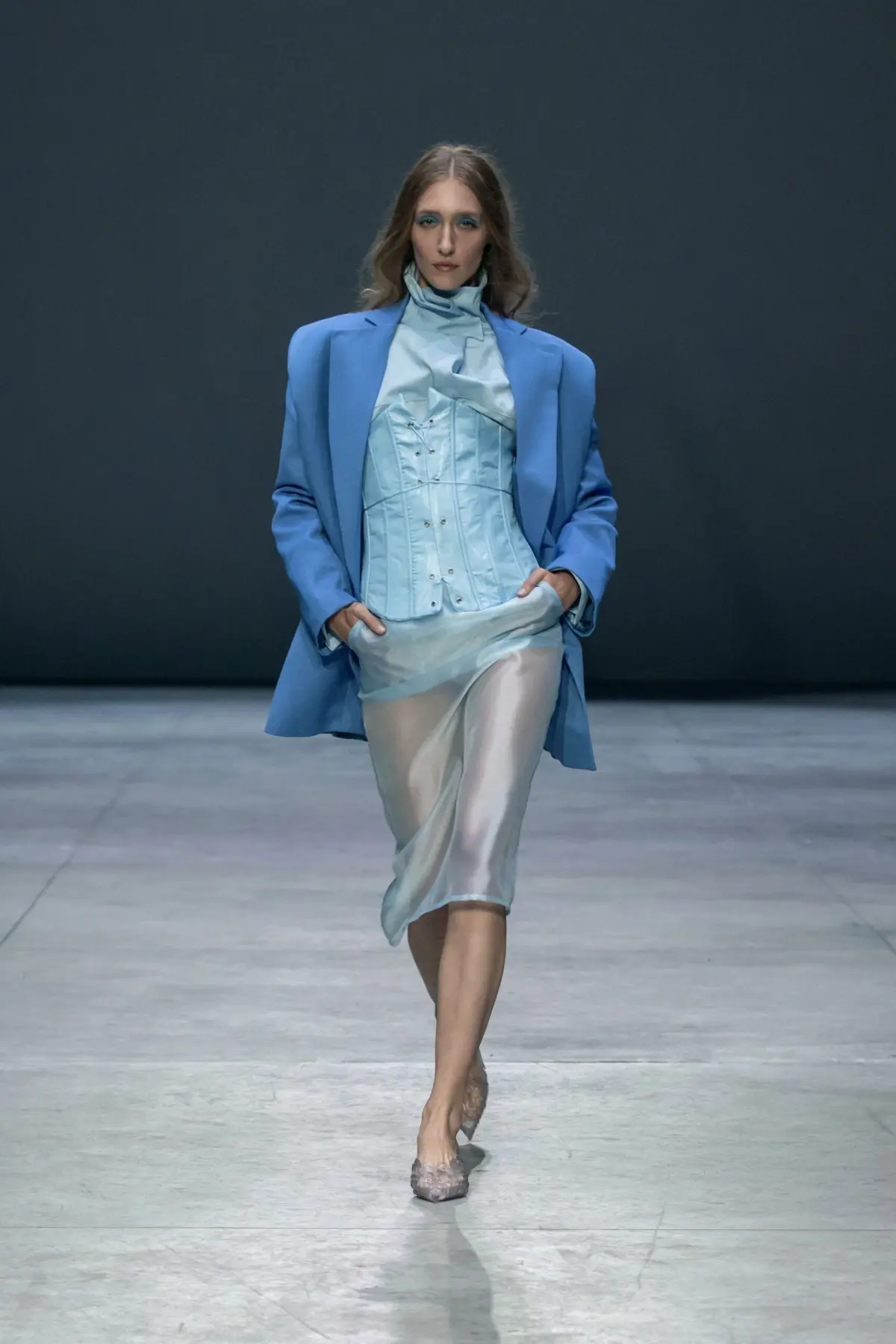
The collection is a masterclass in duality, offering pieces that can be styled to feel either remarkably elaborate or refreshingly practical. This tension between the surreal and the functional is a hallmark of the new Zurce aesthetic. The runway showcased sheer pastel skirts that seemed to float with the ethereal quality of a dreamscape, contrasted against shirts featuring innovative built-in fastenings designed to keep ties perfectly in place—a detail that marries aesthetic flair with technical precision. Sequined pieces shimmered with a playful spirit, directly evoking the atmosphere of La Hora del Té, the iconic chapter from Carroll’s novel that serves as the title and thematic anchor for the collection.
Beyond the more whimsical elements, Herranz introduced a structured dimension to the collection through masterful tailoring. Fluid pleated trousers were paired with matching jackets that defied traditional cut, playing with proportions to sculpt the silhouette in ways that felt both architectural and organic. These pieces suggest a designer who is increasingly confident in his command of fabric and form, moving beyond simple garment construction into the realm of sculptural design.
The collection was thoughtfully conceived in chapters, a structural choice that allowed Herranz to explore different moods and textures without losing the coherence of the overall narrative. One of the most striking chapters in the presentation was a segment that entirely abandoned color, opting instead to explore variations in shape and volume rendered solely through a stark, high-contrast black-and-white palette. By stripping away the distraction of color, the focus was shifted entirely to the construction of the pieces, allowing the audience to appreciate the intricate details of the seams, the drape of the fabric, and the exaggerated silhouettes.
While crochet was once the defining medium of Zurce’s early years, its presence has been significantly pared back as the brand has expanded its material repertoire. However, Herranz did not abandon his roots entirely. Crochet appeared in a few charming, carefully placed sweaters that paid homage to the brand’s history. Perhaps more compelling was its subtle, almost secret presence as a design code layered beneath a trench coat—a nod to the idea that the brand’s origins remain present, even if they are no longer the primary focus.
The ultimate goal for Herranz, however, remains grounded in the realities of the modern consumer. Despite the high-concept inspiration and the artistic flair of the presentation, the designer is adamant that his work must remain accessible and functional. “We want to build a brand that feels Mexican, made for Mexico,” Herranz explained. “We want to create clothes people actually wear, because at the end of the day, you can wear a jacket to work. That’s the versatility we’re looking for.”
This focus on versatility is the bridge that connects the fantastical world of Wonderland to the streets of Mexico City. By creating garments that offer a creative departure from the norm without sacrificing the utility required for daily life, Herranz is positioning Zurce as a label for the modern professional who values self-expression. There is a sense of pride in his commitment to the local industry; he is not just making clothes for a global fantasy, but for a specific, vibrant culture.
In this sense, the comparison to Lewis Carroll’s work is perhaps more apt than it initially appears. Just as Carroll’s writing invites the reader to interpret his work from a multitude of perspectives, Herranz sees Mexico itself as a multifaceted, non-uniform entity. Like the shifting, logic-defying world of Alice’s Adventures in Wonderland, the reality of Mexico is complex, rich, and full of unexpected turns. By channeling this complexity into his designs, Herranz has managed to capture something essential about his environment.
As the brand continues to evolve, the transition from knitwear-focused artisan to conceptual fashion designer appears to be complete. Herranz has successfully navigated the challenges of building an identity in the early years of his brand, arriving at a place where his personal history, his literary influences, and his commitment to functional, high-quality tailoring intersect. The latest collection serves as a testament to this growth, proving that one can embrace the whimsical and the surreal while maintaining a steady, professional gaze on the demands of the real world. For Zurce, the journey through the looking glass has not only resulted in a beautiful collection but has also solidified the brand’s place as a vital, thoughtful voice in the contemporary fashion narrative. The path forward for Herranz remains as unpredictable as the literature that inspires him, but with a clear vision for versatility and a deep respect for his origins, the brand seems poised to continue its steady ascent, turning the pages of its own unfolding story one chapter at a time.