
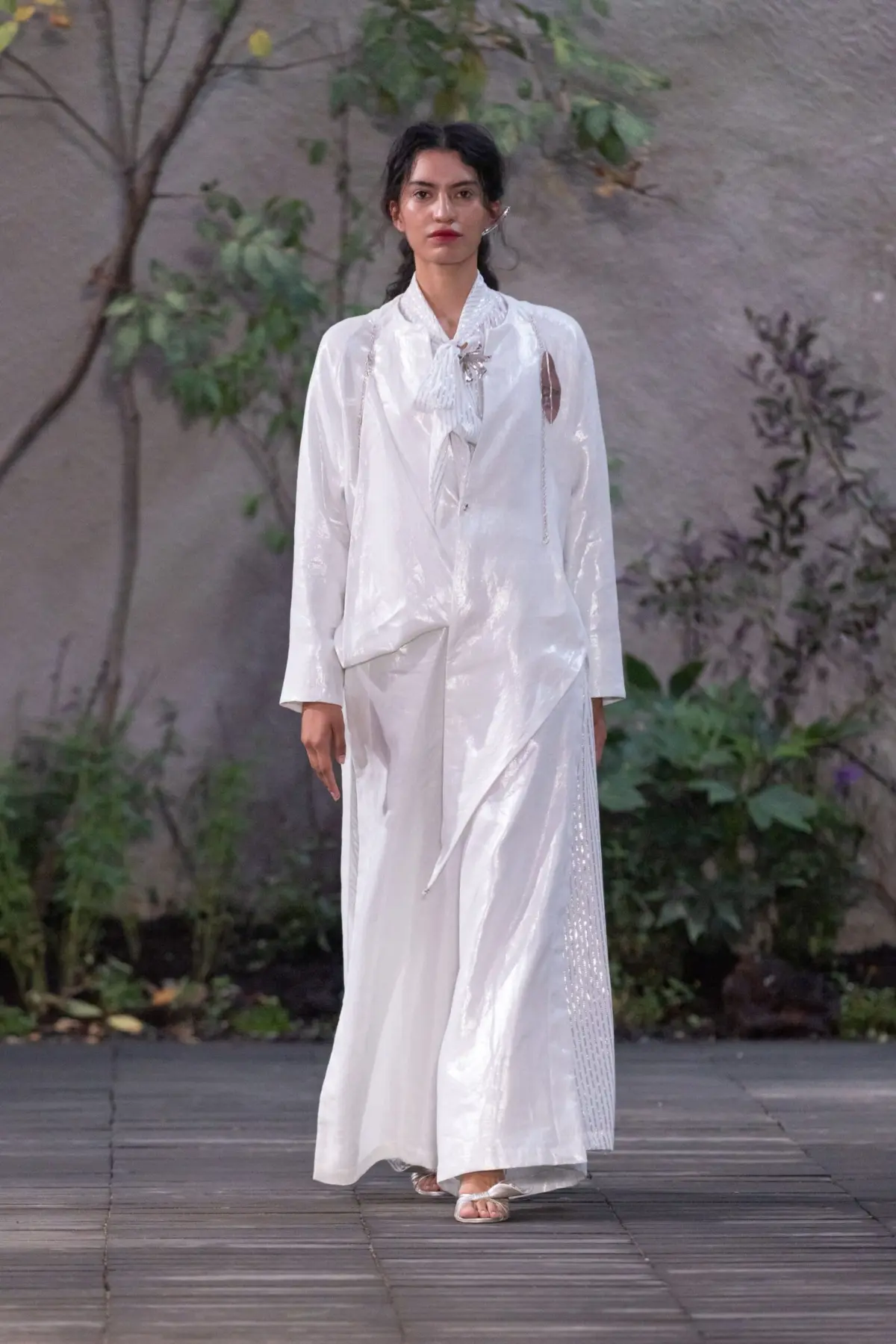
Designers frequently find themselves in a race against the clock during the high-pressure lead-up to a runway show, often leaving little room for the conceptual scaffolding of a collection to be articulated before the lights go down. Carla Fernández, however, opted for a different approach as she inaugurated the first day of Mexico Fashion Week. Taking a rare moment of stillness backstage, she peeled back the layers of her latest collection, grounding the runway’s visual spectacle in a profound historical narrative: the Manila Galleon trade route.
For more than 250 years, this legendary maritime link connected the port of Acapulco with Asia across the vast expanse of the Pacific. It was more than a mere commercial artery; it was a conduit for human migration, cultural synthesis, and the movement of goods that redefined global connectivity. By anchoring her collection in this history, Fernández invited her audience to reconsider Mexico not as an isolated nation, but as a vibrant, essential center of a global network that reached from the shores of Asia all the way to the markets of Europe.
Fernández’s choice of inspiration served as a poignant reminder of the sheer scale of early globalization. During the era of the Manila Galleon, textiles, precious silver, intricate crafts, and exotic flavors circulated with an fluidity that feels remarkably modern. This historical exchange—where the distinct aesthetics of the East met the rich traditions of the Americas—formed the thematic backbone of the evening’s presentation.
The collection’s debut was framed by a striking performance piece that served as an atmospheric prologue to the runway walk. Dancers, clad in fluid, minimalist garments dyed in earthy, natural pigments, moved with deliberate grace around a deliberate formation of chairs. The arrangement evoked the childhood game of musical chairs, yet in this context, the movement felt ritualistic, exploring the precarious and transformative ways in which different cultures collide, converge, and eventually influence one another. The dancers, moving through the empty space between the furniture, symbolized the transient nature of the travelers and merchants who once traversed the Pacific, leaving behind fragments of their own identity in foreign lands.
The dancers’ muted, organic aesthetic provided a sharp, intentional contrast to the opening looks of the runway show. As the models began their procession, the audience was met with a vibrant display of craftsmanship that leaned heavily into the opulence of the trade era. Lustrous, high-shine fabrics shimmered under the runway lights, echoing the silks that were once the pride of the Manila Galleon cargo. Perhaps most striking were the details: intricate embroidery work that paid homage to "papel picado." This traditional Mexican folk art—characterized by elaborate, hand-cut paper designs used to decorate celebrations—was translated here into textile, with delicate, gossamer-like patterns gracing the garments.
Further emphasizing the theme of connection, Fernández utilized knots as a recurring structural motif. These were tied in unexpected, asymmetrical locations—the hip, the shoulder, or the small of the back—serving as both a functional design element and a metaphorical device. "They are the ties, the interweaving of how we become one," Fernández explained backstage, gesturing toward the way the fabric was gathered and bound. These knots served as a physical manifestation of the human connections that defined the trade route, representing the complex ways in which disparate groups became inextricably linked through time and commerce.
In addition to the garments, the collection featured a thoughtful array of accessories that rounded out the narrative. The bags, specifically, were designed with the itinerant merchant in mind. These pieces were not merely added as afterthoughts but were integrated into the looks as essential components of the traveler’s silhouette, suggesting a practical elegance suited for those who move between worlds.
Geometric silhouettes, long a cornerstone of Carla Fernández’s design language, were present in full force. The collection featured architectural wrap skirts, voluminous wide-leg trousers, and impeccably tailored jackets, all finished with the aforementioned floral embroidery that softened the hard lines of the garments. The jewelry selection was equally deliberate, acting as an extension of the collection’s historical storytelling. Silver earrings shaped like chili peppers—a nod to the agricultural exchange that flourished during the trade era—shared the stage with meticulously engraved hoop earrings and dramatic leaf-shaped ear cuffs. These cuffs, which climbed the ear in a bold, sweeping gesture, felt like contemporary armor, grounding the historical inspiration in a distinctly modern fashion aesthetic.
The depth of research evident in the collection is perhaps no accident. Fernández’s fascination with a chapter of Mexican history that many might view as archaic or distant is deeply rooted in her own upbringing. Her father served as the director of museums and exhibitions at Mexico’s National Institute of Anthropology and History. Growing up surrounded by the artifacts and scholarly rigor of the institute, Fernández developed a profound respect for the country’s craftsmanship and the cultural heritage it encodes. For her, the act of designing is not merely about creating new trends; it is a process of curation and historical preservation.
In this light, the collection functioned as a dual narrative. On the surface, it was a deft exploration of a nation’s history, pulling threads from the 16th, 17th, and 18th centuries and re-weaving them into contemporary fashion. Beneath that, however, it was a reflection of the designer’s own history—the culmination of a lifetime spent navigating the intersection of art, anthropology, and identity. By looking back at the Manila Galleon, Fernández invited her audience to see the beauty in cultural synthesis. She posited that when cultures meet—through trade, through art, or through the simple act of dressing—they do not lose their distinctiveness. Instead, they find new ways to knot themselves together, creating a tapestry that is far richer, more complex, and more enduring than the sum of its parts.
As the show concluded and the final looks exited the runway, the atmosphere was one of quiet contemplation. By bridging the gap between the historic maritime routes of the Pacific and the contemporary runways of Mexico City, Carla Fernández successfully demonstrated that fashion remains one of the most potent mediums for historical inquiry. Her work continues to challenge the industry to look beyond the immediate season, urging designers and consumers alike to consider the long, winding paths of exchange that have shaped our modern world. In a week dedicated to the future of Mexican design, Fernández reminded everyone that the future is often best understood by examining the intricate, knotted ties of the past.