
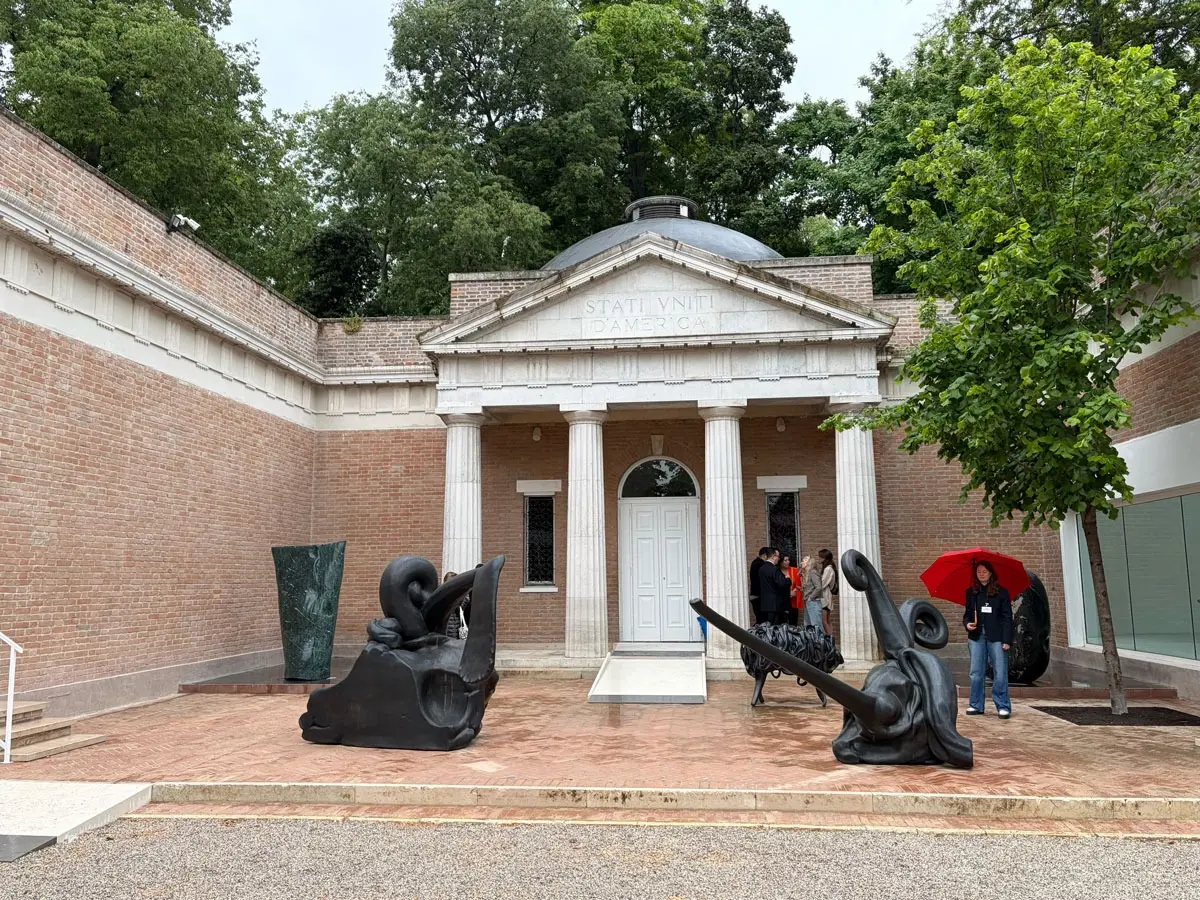
Despite months of persistent controversy and internal friction, the United States successfully transported the massive, imposing sculptures of artist Alma Allen to Venice for this year’s prestigious Biennale. However, as the exhibition nears its conclusion, the triumph of installation has been overshadowed by a logistical and financial nightmare: the organizers are now struggling to secure the funds necessary to bring the artworks home.
According to a recent report in The New York Times, the American Arts Conservancy—the nonprofit organization responsible for managing the US Pavilion—is facing a staggering $1 million budget shortfall. This deficit threatens to derail the final, critical stages of the project, specifically the dismantling of the show and the complex, expensive process of shipping the heavy stone and metal sculptures back to the United States.
Jenni Parido, the pavilion’s commissioner and head of the American Arts Conservancy, has been frantically appealing to potential donors to bridge this widening financial gap. In a private letter obtained by the Times, Parido acknowledged the gravity of the situation, admitting that the project’s final phase has encountered severe difficulties that she is attempting to resolve. "While we have accomplished a tremendous amount in a relatively short period," Parido wrote in the correspondence, "the final phase of this undertaking has presented financial challenges that I am working tirelessly to resolve."
The numbers underscore the severity of the crisis. The American Arts Conservancy has managed to raise $1.4 million against a projected total budget of just under $2.5 million. This shortfall has left the organization without the capital required to cover the specialized storage and international shipping costs for Allen’s large-scale works. The situation is reaching a breaking point as the Biennale is scheduled to close its doors next month. Compounding the urgency is the lack of local solutions; the US Pavilion itself is not equipped for long-term storage, and the Guggenheim Foundation, which maintains the historic building, has reportedly confirmed that it does not have the capacity to house the sculptures once the exhibition ends.
A History of Administrative Controversy
This mounting financial crisis serves as the latest, and perhaps most public, chapter in what has been an unusually tumultuous outing for the American representation at the Biennale. The selection of the leadership team was, from its inception, a departure from established norms that drew immediate scrutiny from the arts community.
Jenni Parido, a figure previously known for her business experience running an upscale pet boutique in Florida, was a surprise appointment to oversee the pavilion. Her selection marked a definitive shift in policy; the Trump administration opted to scrap the traditional, long-standing selection process, which typically involved a competitive proposal phase from major American arts institutions and an independent review panel of experts. Instead, Parido’s path to the commission was paved through personal connections, specifically a recommendation from her friend Erin Scavino, who leads the State Department’s "Art in Embassies" program.
The subsequent search for an artist to anchor the pavilion was similarly fraught. After a series of prominent artists reportedly turned down the opportunity to represent the United States under the new organizational structure, the organizers eventually settled on Alma Allen, a sculptor based in Mexico. What followed was a series of internal breakdowns that further complicated the exhibition’s execution.
Allen, in his comments to the Times, revealed a profound lack of communication between the artist and his leadership team. He noted that neither Parido nor the exhibition’s curator, Jeffrey Uslip, had visited his studio to personally examine the sculptures prior to the show’s opening. By the time the high-profile preview days of the Biennale had concluded, the professional relationship between the artist and the curator had deteriorated to the point where the two were no longer on speaking terms.
Regarding the current financial predicament, Allen maintains that he remained largely in the dark about the nonprofit’s fundraising difficulties. He characterized his own involvement as limited to the creation of the work, noting that his personal expenses—which consisted primarily of travel and a modest Airbnb stay—were reimbursed by the organization.
Shifting Expectations and Fundraising Realities
The organizers had initially framed the exhibition’s "modest" price tag as a core strength, pitching the project as one of the most cost-effective US pavilions in the history of the Biennale. This narrative was intended to contrast sharply with previous years, where budgets were significantly higher. For context, the 2024 American presentation carried a budget of approximately $5 million, while the 2022 edition required nearly $7 million in funding.
The financial model for the current pavilion relied on a combination of a $375,000 grant from the State Department, with the expectation that private donors would provide the remainder. To meet these targets, Parido engaged in a variety of high-profile fundraising efforts, including events held during Art Basel Miami Beach and a gala dinner at Mar-a-Lago. Despite these efforts, the State Department has maintained that it was not directly involved in the fundraising campaign, distancing itself from the logistical and financial management of the project.
The disconnect between the project’s ambition and its financial reality has left many in the art world baffled. The lack of a contingency plan for the return of the artworks has raised questions about the viability of the current oversight model. When asked about potential outcomes should the $1 million gap remain unclosed, the American Arts Conservancy declined to provide a clear strategy to the Times, leaving the future of the massive sculptures in limbo.
The situation has drawn harsh criticism from those with experience in the rigorous demands of managing a national pavilion. Katy Siegel, a veteran organizer who played a key role in the 2017 American pavilion, offered a blunt assessment of the unfolding events when presented with the details of the shortfall. "This is crazy," she stated.
As the closing date for the Biennale looms, the focus remains on whether a last-minute infusion of private capital can be secured to cover the costs of dismantling and transport. For now, the US Pavilion stands as a testament to the complexities of international art exhibitions, where the logistical challenges of returning works often prove as daunting as the task of getting them to the world stage in the first place. Whether the American Arts Conservancy can navigate this final hurdle remains to be seen, but the ongoing silence regarding a backup plan suggests that the situation will remain volatile until the final crate is packed—or until a new source of funding is found to resolve the impasse.