
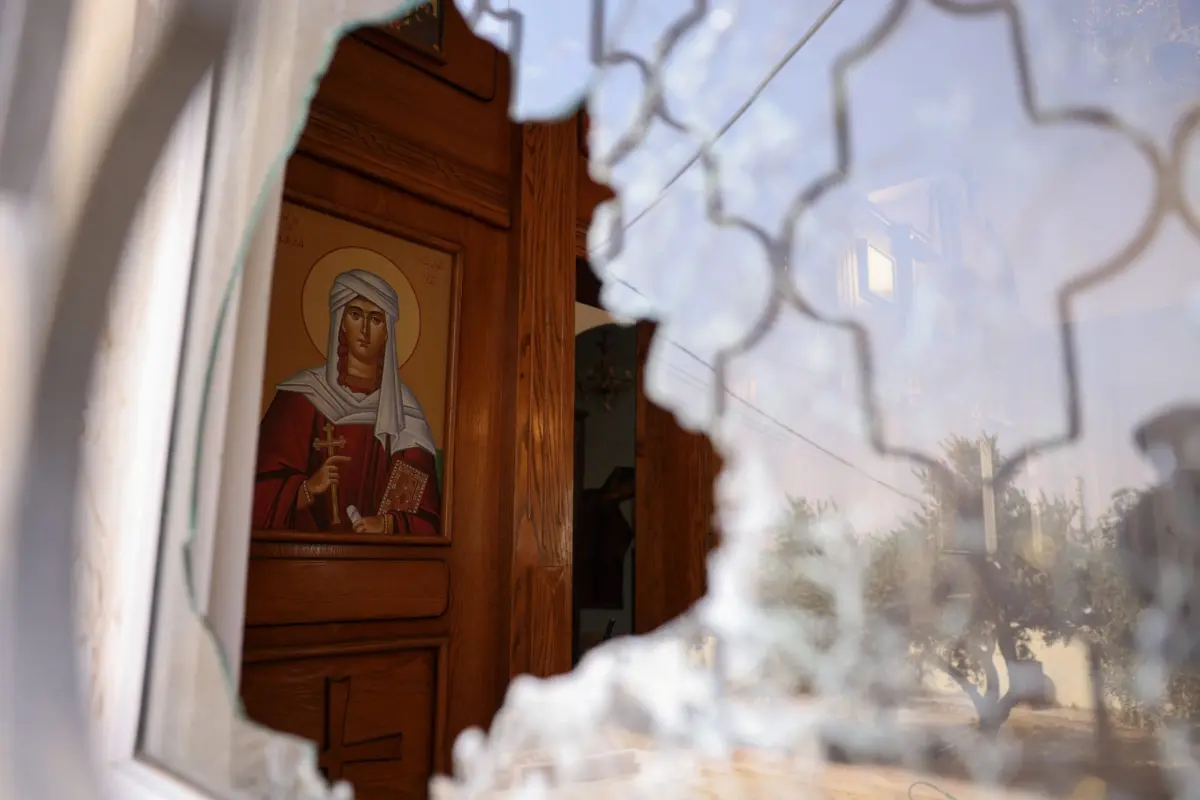
AMMAN — Security forces in Jordan launched an extensive manhunt on Friday following a coordinated terror attack on a Greek Orthodox church in the southern Karak governorate. The brazen assault, which unfolded during a funeral service, left eight people dead and dozens of others injured, prompting national outrage, international condemnation, and a swift vow from the country’s leadership to bring the perpetrators to justice.
King Abdullah II condemned the bloodshed, stating unequivocally that those behind the attack would face the "harshest penalties." Offering his deepest condolences to the grieving families, the monarch personally visited survivors receiving treatment at the Prince Ali Military Hospital in Karak. In response to the tragedy, King Abdullah has ordered an immediate and comprehensive review of the nation’s security procedures concerning terrorist threats and emergency response protocols.
Authorities have formally classified the violence as an act of terror, marking a grim and rare assault on a Christian place of worship in the Hashemite Kingdom. While the precise identities of the attackers remain unconfirmed by the government, the devastating incident has shaken a country long regarded as a pillar of regional stability and interfaith coexistence.
What Happened During the Church Shooting in Karak?
The violence erupted on Friday afternoon in the quiet village of Hamoud, situated within the Karak governorate. Mourners had gathered inside a local Greek Orthodox church to attend a funeral service when tragedy struck without warning.
According to survivors, the solemn atmosphere of the service was shattered by a sudden explosion just after proceedings began. Chaos quickly ensued as two attackers, who had arrived at the scene in a vehicle, forced their way into the building. They were swiftly joined by a third accomplice brandishing a semi-automatic rifle. The armed assailants moved through the church, opening sustained fire on the congregation for several terrifying minutes.
Nasser al-Burqan, a lawyer and survivor of the massacre, recounted the harrowing moments to the Reuters news agency. He recalled that one of the attackers, standing merely two meters—or approximately 6.5 feet—away from him, raised a handgun and fired directly at him.
"When everything finally quietened down, I looked out the window behind me, and I saw two [assailants] — one was masked, the other was not; he was carrying a handgun," al-Burqan said.
In the immediate aftermath of the shooting, al-Burqan received a frantic phone call from his son, who had also attended the service. The young man had sustained a gunshot wound to the leg and was subsequently rushed to a local hospital for urgent medical care.
Other witnesses and relatives expressed profound shock at the devastation. Tarek Ammarin, who visited a relative recovering from injuries sustained in the attack, described the scene in stark terms: "A massacre, a massacre in every sense of the word."
Local civic leaders similarly voiced their horror. Bahjat al-Rushda, mayor of the nearby village of Shihan, joined a growing chorus of officials condemning what he termed a "wicked" attack. Despite the profound grief gripping the community, al-Rushda expressed resilience, stating, "God willing, this country will remain safe."

State-run news channel Al-Mamlaka reported that heavily armed security forces were immediately deployed to the area. Troops and police units established cordons and launched an intensive pursuit of the suspects who had fled in the vehicle.
How Many People Were Killed or Injured?
The human toll of the Karak church shooting has devastated families across the region. According to updates provided by Jordan’s official Petra news agency on Saturday, eight people lost their lives in the attack. Seven victims succumbed to their wounds at the scene, while an eighth person tragically died from her injuries hours later at a hospital.
The Ministry of Health confirmed that approximately 40 people sustained injuries during the shooting. As medical personnel worked around the clock to treat the wounded, 27 patients remained hospitalized. The Director of the Prince Ali Military Hospital in Karak reported that at least one survivor was listed in critical condition after undergoing emergency surgery.
Who Carried Out the Attack?
As the investigation continued, official statements from the government continued to refer to the perpetrators as "unknown assailants," noting that their precise identities and organizational affiliations have not yet been formally confirmed.
Nevertheless, digital evidence has begun to surface. Security camera footage capturing portions of the assault has circulated widely online. Broadcast footage from Al-Mamlaka shows three individuals opening fire outside the church before sprinting toward the main entrance. Additional video evidence documents the attackers firing indiscriminately at a group of panicked men attempting to flee the building.
Jordan’s Interior Minister, Mazin Al-Farrayeh, addressed the public regarding the nature of the perpetrators, describing them as a group of "extremists" who bear "no relationship to humanity." However, authorities have refrained from officially attributing the assault to a specific militant organization pending the conclusion of the ongoing security operation.
Why Was the Church Targeted?
Prime Minister Jafar Hassan addressed the nation on Friday, characterizing the attack as the direct byproduct of a toxic terrorist ideology and "blind extremism." Despite these harsh assessments, specific details regarding the precise motivations of the shooters remain elusive as investigators work to piece together the events.
The lack of a clear motive has left analysts and officials examining the broader implications of the violence. Because the identities of the gunmen are still officially undisclosed, the primary catalyst for targeting a place of worship during a funeral remains under active investigation.
Where Is Karak, and What Do We Know About Its Christian Community?
Karak governorate lies approximately 120 kilometers, or 75 miles, south of the Jordanian capital, Amman. The region is deeply woven into the cultural and historical fabric of the country and is home to a significant portion of Jordan’s Christian minority.
Jordan’s Christian population numbers around 300,000 citizens within a broader national population of approximately 11.5 million people. Taylor Luck, senior Middle East correspondent for the Christian Science Monitor, noted in an interview with Al Jazeera that Jordan’s Christian community has historically prided itself on deep interfaith solidarity and peaceful coexistence.

Luck explained that Muslims and Christians have lived side-by-side in Karak for generations, sharing social and economic life. He suggested that if the perpetrators intended to fracture the social fabric of the community by targeting a church, their efforts would likely yield the opposite effect, noting that such tragedies often cause local populations to "come back even stronger."
Beyond its local communities, Jordan is internationally recognized for its rich historical and biblical heritage, boasting numerous sacred sites that attract pilgrims and tourists from across the globe.
What Has the Response Been to This Shooting?
The attack drew swift and widespread condemnation from the international community. Governments across the globe, including Azerbaijan, Iraq, Poland, Palestine, and Qatar, issued official statements expressing solidarity with the Jordanian government and people.
Religious leaders also united in grief and condemnation. Ahmed al-Tayeb, the grand imam of Cairo’s prestigious Al-Azhar Sunni religious institution, offered his condolences to the victims’ families and denounced the shooting as a "heinous terrorist attack."
"This crime contradicts the teachings of the Abrahamic religions and reveals that its perpetrators are devoid of all compassion, humanity and morality," al-Tayeb wrote in a widely circulated social media statement.
Diplomatic missions inside the kingdom also extended their sympathies. The United States embassy in Jordan released a statement on the social media platform X, offering heartfelt condolences to those affected by the tragedy. "On behalf of the American people, we offer our most heartfelt condolences to the victims and survivors of the terror attack today at a church in Karak, Jordan," the embassy stated.
Domestically, the government took solemn steps to mourn the victims. Prime Minister Jafar Hassan declared three days of national mourning, ordering flags across all government and public buildings to be flown at half-mast.
Has Jordan Experienced Similar Attacks Before?
While acts of terrorism are relatively rare in Jordan compared to some of its regional neighbors, the country has occasionally been targeted by militant groups.
Most notably, in December 2016, operatives affiliated with the ISIL (ISIS) group launched a coordinated series of attacks throughout the Karak governorate. That wave of violence included a protracted and deadly siege centered around a historic Crusader-era castle.
The 2016 siege resulted in the deaths of 10 people, which included seven Jordanian security officers and a Canadian tourist, alongside dozens of injured civilians and personnel. The standoff ultimately ended when Jordanian security forces killed all four heavily armed attackers following hours of intense combat.