
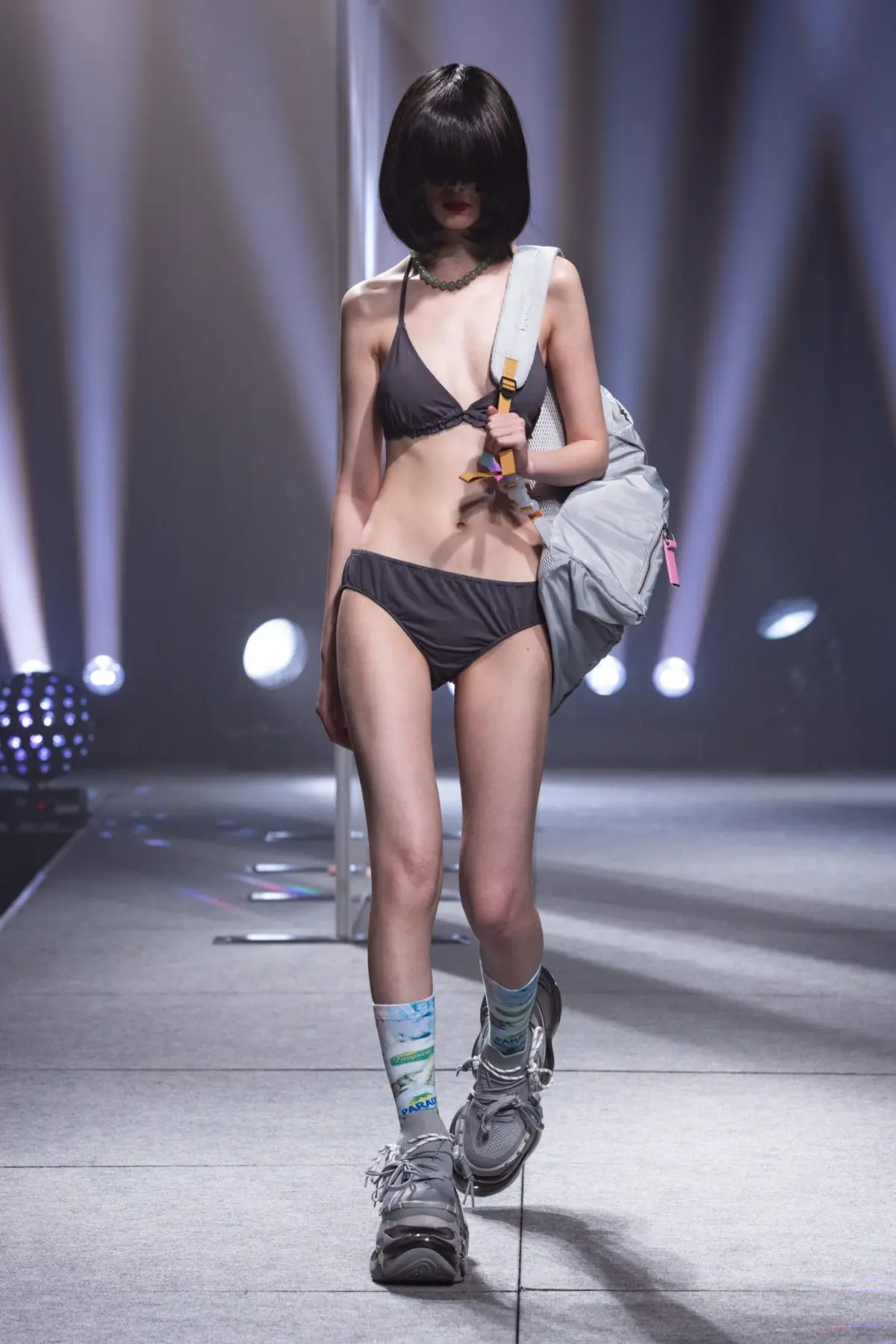
In the heart of Tokyo’s vibrant Harajuku district, the legendary La Foret shopping mall—a site synonymous with the frenetic evolution of youth style—became an unlikely sanctuary for introspection this week. Designer Mikio Sakabe, known for his ability to bridge the gap between avant-garde structuralism and the hyper-specific subcultures of Japan, chose the mall as the stage for his latest runway show. The collection was not merely a presentation of garments; it was an exploration of the hunt for fantasy, anchored in the paradoxical tension between the high-octane desire for escapism and the crushing weight of reality.
The conceptual starting point for the collection was an unexpected and provocative one: Japan’s gravure magazines. These publications, characterized by their vaguely erotic, male-marketed content featuring wide-eyed models in swimsuits, lingerie, or elaborate cosplay, provided the visual lexicon for Sakabe’s vision. By framing his presentation as a "swimsuit show held in a shopping mall," Sakabe tapped into the specific cultural discomfort and allure of these magazines, which exist in a space of artificial performance and idealized femininity.
"There’s something interesting about the concept of a fashion show in a Japanese fashion mall," Sakabe noted, reflecting on the environment that shaped his creative process. "It feels bright and showy, but it’s also a little sad."
To ground this sentiment in the physical environment of the runway, Sakabe intentionally littered the space with discarded coffee cups and empty drink cans. This deliberate act of artifice—placing the detritus of daily life beneath the feet of models—served to underscore the "sadness" he described. It disrupted the pristine, aspirational veneer typically associated with a runway show, forcing the audience to confront the intersection of the idealized images in the gravure magazines and the banal, decaying reality of a commercial space that has seen better days.
The garments themselves oscillated between these two poles. Interspersed with straightforward, minimalist bikini looks that paid homage to the source material were examples of Sakabe’s trademark deconstructed tailoring. Oversized shirts and blazers appeared slashed and reassembled into chaotic, asymmetrical shapes. Some pieces were festooned with excessive frills, while others featured bizarre, floppy appendages that mimicked the aesthetic of bunny ears, lending the collection a sense of surreal, almost cartoonish playfulness that sat uneasily against the more rigid, clinical tailoring.
A unifying visual element across the collection was the use of signature helmet-like wigs that have become a hallmark of Sakabe’s aesthetic over the past several seasons. These opaque, eye-obscuring headpieces served to strip the models of their individual identity, turning them into uniform vessels for the collection’s narrative. "Somehow I really like them," Sakabe said of the wigs, which effectively heighten the sense of detachment and "otherworldliness" he aimed to achieve.
Complementing the clothing were the bubble-soled sneakers from Grounds, the footwear project Sakabe founded in 2019. The brand has become a massive success, currently employing approximately 100 people globally and representing a rare bridge between the high-concept runway aesthetic and commercial viability. The bulbous, gravity-defying soles of the sneakers provided a grounding, futuristic contrast to the nostalgic, sometimes melancholic references of the clothing, suggesting a blend of tech-wear functionality and surrealist art.
Sakabe, who famously studied alongside Demna at the Royal Academy of Fine Arts in Antwerp, has built a career on the ability to mine the depths of underground culture and synthesize it into fashion that feels both intellectually challenging and commercially desirable. Across Asia, his influence is profound, with a dedicated fanbase that treats his collections as a form of cultural commentary.
The collection felt, in many ways, like a continuation of his ongoing discourse regarding the nature of reality. Much of Sakabe’s work focuses on the human desire to escape from the mundane—the impulse to project oneself into a fantasy world—and the inherent futility of that endeavor. By juxtaposing the hyper-real, airbrushed superficiality of gravure imagery against the dusty, commercial context of a shopping mall, he created a dialogue about how we consume images and the spaces we occupy to find meaning.
This thematic tension reached its peak in the final look of the show: a half-worn shirtdress. The garment, decorated with intricate slits of silver, appeared to act as a portal to another universe—a literal manifestation of the desire to "cut through" the reality of the mall and transcend the limitations of the physical world. It was a poignant note on which to end, suggesting that while the pursuit of fantasy may be a repetitive, sometimes sad cycle, the act of creation itself—the "portal"—remains the most powerful tool for exploring what lies beyond the surface.
In selecting La Foret, a bastion of consumerist culture, as the site for this investigation, Sakabe successfully transformed a temple of retail into a site of artistic inquiry. The collection stood as a testament to his unique position in the industry, capable of balancing the irony of underground subcultures with the demand for a coherent, wearable, and deeply resonant fashion narrative. As the models navigated the littered runway, the audience was left with a lingering question: if the fantasy we chase is just another product of the environments we try to escape, where can we actually go? Sakabe didn’t offer a definitive answer, but he provided a compelling, if slightly haunting, map of the terrain.