
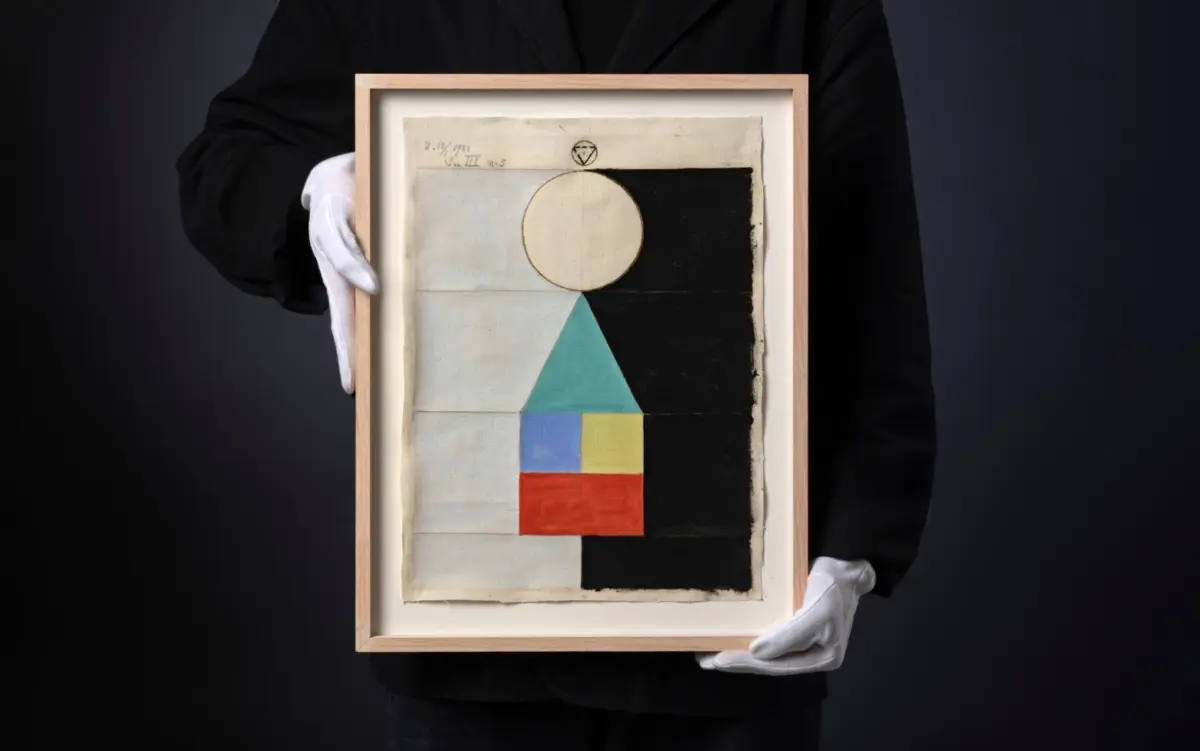
The global art market is bracing for a singular event this November as a Swedish auction house prepares to offer an abstract work by Hilma af Klint—a visionary artist whose pieces are so rarely traded that their appearance at public auction is considered an anomaly of the highest order. The painting, titled Ser III No. 5 (1920), is scheduled to go under the hammer at Bukowskis in Stockholm during their November 19 sale, which focuses on modern art and design.
With a pre-sale estimate ranging between $600,000 and $800,000, the work is expected to generate intense international competition. Should the bidding reach even the lower end of that estimate, it will comfortably shatter the artist’s previous records at auction, marking a significant milestone in the market valuation of one of the most transformative figures in 20th-century art.
The Rise of a Modernist Pioneer
For decades, Hilma af Klint was a peripheral name in the canon of Western art history, often relegated to the shadows of her male contemporaries who were traditionally credited with the invention of abstraction. However, the last decade has seen a dramatic correction to that narrative. Following a landmark 2018 retrospective at the Solomon R. Guggenheim Museum in New York, af Klint has been widely embraced as a "giant of her time," with critics and historians increasingly citing her as a primary architect of abstract art—one who arrived at the style well before the established titans of the movement.
The aesthetic signature of her work—defined by looping lines, geometric pyramids, and ethereal, flowerlike motifs—is deeply rooted in her life as a spiritualist. Her artistic practice was fundamentally intertwined with her belief in, and alleged communication with, spirits from realms beyond our own. These entities, she believed, guided her hand, leading her to conceptualize a physical temple—a grand, permanent repository intended to house her expansive body of work. While that temple was never realized during her lifetime, the dream of such a space remains a focal point for her estate. Her great-grandnephew, who currently chairs the Hilma af Klint Foundation, has long advocated for the construction of a permanent home for her art, a move that would effectively remove her works from the rotating collections of public museums. To date, however, no concrete plans to break ground on such a structure have materialized.
A Market Defined by Scarcity
The scarcity of af Klint’s work on the commercial market is by design. The Hilma af Klint Foundation, which manages the vast majority of her output, has historically maintained a strict, protective stance regarding how her art is exhibited and sold. This hesitation to engage with the commercial gallery and auction circuit is rooted in the artist’s own expressed wishes; according to the foundation, af Klint was adamant that her life’s work should not be commodified or sold off in a conventional manner.
This protective posture has occasionally led to internal friction. Efforts to establish a more formal relationship between the foundation and high-profile commercial entities, such as the David Zwirner gallery, have faced significant hurdles. In one notable instance, a proposed partnership was effectively derailed after objections were raised by two of the artist’s own descendants, highlighting a deeper, ongoing struggle regarding the stewardship of her legacy. Behind the scenes at the foundation, these conflicting visions for the future of her work have reportedly generated significant, and sometimes public, disagreement.
Because of this institutional resistance, the emergence of a piece like Ser III No. 5 is an event of genuine rarity. When works do surface, they are often snapped up by elite institutions with blinding speed. For example, when David Zwirner exhibited her "Tree of Knowledge" series in 2021, the collection was almost immediately acquired by Glenstone, the private museum in Potomac, Maryland, founded by Mitchell Rales and Emily Wei Rales. Such institutional acquisitions underscore the prestige now associated with her name, even as the broader public remains starved for opportunities to see her work in private collections.
The Provenance of a Rare Offering
According to information released by Bukowskis, Ser III No. 5 is a significant example of the artist’s late-career output. It is one of 85 paintings produced during a remarkably productive three-month window in 1920. The current owner, an unidentified collector, has held the piece since 1995. That acquisition occurred during a brief period in the early 1990s when the foundation made a limited number of works available for purchase—a window of opportunity that has since slammed shut, contributing to the current atmosphere of scarcity.
Bukowskis has noted that in the history of the art market, only two of af Klint’s paintings have ever been sold at public auction, and both of those transactions occurred more than 30 years ago. This makes the upcoming Stockholm sale a unique data point for collectors and art historians alike, providing a rare glimpse into the valuation of an artist whose market is essentially non-existent by standard measures.
While the art world watches with bated breath to see how the bidding unfolds, questions remain regarding the level of involvement—if any—the Hilma af Klint Foundation has in this specific sale. The foundation’s rigid control over the artist’s inventory and its general aversion to the auction block suggest that this sale represents a rare exception rather than a shift in policy. ARTnews has reached out to the foundation for comment regarding the sale, though the organization’s long-standing policy of caution regarding the commercialization of her work remains a defining characteristic of her market presence.
As the date of the auction approaches, the art community is forced to reconcile the soaring cultural prestige of Hilma af Klint with the reality of a market that is largely closed to the public. Her work, which began as a private conversation with the spiritual world, now finds itself at the center of a very human, and very public, financial spectacle. For the lucky bidder in Stockholm, Ser III No. 5 represents not just an investment in a piece of abstract history, but the acquisition of an object that rarely leaves the shadows of institutional and private archives. The outcome of the sale will likely serve as a barometer for how the market handles the work of a master who, for most of the 20th century, was hidden from the very world that now clamors for her art.