
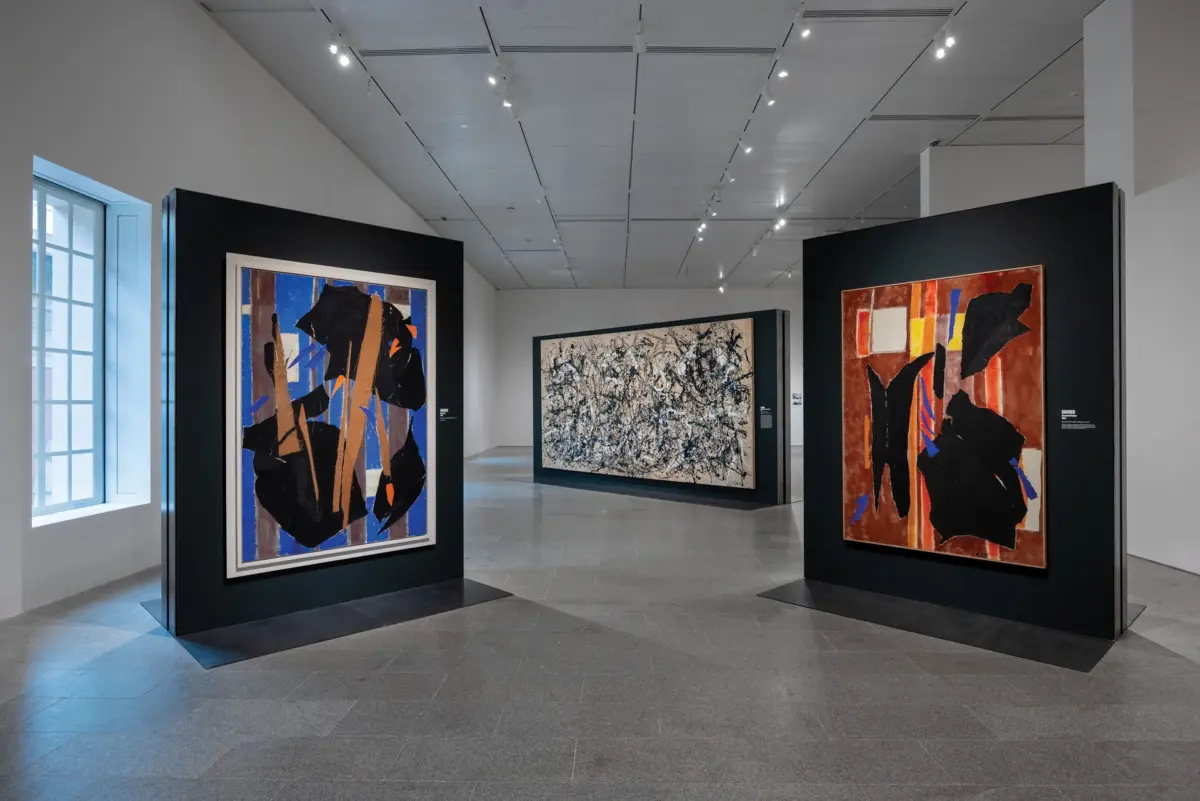
The Metropolitan Museum of Art’s latest exhibition, “Krasner and Pollock: Past Continuous,” is a monumental undertaking, serving as a once-in-a-lifetime gathering of more than 120 works by America’s most storied art couple: Lee Krasner (1908–1984) and Jackson Pollock (1912–1956). For decades, the public consciousness has been almost exclusively occupied by the mythos of Pollock. His meteoric rise to fame, fueled by his status as the quintessential "action painter," has overshadowed nearly every other narrative surrounding his life. From his record-breaking auction prices—solidifying his position in the $100 million club—to the 1991 Pulitzer Prize-winning biography Jackson Pollock: An American Saga, the obsession with Pollock has been relentless. That biography, a 934-page tome, even inspired the 2000 Hollywood film Pollock, a project that earned Marcia Gay Harden an Academy Award for her poignant portrayal of Krasner.
Yet, in that film and the broader cultural narrative, Krasner was long relegated to the role of the long-suffering helpmate, the supporting character in a tragedy that starred only her husband. “Past Continuous” seeks to shatter this persistent frame. The exhibition serves as a corrective, finally treating the two as artistic equals. It is a more daring, nuanced, and expansive show than previous attempts to reconcile their legacies, most notably Barbara Rose’s 1981 exhibition, “Krasner/Pollock: A Working Relationship.” While Rose’s show was a courageous effort to undermine the patriarchal assumption that Krasner was a second-tier artist, the shadow of Pollock proved stubbornly difficult to escape. The Met’s current presentation, however, succeeds by letting the work—and the long, complex life of the woman who outlived her husband by 28 years—speak for itself.
The exhibition opens with a panoramic view of the couple’s modest, unheated, shingled house and studio on Long Island. Through historic stills and footage, visitors see not just the artist, but the human beings: Pollock, Krasner, their dog Gyp, and their tamed crow, Caw Caw. It was in this isolated corner of the world, far from the influence of their favorite New York watering hole, the Cedar Bar, that Pollock developed his groundbreaking drip technique. By unrolling unprimed canvas onto the floor and working horizontally with enamel and house paints—never touching the canvas directly with his brush—Pollock revolutionized modern art.
History often credits Pollock alone for this innovation, but the Met exhibition provides vital context: his methodology was directly influenced by the paintings of Janet Sobel, a self-taught, Ukrainian-born artist. After seeing her work, Milky Way (1945), at Peggy Guggenheim’s Art of This Century gallery in 1946, Pollock was struck by a revelation that led to his own 1947 drip painting, Galaxy.
Just two years later, LIFE magazine propelled Pollock into the stratosphere of celebrity, asking in a bold headline, “Jackson Pollock: Is he the greatest living painter in the United States?” The feature’s photographs cemented a specific image: a brooding, hyper-masculine figure in paint-splattered jeans, cigarette in hand. In this narrative, Krasner did not exist. He was a solitary genius, and she was merely the person who kept the house.

The reality was far more complex. The Met exhibition ambitiously resets this history, beginning with a gallery focused on Krasner’s mid-1950s collages. This was a period when Pollock’s output had slowed, his mental health was deteriorating, and his personal life was spiraling. The exhibition avoids the familiar trap of focusing solely on the tragedy of Pollock’s decline; instead, it highlights the triumphant, methodical emergence of Krasner as an artist who found beauty in destruction.
In Bald Eagle (1955), Krasner utilized scraps of dark brown linen and discarded canvases—some of which were rejected works by both her and Pollock—to create a masterpiece of reclamation. A white shape in the center of the piece, reminiscent of a bird’s profile, prominently features one of Pollock’s own dripped black lines. By literally incorporating the debris of their shared life and his failed experiments, Krasner was reborn, like a phoenix, from the ashes of their domestic and artistic difficulties.
This theme of rebirth runs through the entirety of Krasner’s career. She was a restless spirit, constantly battling periods of self-doubt and the pressure of being married to a man who commanded the world’s attention. Long before she met Pollock, she was acutely aware of the existential burden of the artist. She famously transcribed lines from Arthur Rimbaud’s A Season in Hell onto her studio wall: “To whom shall I hire myself out? What beast must I adore? What holy image is attacked? What hearts shall I break? What lie must I maintain? In what blood tread?” These words underscore the intensity with which she pursued her own integrity, even while navigating a marriage defined by the "larger-than-life" presence of her husband.
To emphasize their equality, the curators have placed their early works side-by-side, showcasing their independent development before they were inextricably linked. The juxtaposition of their self-portraits—Krasner’s graphite and crayon study from 1929-30, and Pollock’s moody, impasto-heavy work from 1930-33—is revealing. They are also shown together in the context of the 1942 “American and French Painting” exhibition, curated by John Graham. Seeing them hung alongside giants like Picasso, Matisse, and Willem de Kooning reminds the viewer that their meeting was not an event where an established master found a protege, but where two ambitious, talented individuals collided.
The exhibition is punctuated by highpoints: Pollock’s lyrical, expansive Number 1, 1950 (Lavender Mist) and the reconstruction of Krasner’s 1955 Stable Gallery exhibition. That show was a turning point, prompting the formidable critic Clement Greenberg to label her “a major addition to the American art scene.” Yet, even then, the praise was filtered through a glass ceiling. While Greenberg credited Pollock with transcending Cubism, he offered only measured applause for Krasner’s mastery of collage, failing to grant her the same transformative status he afforded her husband.

Krasner continued to crash against this hierarchy for the rest of her life. She found her own vocabulary in the verticality of works like Blue Level and Desert Moon (1955), which stood with a sturdy, architectural integrity that felt entirely independent of the "drip" style that defined the era. In the final rooms of the exhibition, it is Krasner who dominates. As Pollock’s output dwindled, Krasner moved into new, bold territories. Her monumental 17-foot work, The Seasons (1957), painted just one year after Pollock’s death, is an act of defiance and rebirth, filled with abundant, organic forms.
Her evolution continued through the decades. From the spare, contemplative Kufic (1965), which drew upon her interest in ancient Arabic calligraphy, to the vibrant energy of Rising Green (1971), Krasner refused to settle into a single style. The exhibition culminates with Future Indicative (1977), a culmination of her lifelong engagement with figure drawing.
Ultimately, “Past Continuous” does not merely document the life of a couple; it documents the persistence of a visionary artist. Lee Krasner was a woman who navigated the crushing weight of a patriarchal art world and the personal tragedy of a volatile marriage, all while producing a body of work that was uniquely her own. By the end of this exhibition, the narrative of the "supporting wife" is definitively retired, replaced by the image of an artist who stood at the center of her own, highly significant, and enduring history.