
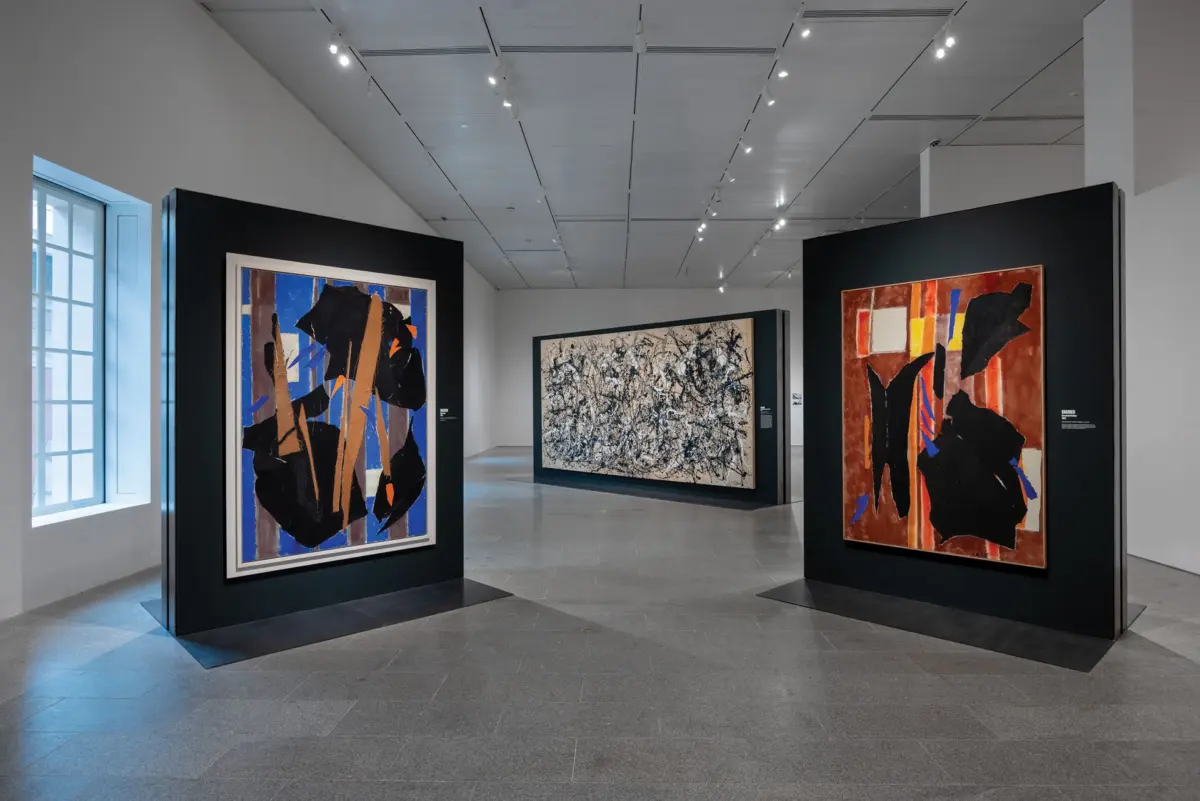
“Krasner and Pollock: Past Continuous,” the sweeping new exhibition at the Metropolitan Museum of Art, represents a once-in-a-lifetime assembly of more than 120 works by two of the most significant figures in the history of American art: Lee Krasner (1908–1984) and Jackson Pollock (1912–1956). For decades, the narrative surrounding this couple has been heavily lopsided, with the art world and the public alike fixating on the explosive, tragic genius of Pollock. His market value reached new heights this past May, cementing his status in the $100 million club, and his life remains immortalized in the 1991 Pulitzer Prize-winning biography Jackson Pollock: An American Saga by Steven Naifeh and Gregory White. That massive, 934-page volume served as the foundation for the 2000 Hollywood film Pollock, a project that, while highlighting the intensity of their union, further solidified the perception of Krasner as little more than a supportive, long-suffering spouse, despite Marcia Gay Harden’s Academy Award-winning portrayal of her.
For far too long, the historical consensus has treated Krasner as a supporting character in her own life. In 1981, curator Barbara Rose attempted to correct this imbalance with the exhibition “Krasner/Pollock: A Working Relationship,” which sought to dismantle the trope that Krasner was a second-tier artist defined entirely by her husband’s career. Rose argued that their marriage was a sophisticated, collaborative partnership between two artistic equals. Yet, even with that intervention, the gravitational pull of Pollock’s myth proved difficult to escape. Krasner remained, in the public imagination, obscured by the shadow of her husband.
“Past Continuous” represents a much more daring and nuanced evolution in this effort. By shifting the focus and giving Krasner the space she has long deserved—especially given that she outlived Pollock by 28 years—the exhibition provides an expansive look at their professional dialogue. It finally treats them as equals, not as genius and muse.
The exhibition opens with a panoramic, immersive view of their modest, shingled home and studio on Long Island. Historic stills flicker on the walls, showing the couple alongside their dog, Gyp, and their tamed crow, Caw Caw. This space was their sanctuary for nearly 11 years, until the devastating 1956 car accident that ended Pollock’s life and that of his passenger, Edith Metzger, while severely injuring his girlfriend, Ruth Kligman. At the time of the crash, Krasner was in Europe, attempting to distance herself from the volatility of Pollock’s alcoholism and his persistent infidelity.
It was within those Long Island walls, far from the influence of New York City and their regular haunts like the Cedar Bar, that Pollock developed his legendary drip painting technique. He famously laid unprimed canvas on the floor, working horizontally and applying enamel and house paints with sticks and brushes, never allowing the tool to make direct contact with the surface. The exhibition notes that this radical departure was deeply influenced by the work of Janet Sobel, a Ukrainian-born, self-taught artist. Pollock’s encounter with Sobel’s Milky Way (1945) at Peggy Guggenheim’s Art of This Century gallery served as the direct catalyst for his own 1947 masterpiece, Galaxy.

Only two years later, LIFE magazine propelled Pollock into the stratosphere of American celebrity, posing the now-infamous headline: “Jackson Pollock: Is he the greatest living painter in the United States?” The accompanying photo spread presented a hyper-masculine, brooding figure, cigarette dangling, clad in paint-splattered jeans. Krasner was notably absent from the narrative; the magazine sold the image of the solitary male genius, ignoring the presence of the woman who lived and worked beside him.
The Met’s new show aggressively subverts that myth, resetting the history of Abstract Expressionism. The first gallery is dedicated to Krasner’s collage works from the mid-1950s—a period when Pollock was spiraling into an artistic and personal impasse. Until now, the dominant history focused almost exclusively on the tragedy of Pollock’s decline. This exhibition balances that narrative with the triumph of Krasner’s creative emergence.
This retelling proves that by the mid-1950s, Krasner had reached a level of artistic parity that demanded recognition. In Bald Eagle (1955), for instance, Krasner utilizes scraps of dark brown linen and unprimed canvas—materials discarded by both her and her husband. In the center of the painting, a white shape mimicking a bird’s profile incorporates a dripped black line characteristic of Pollock’s style. By repurposing rejected scraps from their shared studio, Krasner essentially rose like a phoenix from the destruction of their shared and individual failures.
This metaphor of rebirth is central to understanding Krasner’s career. She faced frequent self-doubt and periods of creative blockage, constantly battling to forge a trajectory that was uniquely her own despite the overwhelming noise of Pollock’s celebrity. Long before she met her future husband, she had transcribed lines from Arthur Rimbaud’s A Season in Hell onto her studio wall: “To whom shall I hire myself out? What beast must I adore? What holy image is attacked? What hearts shall I break? What lie must I maintain? In what blood tread?” These words reflect a restless, uncompromising spirit, a woman deeply aware of the difficulty of maintaining artistic integrity in a world that often demands conformity.
After establishing Krasner’s individual power, the curators pivot to a more biographical look at their early years, placing their pre-marriage works side-by-side. The display includes their respective self-portraits—Krasner’s rendered in graphite and crayon around 1929–30, and Pollock’s in a muddy, impasto style from 1930–33. It also features works from the 1942 “American and French Painting” show, curated by the Russian émigré John Graham. That exhibition was a pivotal moment where their paths crossed; they were hung alongside masters like Picasso, Henri Matisse, Willem de Kooning, and Stuart Davis. Krasner, who did not yet know Pollock, was struck by his work, and the rest, as they say, became history.

The exhibition is dense with high points, including Pollock’s lyrically expansive Number 1, 1950 (Lavender Mist) and a recreation of Krasner’s landmark 1955 exhibition at the Stable Gallery. That show prompted critic Clement Greenberg to label her “a major addition to the American art scene of the era.” However, the exhibition also highlights the limits of that recognition. While Greenberg praised Pollock for moving past Cubism to create the first “great American paintings,” his assessment of Krasner—while positive—lacked the same fervor. Krasner spent her career crashing against this glass ceiling of hierarchical critical thinking.
Krasner’s resilience is most evident in her ability to synthesize the destroyed or abandoned fragments of her life into a cohesive body of work. In Blue Level and Desert Moon (both 1955), she constructed a rigid, vertical architecture that reached beyond the edges of the canvas. These works function as a form of aspirational self-portraiture, where the act of destruction is seamlessly integrated into a process of rebirth.
The latter rooms of “Past Continuous” are dominated by Krasner’s evolution into new territory, contrasting with the limited output of Pollock in his final years, represented by works like Portrait and a Dream and The Deep (both 1953). In her strikingly bold The Seasons (1957), a sprawling 17-foot canvas completed the year after Pollock’s death, Krasner returns to themes of fertility and rebirth, filling the space with abundant, organic forms. This boldness persisted throughout her career, as seen in Past Continuous (1976), her final monumental collage, which incorporates charcoal drawings from her time studying under Hans Hofmann.
The exhibition showcases a breadth of work from every decade of her life, highlighting a restless urge to experiment. Kufic (1965), a spare, contemplative piece, references the ancient Arabic calligraphy style, reflecting her lifelong fascination with the power of linear marks. Rising Green (1971) stands as another testament to her enduring mastery.
The exhibition culminates with Future Indicative (1977), a collage constructed from her own figure drawings. Throughout her life, Krasner remained deeply self-critical, rarely satisfied with her own output. Yet, as this comprehensive retrospective makes clear, her work stands on its own, independent of the myth that surrounded her for decades. By finally recognizing her as a formidable force, “Past Continuous” ensures that Lee Krasner is no longer just a supporting character in the story of American art, but a protagonist whose contributions are both essential and undeniable.