
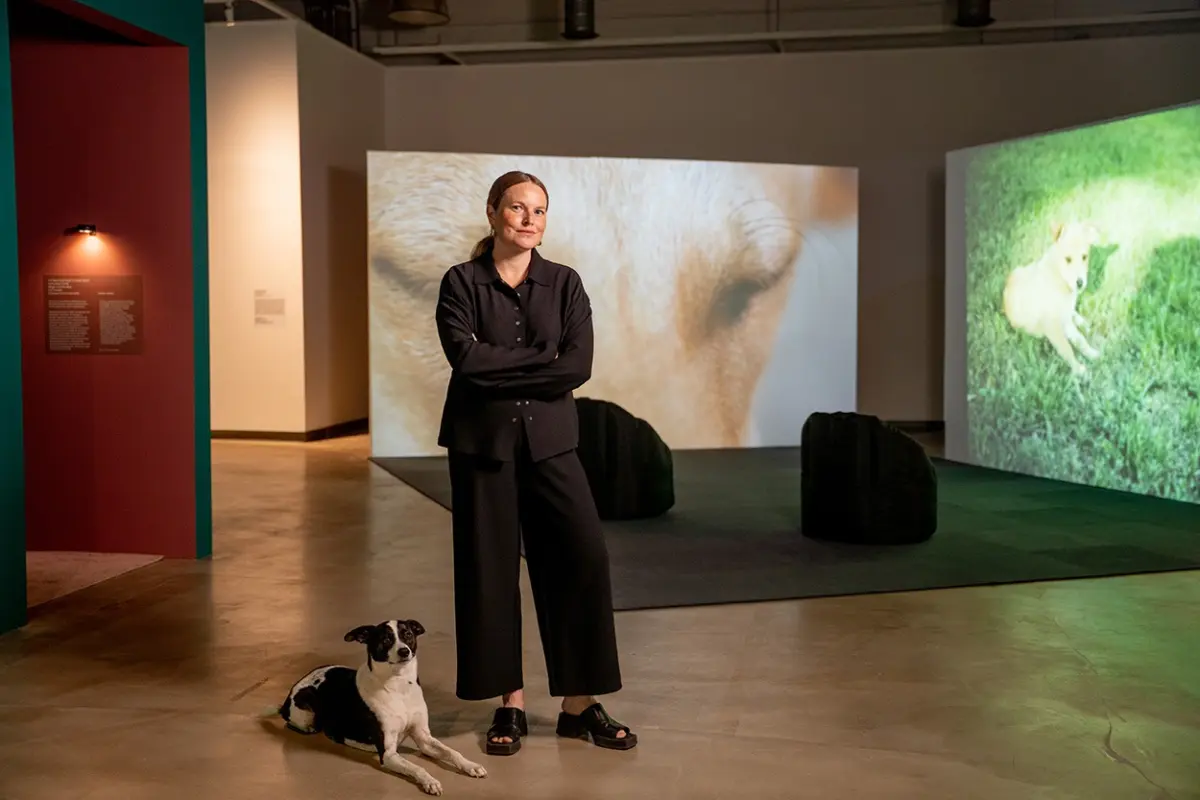
"Who was the first person to domesticate dogs, to dare to bring a wolf into their cave and tame it?" The question hangs in the air, framed by the grizzled, contemplative face of a mustachioed man on screen. This is the opening inquiry of Heavy Water (2018), a two-channel film installation by artist Erin Johnson. The man, ecologist L. Lehr Brisbin, poses the question with a mixture of professional curiosity and existential weight. "They could grow up to eat your children," he reminds us, a blunt reality check that grounds the abstract concept of domestication in the visceral, often dangerous intimacy between human and beast.
The film then pivots with a jarring, poetic grace. The viewer’s attention is pulled from the ancient, dusty past to a slide projector. A hand hovers over the device, displaying a plot of seemingly unremarkable land in South Carolina. However, this is no ordinary patch of dirt; it is a site where nuclear weapons were manufactured during the height of the Cold War. At this juncture, the viewer might feel a sense of disorientation, wondering how the primal bond between human and canine could possibly intersect with the sterile, apocalyptic machinery of atomic weaponry. Yet, as the narrative unfolds, Johnson brings the work full circle, masterfully weaving our apocalyptic future into the fabric of our ancient, ancestral history.
The Ghost Dogs of South Carolina
The connection lies in the landscape itself. In the 1970s, ecologists like Brisbin began documenting "unusual dogs with strange behavior" roaming the fenced-off, restricted perimeter of the South Carolina nuclear site. These creatures were described as "gingerish," Dingo-like, and profoundly feral. They were rare, existing on the margins of human society, yet they carried a profound genetic secret.
Brisbin’s research suggests that these "Carolina Dogs" possess no European DNA, pointing to a lineage that may have been present in the region for thousands of years. The scientist began to notice a striking resemblance between these living animals and the depictions of canines found in ancient cave paintings. It is a haunting suggestion: that these animals had survived in the shadows of the modern world, perhaps acting as a living bridge to a time before the continent was mapped by European settlers.
When environmentalists caught wind of these unique, ancient creatures, they launched a successful campaign to protect the land. Consequently, the nuclear-weapons manufacturing on the site was halted. The result was an unexpected ecological triumph: once the land was cordoned off from human industrial activity, scientists discovered that several federally endangered species of birds and plants were not only surviving but thriving in the silence of the restricted zone. In Johnson’s lens, the dogs become catalysts for environmental preservation, their very existence forcing a pause in the relentless march of technological progress.
An Aesthetic of Sensory Strangeness
Heavy Water is currently on view as part of a major survey of Erin Johnson’s work at the University of Georgia’s Athenaeum in Athens. Like much of the work in the exhibition, the film functions as a kind of essay—though it is an essay that rejects the didactic impulses of traditional documentary filmmaking. Instead of attempting to demystify the world through clinical explanation, Johnson’s work renders it sensorial and strange.

Johnson’s practice is defined by a deep curiosity regarding the interactions between species. Her filmography reads like a catalog of interspecies encounters: she has documented the work of oceanographers in To Be Sound Is To Be Solid (2022), botanists in the upcoming The Ferns (2026), and the intricate social structures of monkeys in Cayo Santiago (2024). She even turns her gaze toward human legends, such as the Georgia folk icon known as "the goat man" in her 2014 film, If it Won’t Hold Water, It Surely Won’t Hold a Goat.
While these subjects might typically be approached with the cold, analytical detachment of scientific inquiry, Johnson consistently pushes back against this distance. In her hands, the clinical nature of scientific data gives way to something remarkably tender and embodied. She forces the viewer to confront the subjectivity of the organisms being studied, shifting the focus from objective classification to an acknowledgment of lived experience.
The Measure Is Something Else
The exhibition title, "The Measure Is Something Else," is drawn from a deeply intimate source: a letter written by the legendary nature writer Rachel Carson to her partner, Dorothy Freeman. At the time of writing, Carson was battling terminal cancer, and the letter centers on her observations of monarch butterfly migrations. While a human life might view the butterfly’s lifespan as heartbreakingly brief, Carson realized that the "measure" of time and existence is subjective—something entirely different from the perspective of the butterfly.
This philosophy of perspective permeates the exhibition. In There Are Things in This World that Are Yet to Be Named (2020), a voice-over reads from Carson’s letters while the film unfolds in a series of rich, sonic textures. The work avoids the dry, intellectual dryness that often plagues research-based art. Instead, lines from the letters are chanted musically, the refrain "there are so many things yet to be named" repeating until it transforms from a simple statement into a radiating sense of wonder.
The film also incorporates the voices of botanists working in a greenhouse, who reflect on how historical, binary, and unscientific biases regarding gender have hindered our understanding of the natural world. By projecting human social norms onto plants, early taxonomists failed to see the more complex, fluid, and marvelous ways these organisms reproduce. The research highlighted in the exhibition—specifically concerning a unique species of bush tomato—serves to challenge and expand our understandings of sexual normativity, showing that the natural world is often far more radical than human classification systems allow.
Ecosystemic Thinking and Collaboration
The exhibition is a physical embodiment of "ecosystemic thinking." This framework posits that every element of our world is connected and dependent upon another. Perhaps no art form captures this interdependence quite as effectively as film, a medium that is inherently collaborative. When the credits roll on a Johnson project, it functions as a roll call of prominent figures in contemporary art, including contributors like Nikita Gale, Farah Al Qasimi, and Sondra Perry. For Johnson, filmmaking is a communal act; it is a process that relies on the strength and input of a village of friends and peers.

This ethos is deeply rooted in her background. Johnson trained at the alternative Warren Wilson College in Asheville, North Carolina—an institution where the curriculum requires students to participate in the physical labor of farming and land management. This hands-on, collective approach to life continues in her current practice. She directs an artist-run space in New York called Winnie, named after her own dog, and remains active in dog-rescue work.
This commitment to organizing and collaborating in both art and life is most visible in works like Tomatoes (2020) and Oranges (2023). In these pieces, the camera captures friends and colleagues—including artists like Tomashi Jackson, Annika Todd, and Chase Hall—simply existing together. In one video, they sit in a circle in a field, eating tomatoes; in another, they consume oranges on a rooftop. There is no grand narrative arc, just the quiet, intimate, and occasionally silly act of people eating. The juices run, the spheres are bitten into, and the viewer is invited to sit in the presence of these moments of shared human connection.
The Overlapping Middles
Thematically, Johnson’s work thrives on the friction created by juxtaposing disparate topics. She is not interested in drawing lines between science and humanity; she is interested in the Venn diagrams of their existence. She dwells in the "overlapping middles," finding the common ground between the structural mapping of the ocean floor and the quiet, hidden histories of queer women in mid-century architecture.
In To Be Sound Is To Be Solid, Johnson speaks on the phone with a scientist who spends his days mapping the deep ocean floor. Simultaneously, she explores the history of the Sea Ranch house she is renting, finding subtle, material clues—such as a single-bedroom floor plan—that suggest the home was once inhabited by a lesbian couple. The film draws a parallel between the vast, inaccessible depths of the ocean and the often-hidden history of queer lives. As the scientist notes, hard data is frequently elusive in the deep sea, forcing researchers to "average the depth" of an area. Similarly, in the absence of written records, we must often "average" the depth of historical lives, inferring meaning from the architectural and material fragments left behind.
Ultimately, Erin Johnson’s work offers a rare and vital contribution to contemporary art. She manages to create research-based projects that do not seek to provide final, authoritative answers. Instead, she enlists the rigors of science to peel back the layers of our reality, showing us just how expansive, deep, and beautifully strange the world remains. By the time one exits the exhibition, the mystery of the world has not been solved—it has been opened, wider than before.