
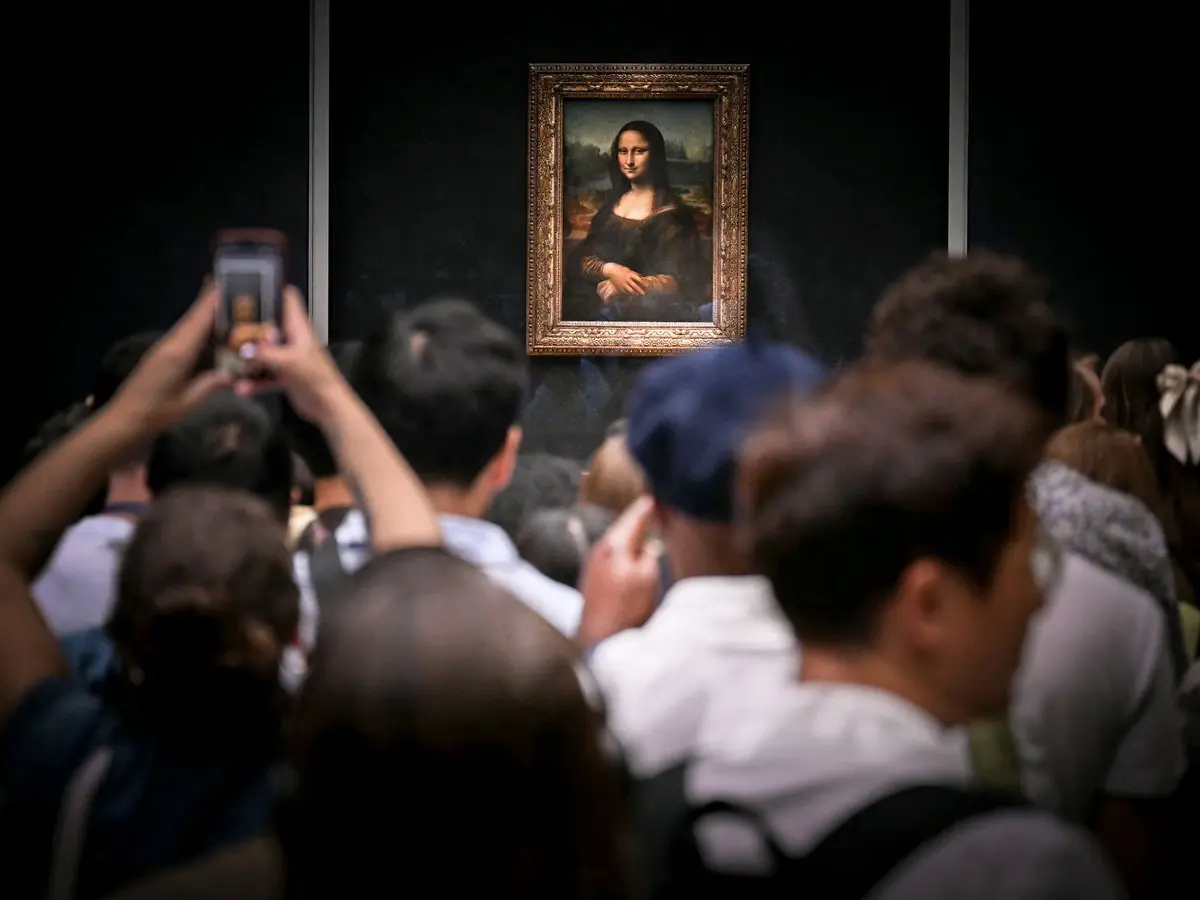
In a bizarre breach of museum security that has raised fresh questions about the operational integrity of one of the world’s most iconic cultural institutions, two visitors to the Louvre in Paris were arrested this past Saturday. According to police sources cited by Agence France-Presse (AFP), the two individuals managed to bypass surveillance to stage an unsanctioned installation within the Salle des États—the high-security chamber that serves as the permanent home to Leonardo da Vinci’s Mona Lisa.
The incident, while ultimately resulting in no physical harm to the museum’s priceless masterpieces, serves as a stark reminder of the persistent challenges facing the institution as it attempts to balance record-breaking visitor numbers with the protection of its historic collection.
A Breach in the Hall of the Masters
According to authorities, the two individuals, identified as German nationals, successfully introduced two small canvases—each measuring approximately 11.8 by 15.7 inches—into the gallery. Utilizing simple adhesive tape, the suspects affixed these unauthorized works directly onto the walls of the Salle des États. The content of the illicit additions appeared to be a form of personalized performance art: one painting depicted one of the suspects dressed in a suit of armor, while the second piece featured a portrait of the two individuals alongside an unidentified woman.
The Mona Lisa, arguably the most famous painting in the world, is protected by a sophisticated climate-controlled bulletproof glass enclosure and is constantly monitored by a heavy presence of security staff and an ever-shifting crowd of tourists. Despite the high traffic and intense scrutiny surrounding the painting, the suspects were able to carry out their stunt before being detained by the Louvre’s security team.
The suspects were subsequently arrested and taken into custody on charges of damaging the museum’s walls. When questioned by police regarding their motivations, the pair reportedly offered a simple, if perplexing, explanation: they claimed they had performed the act merely "for fun." The Louvre, which has become increasingly sensitive to security breaches in recent years, did not immediately respond to requests for comment regarding the specific lapses that allowed the stunt to take place.
A Climate of Heightened Security Concerns
While the intrusion on Saturday was seemingly benign in its intent, the atmosphere at the Louvre and other major European cultural institutions has been one of extreme vigilance for the past year. Historically, museums have focused their security protocols on preventing the theft of valuable artifacts or acts of vandalism by activists. However, the current climate is underscored by a series of high-profile security failures that have forced a reckoning within the French cultural sector.
Nearly a year ago, the Louvre itself was rocked by a major heist. In a brazen incident, crown jewels valued at approximately $102 million were stolen in broad daylight from the Galerie d’Apollon, a space located within the same complex as the Mona Lisa. That theft, which stunned the global art community, shattered the perceived invincibility of the museum’s security measures. The event triggered a wave of concern, leading to a string of reported thefts at other European museums, further straining the resources of security teams already struggling to keep pace with the sheer volume of daily visitors.
The fallout from the 2023 heist was immediate and severe. A government audit, leaked shortly after the incident, delivered a scathing assessment of the museum’s internal safety infrastructure. The report characterized the Louvre’s security system as "outdated and inadequate," highlighting "repeated postponements of the scheduled modernization of security systems" as a critical failure in administrative oversight.
The political consequences were profound. In February, Laurence des Cars, who had made history as the first woman to serve as the president-director of the Louvre, resigned from her position. Her departure marked the end of a turbulent period for the museum’s leadership, and she was replaced the following day by Christophe Leribault, who inherited the daunting task of stabilizing the institution’s operations and restoring public confidence in its security capabilities.
Facing the "End of Its Ropes"
Since assuming his role, Christophe Leribault has been transparent about the existential challenges facing the museum. Over the summer, in testimony before the French Senate, Leribault offered a sobering reality check on the state of the institution, stating that the Louvre is "at the end of its ropes."
Leribault’s testimony painted a picture of a museum struggling under the weight of its own history and scale. "Urgent building issues are piling up, and we are facing a massive investment challenge," he told the Senate. He emphasized that the administration is working to address "the necessary emergencies head-on." Among these priorities is a complete overhaul of the security apparatus; the museum has confirmed that a new, modernized video surveillance system is slated for installation around the perimeter in January, a move intended to provide a more comprehensive, digital shield against potential threats.
The "New Louvre Renaissance"
The incident involving the German visitors on Saturday occurs as the Louvre prepares for the most ambitious renovation in its recent history. The project, often referred to as the "New Louvre Renaissance," is expected to carry a price tag exceeding €1 billion ($1.2 billion). The primary objective of this massive undertaking is to mitigate the chronic overcrowding that has become a defining characteristic of the museum’s daily experience.
Central to the renovation plans is the construction of a new 33,000-square-foot exhibition space specifically designed for the Mona Lisa. By providing the portrait with its own dedicated entrance and more expansive viewing galleries, the Louvre hopes to manage the massive influx of tourists more effectively, potentially alleviating the pressure on the current, more confined, Salle des États.
The path to this renovation has not been without its own complications. The plans were briefly put on hold earlier this year, fueling speculation about the museum’s financial and logistical capacity to see the project through. However, the momentum was restored in May when the Louvre officially selected an architecture team to spearhead the design and execution of the expansion.
As the museum moves toward these structural changes, the arrest of the two visitors serves as a reminder that the Louvre’s challenges are not limited to the grand scale of architectural renovation. In a world where the museum is a global stage, every security breach—no matter how trivial the intent—draws attention to the delicate balance between maintaining an accessible, public space and protecting the irreplaceable cultural heritage held within its walls. For the authorities and the new leadership at the Louvre, the task remains to ensure that while the doors remain open to millions, the sanctity of the collection remains beyond the reach of those seeking their own moments of notoriety.