
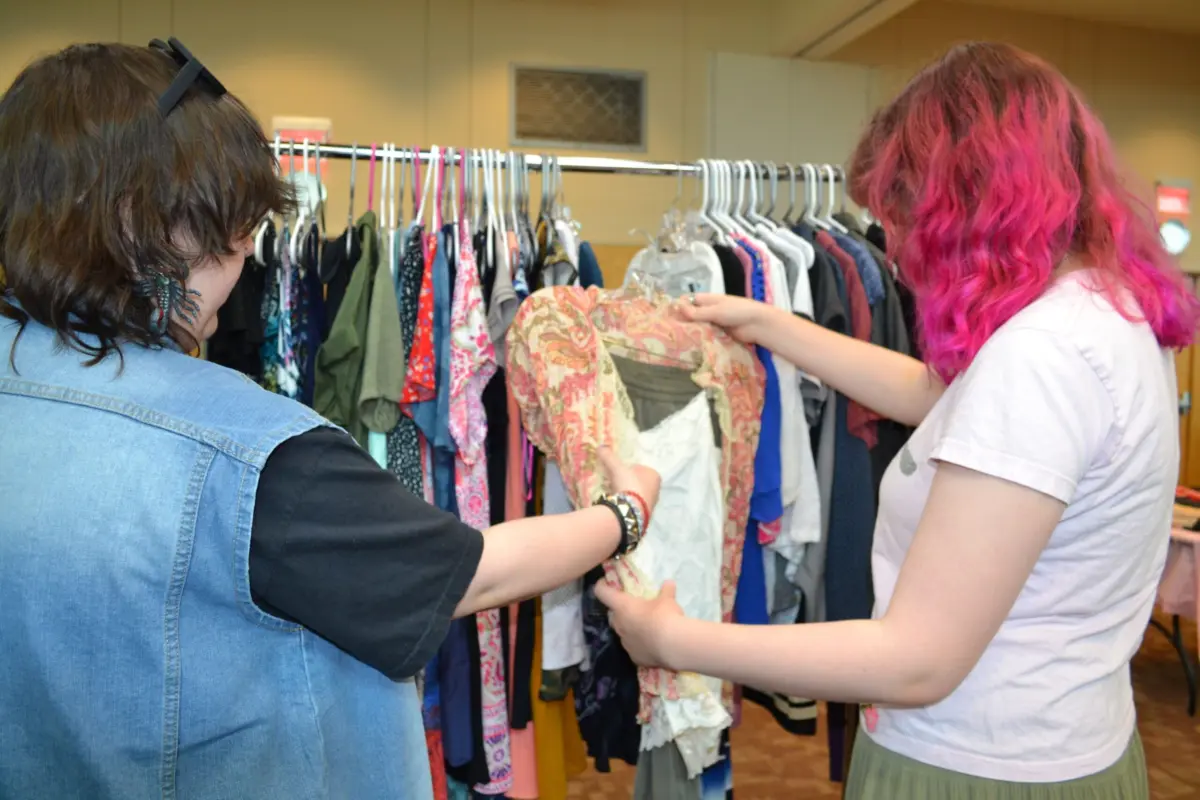
Every time Isaiah Kirk walks away from a clothing swap hosted by Chicago’s Uncommon Closet, they leave with more than just a fresh aesthetic; they leave with a tangible sense of self-assurance. Most recently, Kirk, who identifies as nonbinary and transmasculine, curated a new look consisting of a pair of well-fitting jeans, a button-up shirt, and a Pokémon graphic tee. The financial cost of this entire wardrobe refresh was exactly $0.00. For many, a zero-dollar price tag is simply a perk of the secondhand economy, but for those in the queer and trans community, these swaps represent a lifeline of radical inclusion and self-expression.
"It’s a lot of fun," Kirk says, reflecting on the experience of sourcing items at the Uncommon Closet. "The environment, the camaraderie—it’s safe and inclusive."
For Kirk and countless others, the act of getting dressed is far more complex than simple vanity. Clothing serves as a vital tool for expressing one’s identity in a way that aligns with their internal sense of self. It is a pursuit of gender euphoria, a feeling of alignment and comfort in one’s own skin. This need for authentic self-expression has become increasingly urgent as a wave of anti-trans legislation sweeps across the United States, creating an environment where trans existence is frequently challenged or restricted in public spaces. In this climate, the ability to dress in a way that confirms one’s identity is not just a stylistic choice; it is a profound act of resistance and self-preservation.
The necessity of these spaces is underscored by the work of AJ Mix, who manages community outreach for the Uncommon Closet. Their work is deeply rooted in understanding the specific challenges faced by the LGBTQ+ community. "I primarily work with people who have body dysmorphia or dysphoria," Mix explains. Many of their clients have navigated lives marked by discrimination, often being forced to conform to gender norms associated with their sex assigned at birth. For these individuals, the prospect of entering a traditional retail store can be a source of significant anxiety.
"A lot of people have trauma going to stores," Mix notes. To mitigate this, Mix often assumes the role of a therapeutic personal stylist. They accompany clients—including trans women who may be in the early, vulnerable stages of their transition—on trips to retail spaces, helping them navigate gendered aisles that they might otherwise be too intimidated or uncomfortable to approach alone.
The Uncommon Closet’s clothing swap program was originally conceived as a singular, celebratory event held during the business’s grand reopening in 2024. However, the immediate and overwhelming demand for the service revealed a systemic gap in resources. Recognizing that the community needed more than a one-time offering, Mix transitioned the program into a recurring staple, now hosting three swaps a year—in the spring, summer, and winter—to assist community members in managing the seasonal shifts of Chicago’s harsh climate.

"We have a lot of new people coming in from the South to Chicago due to the political climate," Mix says. "A lot of people use their entire savings to haul their entire lives up here, and so they just don’t have any money." The swaps provide a critical safety net, ensuring that these individuals have access to the basic necessities of life without the burden of financial strain.
Similar initiatives are taking root across the country, each tailored to the specific needs of their local populations. On the East Coast, 20-year-old Alex Carroll founded NYC Youth for Trans Rights with a mission to help young people secure gender-affirming accessories that are often prohibitively expensive. One of the most sought-after items is a chest binder, a compression garment that flattens the chest to create a more masculine silhouette. These items can cost upwards of $50, a steep price for many youth, and they are often difficult to source in a physical retail environment. For Carroll, the highlight of these events is watching a participant walk away with a binder they could not have otherwise afforded, their relief and joy visible.
However, the value of these swaps extends far beyond the physical goods. Carroll emphasizes that the social aspect—the ability to find community and forge friendships—is equally important. "There’s constantly stuff being thrown at trans people," Carroll says. "You have to find people who are similar to you to help support each other."
In Austin, Texas, the motivations are similar but the focus has expanded to address another neglected demographic: plus-sized individuals. Christabell Nunez, the founder of the nonprofit I Slay, sought to create a safe space for marginalized people of all body types to experiment with fashion. "It is still so hard to shop for plus-sized people. You really have to scavenge," Nunez explains. "A lot of our trans people, they are getting stared at. They’re getting looked at in retail spaces."
What began in 2024 as a small gathering of 20 friends in Nunez’s backyard has ballooned into a significant operation. I Slay now hosts monthly swaps attended by over 150 people. The policy is one of radical generosity: everyone is welcome to take as much as they need, with the only condition being a request that items are not resold for profit. The reach of the organization has surprised even its founder. "Our mind gets blown every month," Nunez says, noting that the reputation of the swap has grown so strong that one attendee even flew in from Canada specifically to participate.
The impact of these programs is often felt by those outside the immediate trans community as well. Melissa Grzybowski, the head librarian of youth services at the Pflugerville Public Library in central Texas, has seen firsthand how the library’s trans clothing-swap program serves a broader purpose. "It helps everyone," she says. At one of the library’s inaugural events, Grzybowski witnessed a refugee mother find much-needed clothing for her children, the family having arrived in the country with nothing more than two suitcases of belongings.

Despite operating in Texas, which in 2021 introduced the highest number of anti-trans bills in the country, Grzybowski remains committed to inclusive programming. She views the library as a bastion of public service that must remain accessible to all. "Public libraries are supposed to be welcoming to all people," she says. "We have lots of books that represent the LGBTQ+ experience."
Further north, in Tennessee, the landscape for trans individuals has historically been challenging. Jack Knoxville, who began organizing clothing swaps in the state in 2016, recalls a time when he felt there was almost no positive representation for trans people in his home state. Reflecting on his own history—having been on his own and unhoused since the age of 14—Knoxville understands the multifaceted barriers that trans people face. He notes that the struggle for survival is exacerbated when one’s identity becomes a barrier to employment.
"I know what it’s like to be trying so hard to get a job and getting the door shut in your face because your name on paper doesn’t match the perception of your gender with that interviewer," Knoxville says. The clothing swaps he organizes provide more than just warmth; they provide the tools for confidence. He has seen firsthand how participants leave these events feeling better prepared for job interviews or simply more equipped to handle the realities of living in precarious housing situations.
"It’s the same kind of euphoria that you feel when you have a good haircut… You can feel like you’re on top of the world," Knoxville says. "Clothing has a huge impact on people and their ability to interact with each other, but then on top of it is that layer of safety and how other people perceive you."
Today, through his nonprofit, the Trans Empowerment Project, Knoxville is working to scale this impact by teaching organizers across the country how to establish their own clothing swaps. He views the movement as a testament to the enduring spirit of the community. "Queer people especially have to be resilient, and they have to tap into creativity and create something from nothing," Knoxville says. "We find ways to take what’s left, the crumbs that are given to us, and turn them into celebrations."