
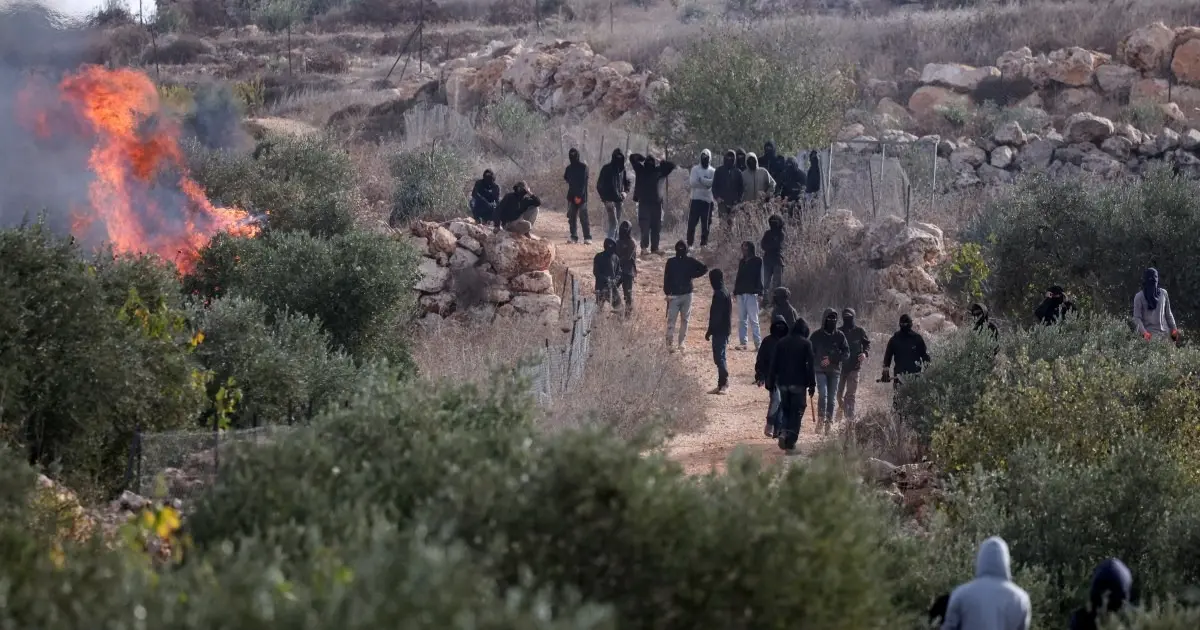
A month into this year’s olive harvest season, Israeli settlers and soldiers have already damaged or uprooted 4,500 olive trees across the occupied West Bank. This targeted destruction is part of a relentless, long-term trend; since January alone, an estimated 100,000 olive trees have been destroyed. The devastation is even more absolute in the Gaza Strip, where ongoing military operations since October 2023 have wiped out a staggering 97 percent of the region’s two million olive oil trees. This modern ecological devastation builds upon a historic precedent: between the onset of the Israeli occupation of Gaza and the West Bank in 1967 and the 2010s, more than 800,000 olive trees were systematically destroyed.
These statistics evoke a deeply personal and devastating sight for many Palestinians, including the poignant memory of uprooted trees in family groves passed down through generations. Such painful realities stand in stark contrast to the frequent news of Israeli delegations traveling to international climate, biodiversity, and desertification conferences. At these global summits, Israeli officials routinely boast of a "unique expertise" in "making the desert bloom"—a narrative of ecological prowess that has been propagated for decades.
However, the systematic destruction of olive trees is merely one facet of a much broader, multi-layered war waged against Palestinian land, vegetation, soil, water tables, and fragile ecosystems. Since the Nakba of 1948, Israeli colonial policies have extended far beyond physical land seizure and the forced displacement of human populations. They have actively sought to reshape the natural landscape itself, systematically undermining its long-term capacity to sustain the communities that have lived on, cultivated, and protected it for generations. Far from the benevolent environmental stewardship claimed in its international PR campaigns, the historical record demonstrates that Israel’s presence has transformed a historically blooming landscape into one marked by scorched earth.
Re-engineering “The Desert”
When the first Zionist settlers began arriving in Palestine in the late 19th century, the narrative they constructed upon arrival frequently framed the territory as an empty, barren wasteland waiting to be rescued. In reality, what they found was a diverse, highly productive ecosystem that was already blooming. Palestinian land was producing not only enough food to sustain its local population but also generating surplus crops for export to neighboring regions within the broader Ottoman Empire and across the Mediterranean to Europe.
Palestinian agricultural life was rich and varied. Communities grew staple crops such as wheat, barley, and oats, alongside intensive harvesting of ancient olive groves and fruit orchards. Closer to the Mediterranean coast, lush, fertile gardens produced an abundance of seasonal vegetables and diverse fruits. Further south, within the more arid Naqab (Negev) desert, Indigenous Bedouin tribes expertly tended to herds of sheep, goats, and camels, sustainably producing meat, milk, and wool that matched the natural carrying capacity of the land.
Historically, Palestinians co-existed harmoniously with the varied ecosystems they occupied, adapting their practices from wetlands to dry deserts. They tended to the soil using time-tested techniques that respected local environmental conditions rather than seeking to forcefully re-engineer them. Local, drought-resistant crop varieties were carefully cultivated in drier regions, while more irrigation-dependent agriculture was concentrated in fertile valleys closer to natural water sources.
By stark contrast, Zionist settlers arriving from Europe sought to aggressively reshape Palestine’s natural landscape into forms that felt familiar to them from their European homelands. They planted non-native trees imported from Europe, such as the stone pine, frequently uprooting irreplaceable native species, including ancient olive trees, to make room for them. They drained vital wetlands and swamps, rerouted natural streams, and attempted to force afforestation upon arid desert landscapes unsuited for such interventions.
Some of these heavy-handed ecological alterations had disastrous consequences for local ecosystems. The introduction of non-native flora, such as the eucalyptus tree, proved particularly problematic; it burns easily and has directly contributed to a significantly higher frequency and intensity of destructive wildfires throughout the region.
Furthermore, these aggressive efforts to reshape the natural landscape were driven by a clear political desire to erase the physical evidence of Palestinian presence. Trees were deliberately planted directly over the remains of pillaged and depopulated Palestinian villages to obscure them from view. Imported European-style industrial agriculture systematically undermined and wiped out native Palestinian farming techniques that had sustainably fed human populations for centuries.
Ecocide in Palestine
The Zionist assault on Palestinian land did not stop at the 1948 armistice boundaries. As soon as the Israeli military occupied the West Bank and Gaza Strip in 1967, it subjected not only the civilian population but also their natural resources to strict martial rule.
Water quickly became the epicenter of this resource dominance. As illegal settlements expanded across the occupied territories, settlers began systematically taking over local water resources. Today, Israel’s national water company, Mekorot, operates an extensive infrastructure network that deliberately reroutes water away from Palestinian towns and villages and funnels it directly to illegal Israeli settlements. During the scorching summer months, when water is most critical, this system frequently cuts off supplies to Palestinians entirely to guarantee an uninterrupted, abundant flow to the settlements.
This systemic water theft has devastated Palestinian agriculture, dried up local aquifers, and crippled fragile ecosystems. Meanwhile, land appropriation has been accompanied by sustained violence directed not just at people, but at the soil itself. For years, the Israeli military and aggressive settlers have sprayed agricultural land with toxic herbicides and pesticides specifically designed to discourage farmers from working their fields. Concurrently, the routine burning and uprooting of trees, the destruction of wild vegetation, and heavy construction associated with settlement expansion have badly degraded the soil, triggering severe erosion.
In the Gaza Strip, this pattern of ecological destruction has been pushed to an unprecedented extreme. The ongoing military campaign has devastated agricultural lands, uprooted remaining orchards, pulverized soil structures, and contaminated vital water aquifers.
These acute harms are exponentially compounded by relentless bombardment and heavy bulldozing. Israel has destroyed approximately 85 percent of all buildings in the Gaza Strip, leaving behind an estimated 70 million tonnes of toxic rubble. Comprehensive field assessments indicate that heavy bombardment has dispersed dangerous heavy metals—including lead, cadmium, arsenic, tungsten, and aluminum—alongside powerful explosive compounds like TNT, RDX, and perchlorates into the immediate environment.
Over time, these toxic substances seep deep into the soil and underground water tables, causing severe, systemic environmental damage whose poisonous effects are expected to persist for generations. Meanwhile, the continuous, heavy-duty bulldozing of infrastructure and agricultural land strips away the topsoil—the vital layer rich in organic matter and nutrients essential for any plant growth—leaving the land utterly sterile.
A Coloniser’s Logic
A profound paradox lies at the heart of this conflict: the very individuals who claim an ancient, ancestral right to the land are those who actively damage, poison, and destroy it. Yet, this dynamic is entirely consistent with the classic framework of colonialism.
A coloniser views land primarily as an object to capture, possess, and exploit for material gain. The colonial relationship to the natural world is defined by extraction and abuse rather than genuine care, stewardship, or belonging. The Israeli approach to Palestinian land—relying on poisoning, bulldozing, and destruction as mechanisms of territorial control—stands in stark, irreconcilable contrast to the Palestinian philosophy of land stewardship. Since 1948, Palestinians have faced relentless physical attacks, resource theft, and property pillaging. Yet, generation after generation, they have continued to rebuild, replant, and restore the earth.
The story of individuals like Hamdan, a Palestinian grandfather who spent four decades tending to an eight-dunam olive grove that produced 1,500 kilograms of high-grade olive oil every single season, illustrates this enduring spirit. During the 2008 military assault, the Israeli army bulldozed his grove. Rather than giving in to despair, Hamdan immediately set about replanting olive saplings with the help of his family. Just as the young grove was beginning to recover and bear fruit, the Israeli army destroyed it once more during the 2014 war.
For Hamdan and millions of others, olive trees represent far more than a simple economic livelihood. They are viewed as living children, the physical embodiment of decades of careful labor and an unbreakable family bond to the ancestral soil. Tragically, less than a week after the second destruction of his life’s work in 2014, Hamdan passed away from the profound shock.
Yet, his family refused to relent. They returned to the land in 2015 to clear the debris and replant the grove with new olive trees, a painstaking process that took several months. The young trees required three years of attentive care before they finally bore fruit. The family managed to harvest olives for two successive seasons before the Israeli army bombed the grove yet again during the 2021 military escalation.
The resulting damage left the land completely unsuitable for traditional olive cultivation. Clearing the deep chemical contamination and filling the massive bomb craters took a vast amount of time, but the family persevered, planting portions of the ruined land with seasonal crops like wheat. Then, in December 2023, the military devastated the grove once more.
The author notes that they would be out on that land replanting today if the site did not now lie beyond the military’s ever-expanding "Yellow Line."
This innate drive to tend to the earth remains so deeply ingrained within the Palestinian psyche that even inside overcrowded camps for displaced persons, people carve out tiny, desperate gardens in front of their canvas tents, carefully planting sprigs of mint, basil, and simple flowers.
Despite the extensive international public relations campaigns and greenwashing deployed by Israel, the reality on the ground makes it increasingly clear who truly sustains and cherishes the Holy Land. It is not those who destroy, poison, and bulldoze the earth, but those who remain deeply rooted within it—planting, growing, and caring for it against all odds.