
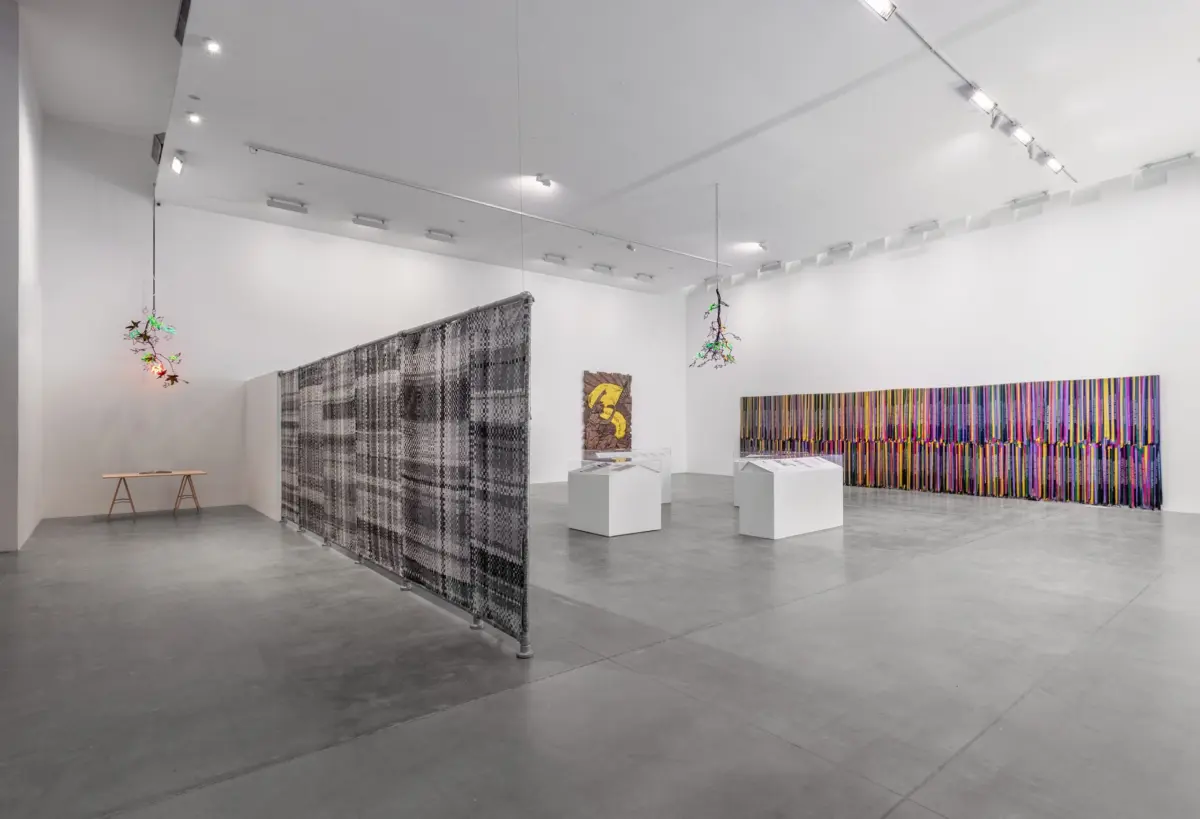
At the Fondazione Sandretto Re Rebaudengo in Turin, Italy, a quiet revolution is unfolding. Andrea Bowers’ solo exhibition, "La Ragnatela," serves as both a historical excavation and a contemporary rallying cry. While the exhibition is deeply rooted in the archives of the 1980s, its thematic resonance with today’s geopolitical climate is striking, if not entirely intentional. The show centers on the politics of climate change and the long-standing struggle for environmental sovereignty, a subject that has gained renewed friction in Italy. Only last year, Prime Minister Giorgia Meloni’s administration moved to restrict the installation of solar panels on agricultural land, framing the transition to renewable energy as a potential "threat to our food sovereignty." Against this backdrop, Bowers’ work—which champions the necessity of radical ecological action—feels remarkably, and perhaps urgently, timed.
"La Ragnatela," which translates from Italian to "The Spiderweb," draws its name and its spirit from the Italian anti-nuclear feminist movement. In 1983, a group of women established a peace camp in Comiso, Sicily, to protest the stationing of United States nuclear cruise missiles at the local NATO base. This movement, while once a potent force in the international anti-nuclear circuit, had largely slipped into the shadows of collective memory. By mounting this mini-retrospective, Bowers aims to weave those forgotten threads back into the tapestry of modern activism. The exhibition functions as a bridge between the past and the present, featuring works that Bowers created as a young artist fresh out of graduate school in 2003, as well as pieces produced throughout 2013, 2022, and 2023. To anchor the show, she has also debuted four new works specifically commissioned for the Turin presentation.
The project was not a solo endeavor of historical imagination; it was an arduous process of reconnection. Much of the history surrounding the Comiso camp had been lost to time, prompting Bowers to collaborate closely with curator Bernardo Follini. Together, they embarked on a detective-like quest to locate the original members of this network of Italian ecofeminists. Their search proved successful, uncovering three women—now in their 80s and 90s—who provided the exhibition with essential primary documents, personal clippings, and firsthand accounts of the protest movement.
During a preview of the exhibition in Turin, Bowers stood before her work, dressed in a signature monochromatic black ensemble, her hair cascading in a style reminiscent of a Botticelli portrait. She spoke candidly about the nature of her practice, noting that while the art world often prioritizes the production of tangible objects, her heart lies in the labor of social engagement. "The social engagement part of my practice is the least known about or documented because the art world is more focused on objects, but this is what I’m most proud of," she remarked.
The narrative arc of the exhibition begins with Defense of Necessity (2003), a textile work that utilizes the medium of a quilt to pay homage to the tradition of women’s craft. It stands as one of the earliest examples of Bowers positioning herself as a political artist. A closer look at the quilt reveals intricate stitching of spiderwebs—a recurring motif that served as a symbol for the Women’s Pentagon Action. This American grassroots ecofeminist movement operated in parallel with the Comiso camp in Italy and the Greenham Common Women’s Peace Encampment in England.
In the gallery space, the quilt is hung to mimic the appearance of a fence, a deliberate choice that invites reflection on the boundaries of civil disobedience. Bowers explains that the fence acts as a physical site where the ethics of nonviolence are frequently debated. "Activists who are involved in nonviolence are always saying, if we cut that fence, does it become violence? Or is this called an offense of necessity, which is an argument that smaller injustices, or you break small laws to protect the world from larger injustices," she explained. "It’s a legal term and because it has the word ‘fence’ in it, it’s a play on words and it’s poetic."
Beyond this metaphorical barrier lie four vitrine cases that provide the historical backbone of the exhibition. Two of these cases contain a meticulously curated timeline of the La Ragnatela movement. The others house intimate exchanges: letters sent between the women of Comiso and their international comrades in England, who traveled to Sicily to join the protest. Among the items are photographs of activists who were arrested, as well as a poignant letter from a woman who endured a long detention and a subsequent trial. During her trial, she famously wore a T-shirt emblazoned with the words "question authority."

Bowers has reclaimed this slogan for her own work, integrating it into Neon Spiderweb #3 (2026). The phrase is etched onto the outer string of a glowing neon web. This piece is part of a larger series of neon works, including messages like "A better end of the world is possible," "Return our future," and "To be free from fear." These slogans of hope bleed into another installation, Political Ribbons (2026), which features brightly colored, silky ribbons fluttering on the wall. These ribbons repeat the mottos found on the neon signs while introducing new, provocative sayings such as "People over profits," "Outlaw women are the only hope for earth’s survival," and "Widen the web to break the nuclear chain."
In a move that breaks the traditional "do not touch" barrier of the museum space, visitors are encouraged to take these ribbons home. For Bowers, this is a "simple way for people to take a position." It is a methodology she has employed throughout her career, and she maintains that she still experiences a genuine thrill when she encounters these ribbons in the wild or shared across social media platforms, serving as a lingering reminder of the exhibition’s message.
The exhibition also showcases Bowers’ mastery of technical precision. Her graphite on paper works, such as Diabloblockade, Diablo Nuclear Power Plant, Abalone Alliance, 1981 (2003) and Women’s Pentagon Action, 1981, Detail of Woven Web Around Pentagon (2003), are hauntingly hyperrealistic. These works were derived from photographs gifted to her by friends of her mother who were members of the Californian environmental group Mothers for Peace. In a more contemporary vein, the work Cardboard (2026) features an image of an "empowered Italian woman" viewed from behind, holding a flag that reads "Sun and wind." The piece is a testament to the artist’s willingness to adapt, as Bowers taught herself to use an iPad to create the digital drawing that was subsequently projected onto the thick cardboard surface.
For Bowers, the show at the Fondazione Sandretto Re Rebaudengo feels like a homecoming. She first exhibited at the foundation nearly three decades ago, in 1998, as part of a group exhibition titled "Guarene 98." Returning 28 years later, her Chandeliers of Interconnectedness grace the halls, situated in the same institution that now hosts work by artists like Nan Goldin and Joseph Yaeger.
There is a sense, however, that the scope of Bowers’ work is nearly too expansive for the designated space. While the exhibition is compelling, it feels somewhat curtailed, leaving the viewer to wonder if the artist had more to say than the walls could hold. One cannot help but feel that a larger, two-gallery presentation would have better served the breadth of her two-decade-long commitment to environmental activism.
Nevertheless, the impact of the work remains undiminished. The installation Neon Opland (2026) exemplifies this ability to make a mark. The neon sign reproduces a doodle from a vintage La Ragnatela poster depicting a woman kicking a missile, accompanied by the slogan "No ai missile" (No to missiles). The imagery is subtly phallic, a touch of humor that seemed to land with the audience—most notably with a teenage couple who were spotted flirting on a bench directly opposite the neon light’s glow. By bridging the gap between the grave historical struggle of the 1980s and the casual, present-day interactions of museum-goers, Bowers succeeds in ensuring that the spirit of La Ragnatela remains, as the ribbons suggest, a living, breathing, and expanding web.