
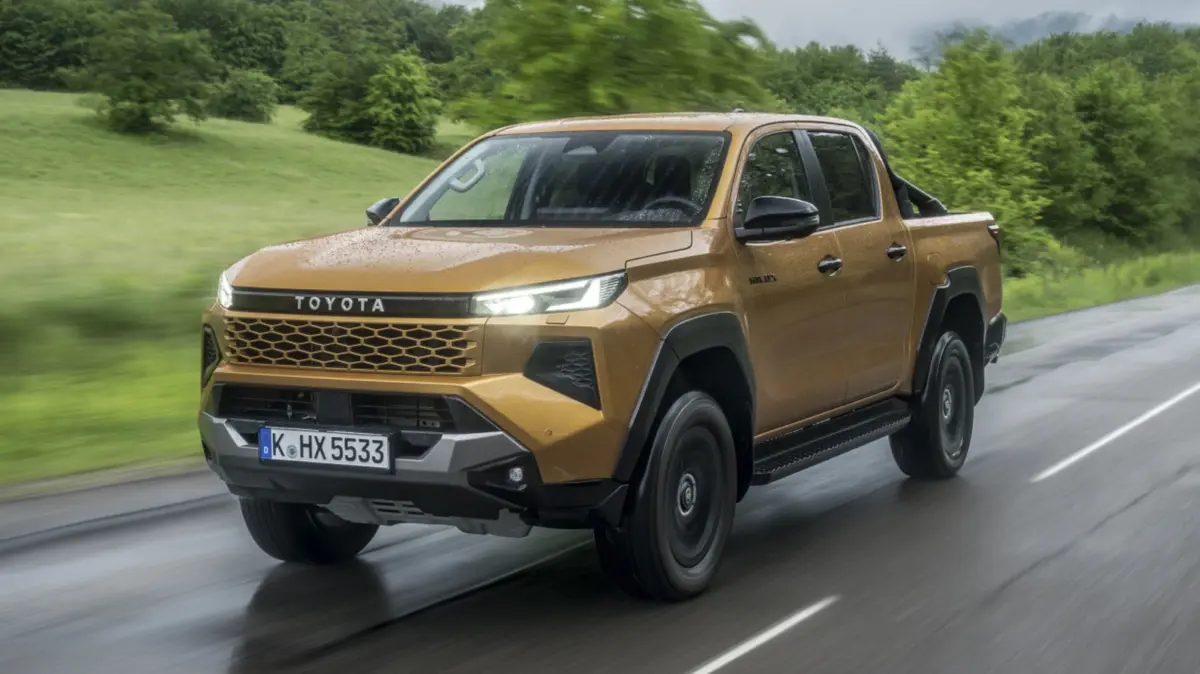
When automotive historians and enthusiasts compile lists of the most durable, reliable, and indestructible machines ever to grace four wheels, few brands claim a reputation quite like Toyota. Within the Japanese automaker’s vast and varied global lineup sits a midsize pickup truck that, despite being practically invisible on American roadways, enjoys a near-mythical status across almost every other continent: the Toyota Hilux.
For decades, the Hilux has earned a reputation as a mechanical titan. While modern vehicles are often packed with delicate electronics and sensitive powertrain management systems that can leave drivers stranded at the first sign of trouble, the Hilux has long stood as a symbol of rugged simplicity. It is a workhorse built for the most punishing environments on Earth, engineered with a robust ladder-frame chassis, a straightforward mechanical layout, and an uncanny ability to absorb severe punishment and keep on running. Yet, despite its undisputed global dominance and a heritage built across more than 190 countries and territories, the Hilux remains one of the automotive world’s greatest forbidden fruits for drivers in the United States.
To understand how the Hilux achieved its legendary status, one must look beyond standard consumer automotive reviews and into the realms of television infamy, military history, and extreme global endurance. It is virtually impossible to discuss the Hilux without recalling the legendary, albeit unintentional, promotional campaign gifted to it by the British motoring television show Top Gear. During a series of now-classic episodes, the program subjected a well-worn, high-mileage diesel Hilux to an escalating array of catastrophic tortures designed specifically to break it.
The production crew drove the truck down a flight of concrete stairs, smashed into it with a wrecking ball, set it entirely on fire, and dropped it into the tidal waters of the Bristol Channel, leaving it submerged overnight. When the tide receded, the battered pickup was recovered, covered in mud and marine life. Armed with nothing more than a basic set of hand tools, a wrench, and a dose of mechanical sympathy, the presenters managed to coax the engine back to life without replacing a single major component.
The crowning achievement of its television career came when presenter James May drove a similarly resilient Hilux up the slopes of an active volcano in Iceland. That exact vehicle was later pressed into service by the show’s camera crew during their famous Polar Special expedition, where May and co-host Jeremy Clarkson navigated some of the most unforgiving, freezing terrain on the planet to reach the magnetic North Pole. These stunts cemented the Hilux’s cultural identity as an indestructible force of nature, capturing the imagination of millions of viewers worldwide and turning a humble commercial vehicle into a global pop-culture icon.
Beyond the controlled chaos of television entertainment, the Hilux has carved out a very real, high-stakes legacy on actual battlefields. The pickup is perhaps most famously associated with the late-twentieth-century conflict in the Saharan desert known colloquially as the "Toyota War." During the mid-1980s border conflict between Chad and Libya, the Chadian military utilized fleets of hastily modified Hilux trucks equipped with anti-tank weaponry and troop-transport configurations. The lightweight, fast, and remarkably durable trucks allowed Chadian forces to execute swift, highly mobile guerrilla tactics against heavily armored Libyan columns, proving that the unassuming pickup could hold its own in active military combat zones.
The vehicle has also established an intensely loyal, almost fanatical following in Australia, a vast continent renowned for its punishing terrain, extreme temperatures, and demanding Outback conditions. Over the past decade, Toyota has managed to shift well over half a million units of the Hilux in Australia alone, propelling it to the top of the sales charts and making it the country’s best-selling vehicle overall during that extended period. Farmers, miners, tradespeople, and adventure seekers alike rely on the Hilux to navigate environments where mechanical failure can spell disaster.
This combination of a robust ladder-frame build, mechanical simplicity, ease of repair, and an unwavering tolerance for extreme abuse across the harshest environments on Earth explains why the Hilux is revered globally. Its formula is a testament to an era of engineering where utility and longevity took absolute precedence over fleeting luxury trends.
So why isn’t the Hilux sold in the U.S.?
The legend of the Hilux is only amplified when one considers the sheer scale of its global distribution. Toyota officially sells the Hilux in more than 190 countries and regions around the world. To put that figure into perspective, geopolitical definitions place the total number of countries in the world between 193 and 237, depending on how disputed territories, partial sovereignties, and micro-states are counted. This means Toyota exports the Hilux to virtually every corner of the planet—with one glaring, major exception.
Despite shipping the truck to almost every other market, Toyota does not sell the Hilux in the United States. North American buyers looking for a midsize pickup from the Japanese manufacturer instead find the Toyota Tacoma parked on dealership lots. While older American enthusiasts may remember a time when compact Toyota pickups were a ubiquitous sight on U.S. roads during the 1970s and 1980s, those vehicles generally bore the simple "Toyota Truck" moniker rather than the Hilux nameplate. That era officially ended in the U.S. market in 1995 when Toyota retired the line to make way for the Tacoma, a truck specifically engineered and tailored to suit the comfort, safety, and performance preferences of American consumers. As far as corporate strategy was concerned, the Tacoma—featuring a slightly larger footprint, different powertrain options, and ride dynamics better suited to American highways—was a far superior fit for domestic buyers.
Economic policy and trade regulations have also played a permanent role in keeping the Hilux off U.S. soil. The enduring presence of the so-called "Chicken Tax"—a protectionist 25% tariff levied by the United States on imported light trucks—remains a formidable financial hurdle. Enacted in 1963 in response to European tariffs on American poultry imports, the tax disproportionately impacts foreign automakers attempting to import completed light commercial vehicles into the American market.
If Toyota were to bring the latest ninth-generation Hilux to U.S. showrooms as an import, the company would either have to absorb or pass along the heavy 25% tariff, severely undermining the vehicle’s competitive pricing. Alternatively, Toyota would need to invest heavily in local manufacturing capacity within the United States or establish production lines in neighboring countries like Mexico or Canada to qualify for preferential trade treatment under regional agreements. Complicating matters further, the Hilux is already produced in a massive network of global manufacturing hubs, including Argentina, Venezuela, India, Pakistan, Thailand, and five additional facilities distributed across Asia and Africa, leaving little logistical incentive to reconfigure North American production solely for a model that would directly cannibalize sales of the domestic Tacoma.
Instead, Toyota continues to refine its truck strategy for the American market while keeping an eye on evolving segments. Industry reports indicate that the automaker is actively developing a compact pickup truck based on the platform of the popular Corolla. According to automotive publications such as Car and Driver, this upcoming compact unibody truck could potentially revive a classic nameplate like the Stout or simply be marketed as the Corolla Pickup. Although official details remain scarce, the probability of such a vehicle filling the smaller, more accessible truck space for American buyers appears significantly higher than the legendary Hilux ever crossing the ocean to take its place in U.S. dealerships.