
A single ancient elephant tooth is offering scientists a remarkable glimpse into a world that existed nearly 700,000 years ago. Found in northern Israel, the fossil has helped researchers reconstruct a surprisingly lush prehistoric landscape filled with dense forests, winding rivers, expansive wetlands, and abundant vegetation. This ancient environment once supported enormous elephants and some of the region’s earliest human populations, revealing how critical access to dependable water and natural resources may have helped our ancestors survive and successfully move between continents during the Pleistocene epoch.
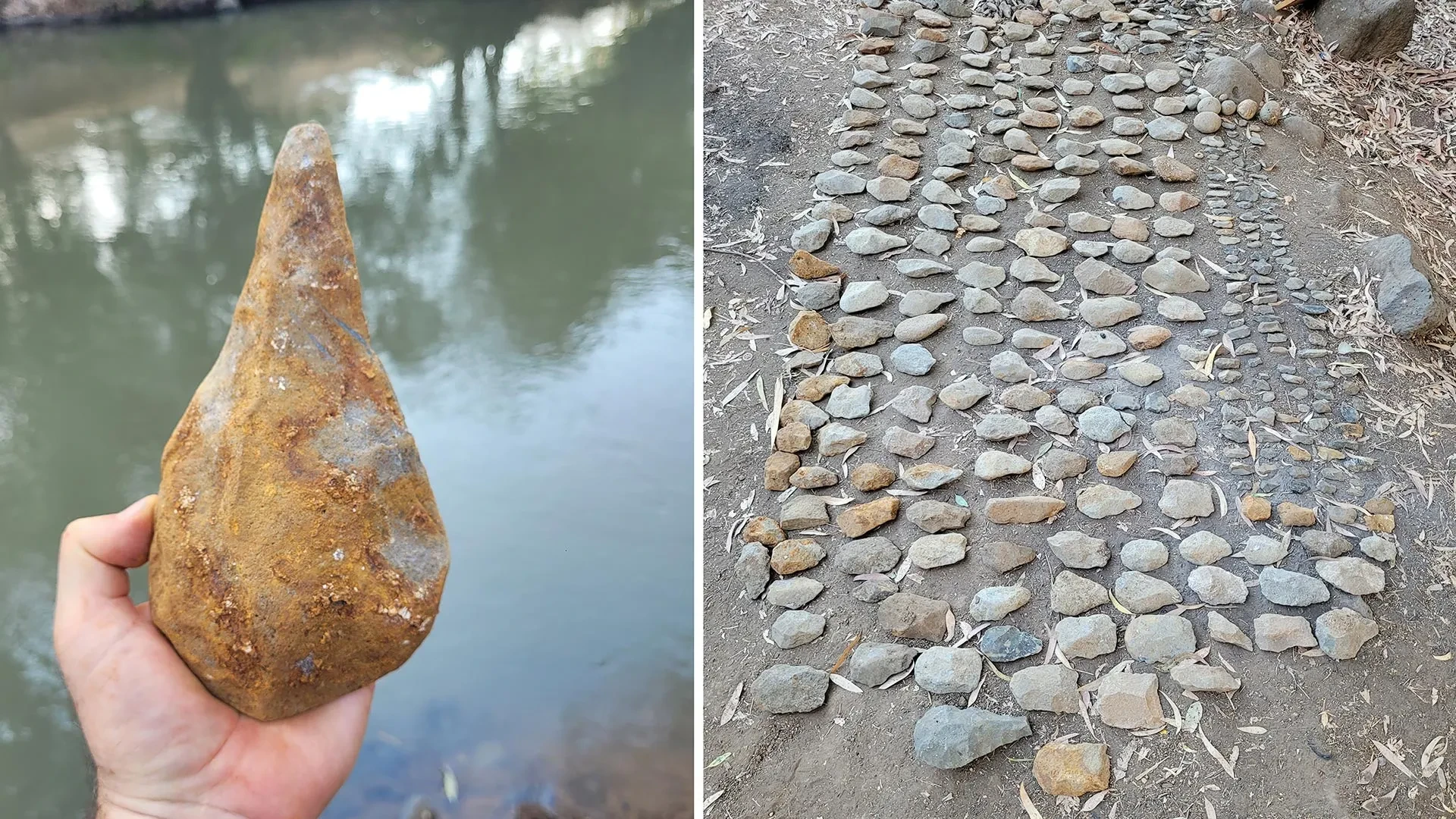
The groundbreaking discovery originates from Gesher Benot Ya’aqov, frequently abbreviated as GBY-NBA, a globally significant archaeological site where early humans manufactured sophisticated stone tools hundreds of thousands of years ago. At this rich site, fossilized elephant remains were unearthed alongside masterfully chipped handaxes and heavy-duty cleavers crafted from basalt, a dark volcanic rock formed from cooled lava flows. These implements belong securely to the Acheulian stone tool tradition, recognized by historians and archaeologists alike as one of the oldest, most enduring, and most widespread stone tool technologies in human history.
The comprehensive research project, which has now been published in the academic journal Quaternary Science Reviews, was spearheaded by Hannah Farrell, a dedicated PhD candidate at the University of Haifa. The interdisciplinary research team closely examined a large elephant molar alongside several fragments of fossilized tusk recovered from Gesher Benot Ya’aqov—a name that translates to the Daughters of Jacob Bridge. The site is situated strategically within the Jordan Rift Valley, just south of today’s fertile Hula Valley. The extensive excavations at the site were led by Prof. Gonen Sharon of Tel-Hai University, located in Kiryat Shmona in the Galilee, alongside his esteemed colleagues and archaeological collaborators.
A Giant Elephant Tooth Reveals a Lost Prehistoric World
The fossils analyzed in the study belonged to Palaeoloxodon antiquus, an extinct species commonly known as the straight-tusked elephant. This enormous prehistoric animal was undeniably among the largest land mammals of the Pleistocene, the sprawling geological epoch that encompassed the most recent series of global ice ages and profound climatic fluctuations. Standing taller than modern African elephants and armed with distinctive, slightly outward-curving tusks, these megafauna dominated their respective ecosystems.
Rather than focusing solely on the skeletal remains of the animal itself or treating the fossil as an isolated specimen, the scientists took a broader, more holistic approach. They treated the massive elephant tooth as a rich, biological archive recording the very world in which it lived and fed. Tooth enamel and dentin are known to preserve valuable chemical clues and stable isotopes reflecting an animal’s specific diet and immediate surroundings over the course of its life. By extracting these signals, researchers can investigate delicate environmental conditions that prevailed hundreds of thousands of years ago with surprising precision.
To uncover those hidden chemical and biological clues, the research team combined a robust suite of modern scientific techniques. Their methodology integrated advanced CT scans, detailed 3D digital reconstructions, microscopic examination of dental wear patterns, high-resolution isotope geochemistry, and comprehensive pollen analysis. State-of-the-art computed tomography imaging allowed the team to peer safely into the internal structure of the fossil without causing damage, while chemical measurements and microscopic wear evidence helped construct a vivid, multifaceted picture of the ancient habitat.
The results derived from this multi-pronged analysis pointed toward a remarkably persistent and stable landscape. The data revealed an ecosystem containing a diverse mosaic of woodlands, open grasslands, sprawling marshes, flowing rivers, and shallow bodies of water. Stable carbon and oxygen isotope measurements strongly suggested that the giant elephant lived in a well-watered environment featuring a dependable, year-round water supply. Meanwhile, microscopic pollen grains preserved securely in nearby sediment layers revealed a rich variety of wetland and riparian plants, including reeds, sedges, willow trees, tamarisk, and various forms of lush aquatic vegetation.
Together, these varied findings suggest that the region offered an exceptionally diverse and biologically productive environment. It was a landscape fully capable of simultaneously supporting massive herbivores like giant elephants alongside foraging communities of early humans who required reliable game, plant foods, and fresh water.
An Ancient Oasis Along a Crucial Human Migration Route
The geographic location of this reconstructed prehistoric landscape makes the discovery particularly significant for evolutionary anthropology and Pleistocene archaeology. The Hula Valley lies directly within the Levantine Corridor, a natural geographical passage bridging the continents of Africa and Eurasia. For hundreds of thousands of years, this corridor served as a critical superhighway that profoundly influenced the movements and dispersals of ancient human populations and migrating fauna alike.
Researchers believe that the area functioned historically as a relatively stable ecological refuge. By maintaining vital habitats, dependable food sources, and predictable resources over long evolutionary periods, the valley acted as a biological haven. Its interconnected rivers, extensive wetlands, shaded forests, and open grasslands would have provided reliable sources of fresh water, abundant edible vegetation, and rich animal life for traveling groups of hominins passing through the region.
For these early human groups, having access to such resource-rich environments could easily have meant the difference between successfully surviving in an unfamiliar and potentially hostile landscape or perishing due to resource scarcity. Understanding the nature and distribution of these ancient habitats may therefore help explain the long-standing mysteries of how ancient human groups navigated through the region, sustained their populations, and adapted dynamically to changing climatic and environmental conditions over deep time.
According to Prof. Sharon, understanding how ancient humans and contemporary wildlife responded to environmental change hundreds of thousands of years ago provides vital context for humanity. It helps modern researchers better comprehend the deep-seated ecological forces that ultimately shaped our own species and its capacity for global dispersal.
The findings highlight the profound importance of studying ancient landscapes hand in hand with the physical fossils and stone artifacts recovered from them. By reconstructing the ancient environments that actively supported prehistoric life, modern researchers can gain a much clearer, more nuanced understanding of the environmental pressures and opportunities that influenced early human survival, technological innovation, and migration.
The availability of water, diverse vegetation, and rich animal resources directly shaped where both humans and wildlife could establish themselves and survive, Sharon notes. He emphasizes that the ancient wetlands, rivers, and woodlands of the Hula Valley helped sustain life along one of the world’s very earliest migration corridors. This unique ecological snapshot offers contemporary researchers a rare opportunity to understand the exact environmental conditions that supported both massive animals and human populations nearly 700,000 years ago.
The successful study was made possible by bringing together specialists from several prominent Israeli academic institutions. Farrell of the University of Haifa conducted the core research utilizing archaeological and paleontological material recovered from the site originally excavated by Sharon and his dedicated field colleagues. Additional essential collaborators on the project included Cheryl A. Makarewicz, who spearheaded the isotope studies, and Nimrod Marom, who oversaw the archaeozoological analysis, both representing the University of Haifa. They were joined by Minji Jin and Dafna Langgut of Tel Aviv University, who lent their expertise to the detailed pollen analysis that brought the ancient flora of the Hula Valley back to life.