
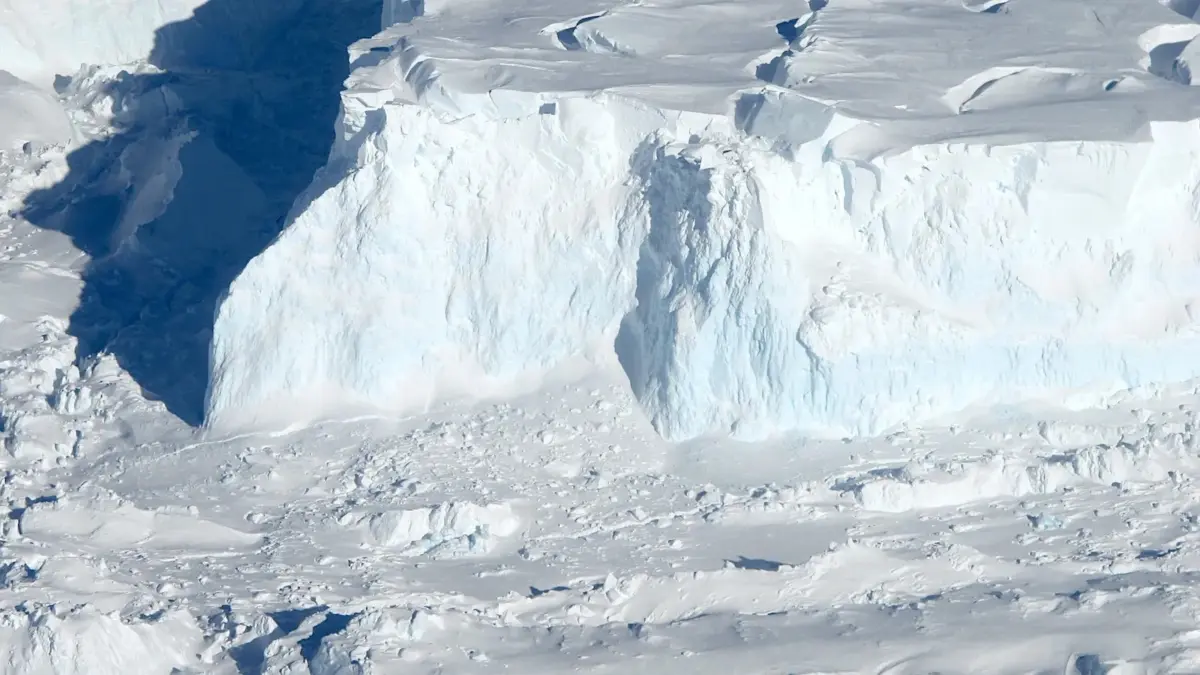
A single colossal glacier sitting at the bottom of the world may be all that is currently holding back catastrophic amounts of global sea level rise. As it melts away faster than ever recorded in modern history, scientists are racing to get a better understanding of when it might fundamentally fail. Unfortunately, recent research has brought to light even more alarming news regarding its structural stability and its potential impact on coastlines worldwide.
The Antarctic bulwark known as Thwaites, often referred to by glaciologists and the public alike as the "Doomsday Glacier," is gargantuan. Roughly the size of the state of Florida, it holds an immense volume of ice—enough on its own to push the planet’s global coastlines up by approximately two feet. But the edge of Thwaites performs an even more critical mechanical role: it acts as a massive cork, holding back the rim of the broader West Antarctic ice sheet, much of which actually sits well below sea level.
As Thwaites deteriorates, more ice in this vast interior bowl becomes directly exposed to the warming ocean. This dynamic creates a dangerous feedback loop that accelerates melting across the entire region. If Thwaites were to succumb entirely to these pressures, the whole interior of the ice sheet might follow suit, unleashing enough water to raise global sea levels by as as much as 10 feet.
It has long been easy to track the physical demise of Thwaites from space using satellites, but predicting its future behavior has proven significantly trickier for researchers. For years, the complex computer models used to simulate the retreat of Thwaites simply were not able to pass a basic reliability test: they could not accurately re-create the physical retreat that satellites have captured over the last few decades. This shortfall rendered them unreliable tools for looking far ahead into the future.
However, scientists have finally plugged in a major missing piece of this complex climatic puzzle. A new paper, published in the journal Nature Communications earlier this month, appears to be the first of its kind to accurately account for what is happening underneath Thwaites in order to simulate how quickly it may lose ice over the coming decades. Using this enhanced model to simulate the future paints a grim picture, suggesting that Thwaites could contribute twice as much to global sea level rise by the end of the century as previously projected by older scientific models.
"There are many other unknowns, but this solves a specific and very important piece of the puzzle," said Mattia Poinelli, a glaciologist at the University of California, Los Angeles, and the lead author of the newly published paper.
The primary problem area lies where the icy underbelly of Thwaites rests directly upon the seabed, a region known to scientists as the grounding zone. Only relatively recently did researchers realize that this critical zone is not a fixed boundary, but rather a dynamic frontier that oscillates back and forth with the ocean tides. As the glacier bobs up and down with the changing tides, warm ocean water manages to push underneath the massive ice structure, creating stress fractures and miles-long channels that allow for even more aggressive melting from below.
Previous simulations of how Thwaites might melt over time failed to account for this tidal dynamic, Poinelli explained. By incorporating these mechanics, his team’s updated model was finally able to match the structural changes to the glacier that satellites had previously observed in reality. The simulation also revealed that Thwaites could become permanently unpinned from the seafloor as early as 2038, with a 60 percent chance that this pivotal unpinning could happen by the end of the century. Such an eventuality would likely cause the rate of melting to ratchet up even more dramatically.
If the global climate remains only as warm as it is today, the updated model shows that Thwaites would still be on track to add three centimeters of sea level rise by the close of the century. While that figure may not initially sound like much, it actually doubles the projections made by previous scientific models, according to the study. Historically, Thwaites already contributes about 4 percent to global sea level rise. Over the past three decades alone, that contribution amounts to some 10 centimeters of overall sea level rise.
That seemingly modest amount has already proven devastating in many parts of the world, proving to be enough to have sent homes in coastal North Carolina crashing into the sea, while forcing vulnerable coastal communities in places like the Solomon Islands and Senegal to abandon their ancestral lands and move to higher ground.
Of course, global warming is not holding steady at current levels; rather, it continues to ramp up across the globe, with each passing decade widely expected to be significantly hotter than the one before it. As a direct result of this ongoing warming trend, the world should brace itself for even more ice melt than the model currently predicts, Poinelli warned.
This raises a critical question for humanity: What if governments and societies actually get their act together to significantly slow down climate change, or successfully find a way to safely cool the world’s oceans through atmospheric or marine geoengineering?
A separate study, published in Geophysical Research Letters in July, utilized a different advanced model to test this exact kind of hypothetical scenario involving Thwaites and its comparably massive neighbor, the Pine Island glacier, which currently stands as the fastest-melting glacier in all of Antarctica.
Together, Thwaites and Pine Island account for the overwhelming bulk of sea level rise originating from the Antarctic ice sheet. Because ocean-driven melt is universally recognized as the primary culprit behind their retreat, the researchers testing this scenario decided to "switch it off completely" within their model. This radical step was taken as a way of understanding the underlying structural condition and resilience of each individual glacier, explained Rosie Williams, an ice sheet modeler at the British Antarctic Survey and lead author of that paper.
Despite all their geographical similarities, the study revealed that Pine Island and Thwaites would respond in drastically different ways to such an intervention. Under cooler ocean temperatures, Pine Island would theoretically be able to recover a significant amount of ice within a decade, and would eventually regrow to roughly where it stood 80 years ago. This relative resilience is due in part to its relatively intact outer shelf, which provides structural support.
Thwaites, on the other hand, would keep losing ice and raising sea levels worldwide for at least another 150 years even if ocean melting were entirely halted. The researchers hypothesize that this stark difference is because Thwaites is in a vastly worse structural condition overall, with its eastern half significantly diminished and its western half already disintegrated into a chaotic field of separate icebergs. While the physical speed of ice loss would undoubtedly slow down under cooler conditions, the glacier may effectively be doomed even in this fictional, highly optimistic best-case scenario.
Yet, experts emphasize that this grim reality does not mean humanity is entirely powerless. "That doesn’t mean there’s nothing we can do," Williams noted. Every single fraction of a degree of avoided global warming makes a tangible difference in how quickly Thwaites ultimately disintegrates, and aggressively lowering global greenhouse gas emissions could still protect many other vital glaciers scattered across the vast expanses of Antarctica.
"The more we can slow it down," she added, "the longer we have to adapt to any change that’s coming."