
For more than four decades, hot hatchbacks have served as the quintessential entry point for automotive enthusiasts, offering a compelling blend of affordability, everyday practicality, and engaging driving dynamics. In the United States, these nimble, front-wheel-drive or all-wheel-drive runabouts have built a fiercely loyal following. However, the contemporary automotive landscape has shifted dramatically, with mainstream buyers increasingly favoring crossovers—often described colloquially as hatchbacks on stilts.
This market pivot has squeezed the traditional hot hatch segment. Today, buyers seeking a genuinely affordable hot hatchback have a dwindling selection. The market is largely anchored by the Volkswagen GTI, which remains an excellent, ubiquitous, though admittedly somewhat subdued daily driver, alongside the Mini Cooper S, which has evolved to become somewhat less driver-focused than its predecessors.
Stepping up the budget unlocks more hardcore contenders, such as the aggressive Toyota GR Corolla and the track-capable Honda Civic Type R. Yet, while these modern machines are undeniably fast and competent, they often lack a certain eccentricity—an injection of pure personality and unmistakable flair. For enthusiasts seeking a truly unhinged piece of automotive history that breaks the mold of conventional design, the current automotive market rarely delivers.
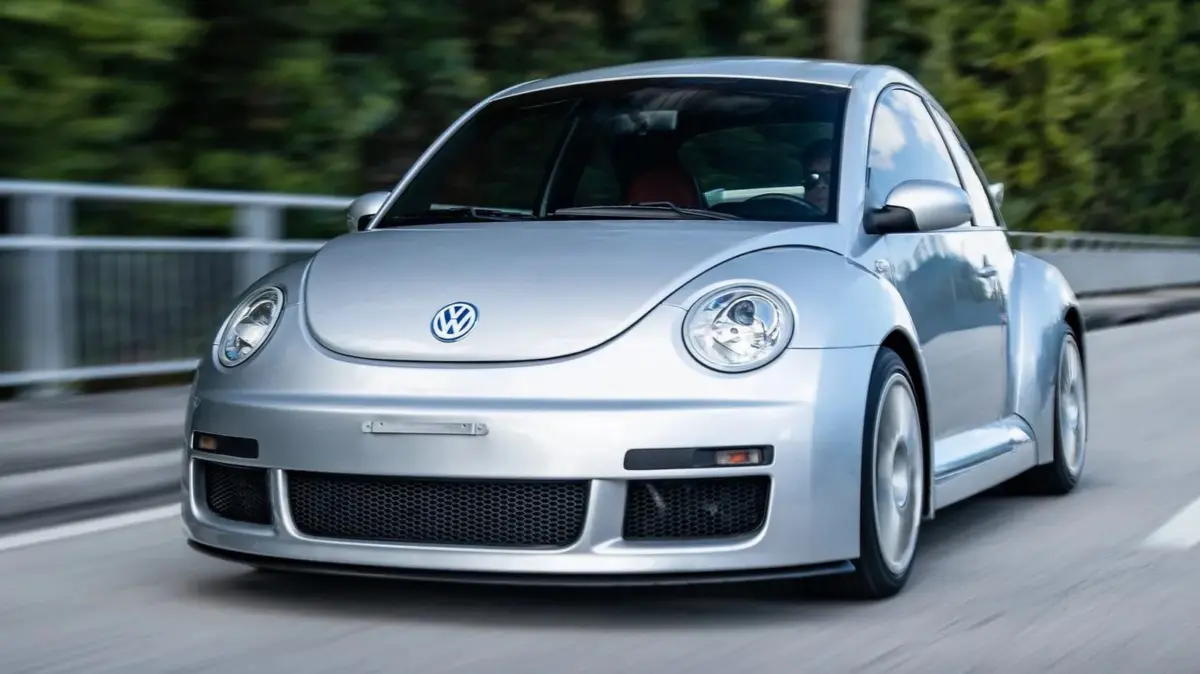
Fortunately, the used and collector market occasionally remedies this void. A pristine, incredibly rare 2001 Volkswagen Beetle RSi has surfaced on Bring a Trailer, offering a potent reminder of an era when automakers were willing to take wild, eccentric design and engineering gambles.
For budget-conscious enthusiasts, however, this bullish Beetle is entirely out of reach. With a strict production run of just 250 units worldwide, the Volkswagen Beetle RSi is neither cheap nor remotely accessible for the average car buyer. Yet, measured purely by its charisma, presence, and engineering provenance, it towers above almost any modern hot hatchback on the road.
At the heart of the Beetle RSi is a naturally aspirated 3.2-liter VR6 engine. This charismatic powerplant churns out a healthy 221 horsepower and 236 lb-ft of torque, routing its power through a traditional six-speed manual gearbox to all four wheels via Volkswagen’s pioneering 4Motion system. For purists and collectors alike, this combination cements the Beetle RSi as the ultimate production Beetle ever conceived, blending a uniquely configured layout with the mechanical soul of Volkswagen’s most celebrated era of performance engineering.
How can you put a price on something this special?
To understand the significance of the Beetle RSi, one must look back at its development. The car served effectively as an advanced testbed for the legendary Golf R32, which would soon introduce the same formidable VR6 powertrain and all-wheel-drive system to the more conventional Golf hatchback. But unlike the R32, which blended into traffic with relative sleeper status, the limited-run Beetle RSi was wrapped in an aggressive, unapologetically racy aesthetic package.
On the outside, the RSi borrows heavily from the New Beetle Cup race cars that once populated dedicated support series in Europe. Its muscular stance is achieved through a bespoke bodykit that dramatically alters the car’s proportions, stretching outward to cover a track that is 1.8 inches wider at the front and 2.32 inches wider at the rear. The aggressive exterior restyling features a square-jawed front bumper designed to feed cooling air to the engine bay, a striking and dramatic twin-spoiler setup at the rear, and a functional rear diffuser that houses a Remus twin-pipe exhaust system.
Filling out those prominently flared wheel arches are a set of iconic 18-inch OZ Superturismo wheels wrapped in sticky 235/40ZR tires. Underneath the skin, the RSi benefits from a specialized, track-tuned, four-wheel independent suspension setup that elevates its handling capabilities far beyond the standard New Beetle upon which it is based.
Unlike many special-edition vehicles that limit their upgrades to superficial body kits and unique badges, the Beetle RSi’s transformation runs deep into the cabin. The interior is clad in materials that were considered cutting-edge for a production car in the early 2000s, including extensive use of genuine carbon fiber and polished billet aluminum trim pieces. Front-seat occupants are held firmly in place by heated, hard-back carbon-fiber Recaro racing bucket seats, which are finished tastefully in striking, contrasting Tropical Orange leather to break up the dark cabin environment.
In the pursuit of transforming a cheerful economy car into a focused track machine, however, the Beetle RSi had to make a few sacrifices. Most notably, the high-performance conversion process meant deleting the standard New Beetle’s charming dashboard-mounted "bud vase"—a whimsical flower holder that had become a defining signature of the quirky modern Beetle’s interior design language.
This specific example represents chassis number 176 of the strict 250-unit production run. Originally registered and driven in Japan before making its way to the United States with a clean Florida title, this particular Beetle RSi is remarkably well-preserved. Its odometer displays just 18,000 kilometers, translating to roughly 11,000 miles of total use.
When it was new in 2001, the Beetle RSi carried an astronomical price tag of around £50,000, which translates to well over $131,000 in today’s inflation-adjusted dollars. Because of this prohibitive original cost and extreme rarity, public sales of the RSi are exceedingly scarce, leaving collectors with few recent benchmarks to gauge market value.
With a week remaining on the auction clock, bidding for this pristine, low-mileage example has already climbed past $86,000. The strong bidding activity demonstrates that automotive enthusiasts and collectors remain willing to pay top dollar for the rare privilege of owning what is undeniably the ultimate performance Beetle ever built. Whether the next custodian chooses to preserve it statically in a private collection or stretch its VR6 legs on an open backroad, this eccentric German machine remains a high-water mark for factory-backed automotive absurdity.