
Some losses in life refuse to conform to the tidy, linear narratives of adversity overcome. We are often told that grief is a process with a clear beginning, middle, and end—a journey that leads inevitably to a state of healing or "moving on." But for many, the reality is far more fragmented. How does one keep moving forward without the pretense of having left those difficult chapters behind? It is a question of existential weight, yet it served as the poignant, philosophical foundation for the latest collection from Oude Waag designer Jingwei Yin.
Drawing on a particularly challenging period in his own life, Yin sought to trace a gradual, non-linear shift from the rigid emotional armor we construct for protection toward a state of mind that is more open, vulnerable, and accepting. It is a fragile concept that could easily have tipped into the realm of solemnity or performative melancholy. However, the collection proved remarkably persuasive precisely because it allowed opposing impulses to play off one another. There was no forced reconciliation here, no desperate push for a happy ending; instead, there was an honest exploration of the tension between holding on and letting go.
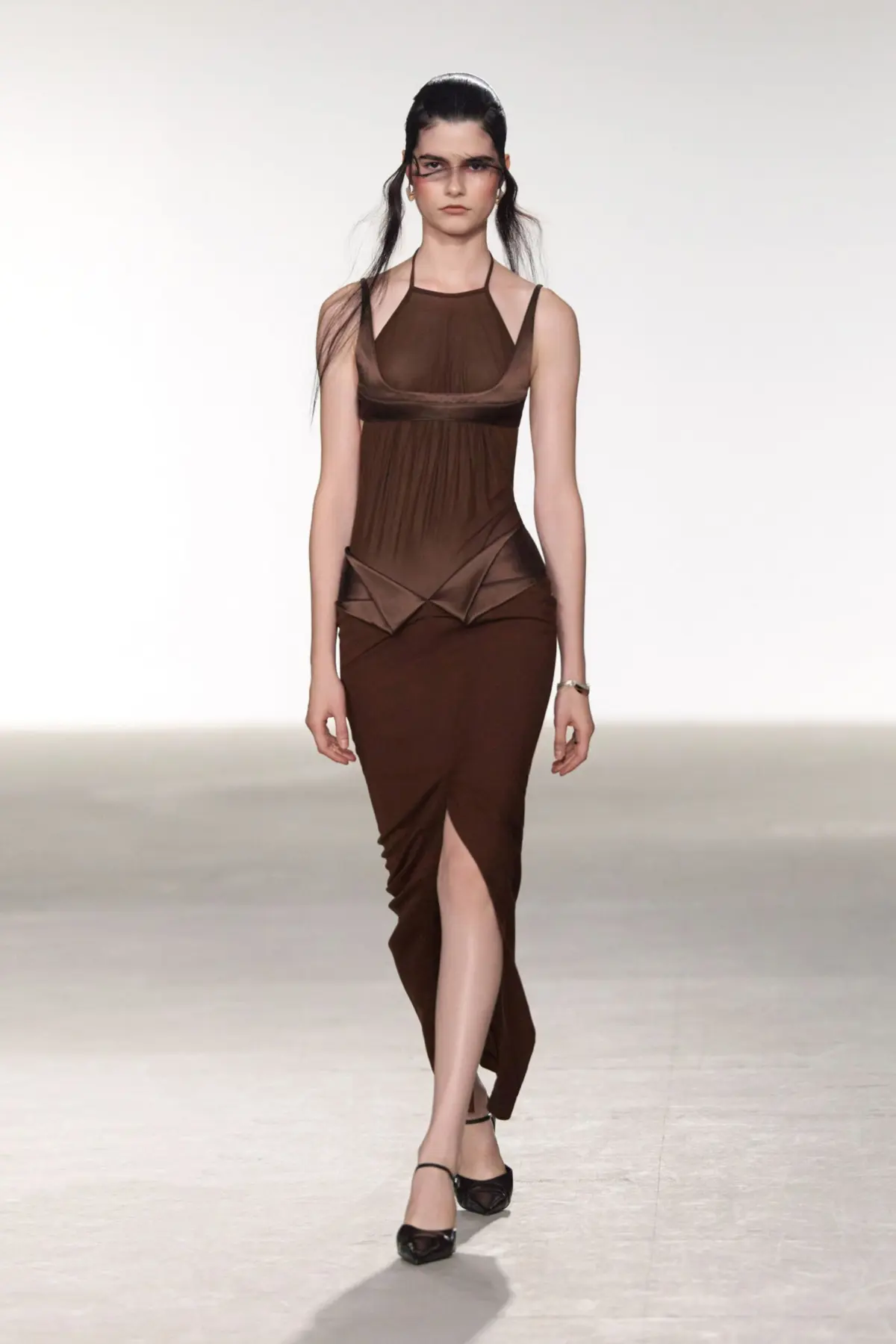
The visual language of the runway reflected this internal dialogue through a deliberate study in contrasts. Sharp, architectural tailoring and neat, controlled contours met the soft, ethereal pull of liquid draping and floating chiffon. These silhouettes were punctuated by washed, timeworn surfaces, suggesting that the garments—much like the people who wear them—have lived through something. The interplay between these textures lent the clothes a deep sense of sensuality, one that felt most intriguing when the structural integrity of the construction gave the delicate fabrics real substance and allure.
Yin, a designer known for his thoughtful and sophisticated approach to garment-making, brings a rich pedigree to his work. Having previously worked under the tutelage of Haider Ackermann, Yin clearly absorbed the master’s legendary ability to manipulate fabric around the human form. Yet, Yin’s perspective is distinctly his own, rooted in a synthesis of disparate traditions. "I see a connection between draping and the flat-cutting techniques of Eastern and Japanese design," Yin explained following the show. "I try to bring these approaches together in a modern way. Draping is a form of drawing, even sculpture, requiring the eye, mind, and hands to work as one."
This hands-on methodology was evident in every look that traversed the runway. The garments displayed an elaborate yet fluid technicality, with fabrics intricately knotted, twisted, and gathered around the body as if they were being molded in real-time. This technique created a sense of movement that felt both intentional and spontaneous. To further complicate the narrative, Yin introduced ink-splash prints, inspired by the pomo technique of traditional Chinese ink painting. These prints served as a deliberate disruption, introducing an element of chance and unpredictability into an otherwise highly calibrated composition. It was a visual metaphor for the chaos that grief or significant life changes can inject into a structured existence.
The color palette began in a place of muted introspection—earthy browns and soft, shadowy grays that suggested a quiet, perhaps guarded, state of being. However, these somber tones eventually gave way to a sudden, striking slash of crimson. It was not a grand, theatrical declaration of total recovery, but rather a subtle suggestion of a renewed appetite for life. The color acted as a pulse, a flicker of vitality that persists even when the underlying narrative remains unresolved.
What made the collection so compelling was its refusal to promise the audience a neat, sanitized version of healing. It acknowledged, with grace and maturity, that life rarely proceeds in a straight line. The clothes were at their most convincing when they gave physical form to that realization, allowing for contradictions, loose ends, and unexpected turns without feeling the need to spell everything out for the observer. By avoiding the didactic, Yin allowed the audience to project their own experiences onto the fabric, creating a quiet intimacy between the clothes and the viewer.
This focus on the internal experience of the wearer is a hallmark of Yin’s design philosophy. When asked about his enduring interest in the feminine form and the narratives he constructs for his collections, he spoke with an appreciation for the complexities of the human condition. "I love women’s complexities," Yin said. "But above all, I’m drawn to their mystery."
That sense of mystery was woven into the very seams of the collection. By centering the work on the idea that we do not have to "solve" our losses, but rather learn to carry them with a more open heart, Jingwei Yin has created a body of work that feels both timely and timeless. He captures the beauty of the in-between—the space where we are neither fully armored nor fully exposed, but simply present. In the world of high fashion, where the pressure to innovate often leads to a constant pursuit of the new, Yin’s work serves as a reminder that the most profound design is often that which dares to reflect the messy, beautiful, and often contradictory nature of being human.
As the final models walked the runway, the lack of a traditional, triumphant finale was telling. There was no "all-clear" signal, no sudden transformation into something unrecognizable. Instead, the collection ended as it began: with a quiet, persistent elegance that suggests that while the narrative of loss may not have a tidy arc, it is something that can be navigated with style, sensitivity, and, ultimately, a sense of quiet resilience. The work of Oude Waag continues to prove that fashion is not merely about the clothes we wear, but about the stories we choose to tell ourselves about who we are and what we have survived. For Yin, the clothes are a vessel for those stories, a sophisticated, draped, and knotted reminder that it is possible to hold onto our history while still allowing ourselves the room to move forward.