
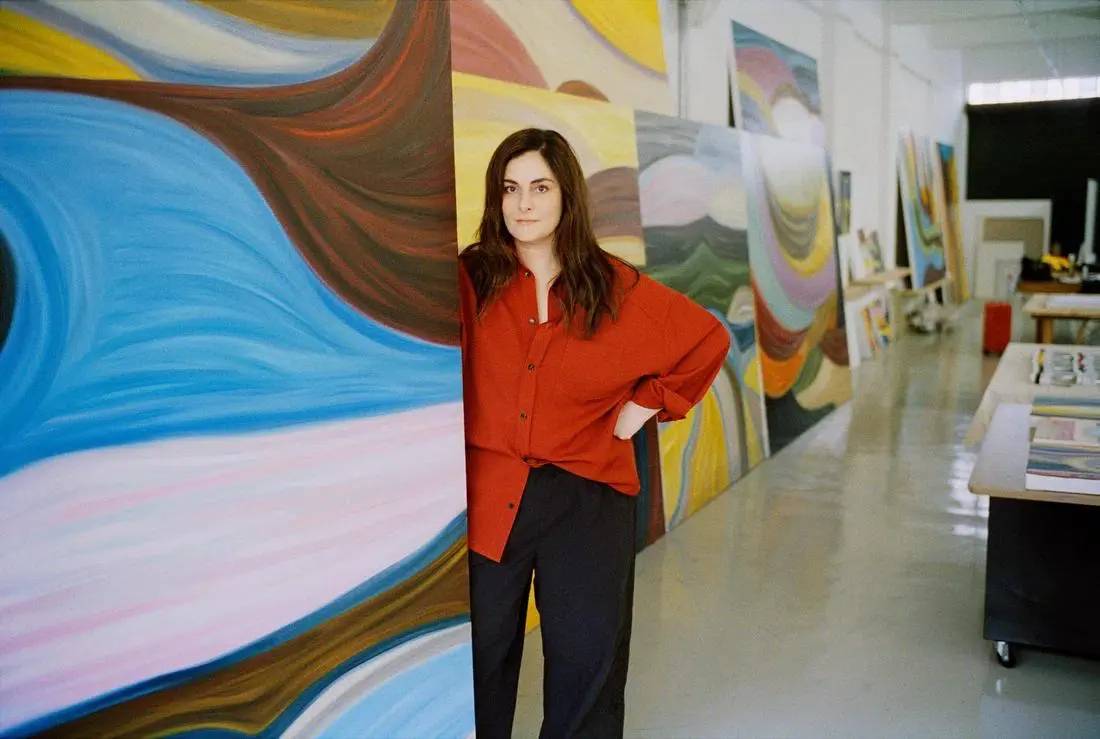
Amid the high-octane atmosphere of Frieze London, where the air is often thick with the clinking of champagne flutes and the urgent whispers of art market negotiations, Brazilian abstract artist Marina Perez Simão has orchestrated a deliberate departure from the fair’s frantic pace. Within the sterile, white-walled confines of the Pace Gallery booth, Simão has constructed what she describes as a "spaceship"—a sanctuary for quiet contemplation that asks visitors to slow down and physically engage with the nuances of light, pigment, and form.
The installation, a precisely curated assembly of 11 new canvases, marks a significant shift in Simão’s practice. The works are organized into a strict color-coded taxonomy: three canvases dominated by deep, complex blues, three by ethereal grays, and five by a striking, vibrant magenta. The booth itself is configured in the shape of an "X," a structural choice that dictates the flow of human traffic through the space. With two blue paintings on either side, a stabilizing gray anchor in the center, and two additional canvases placed strategically on the periphery, the booth invites guests to enter through the central axis or navigate the flanks, creating a sense of movement that mirrors the fluidity of her brushwork.
"The structure is super open and closed at the same time, but there’s also a sense of discovery depending on which side you walk through," Simão explained in a recent interview with ARTnews, speaking from her studio in São Paulo.
For the artist, this exhibition is less about the transactional nature of the art fair and more about creating a meditative environment where the viewer is forced to confront the tactile reality of the object. She encourages visitors to approach the canvases with an intimacy that is increasingly rare in an era dominated by the rapid, two-dimensional scrolling of social media feeds. These paintings, she says, are "more or less vague descriptions of strange worlds," each possessing its own distinct "nature and behaviors."

Simão’s work occupies a liminal space between pure abstraction and the suggestion of landscape. Her process is an attempt to translate the overwhelming complexity of the natural world—a "big, complex and vast organism that we don’t fully understand"—into a visual language that can bridge the gap between human experience and the inexplicable. By stripping away the representational, she allows the viewer to project their own sense of discovery onto the surfaces.
"Nature is a big, complex and vast organism that we don’t fully understand how it works, art is a way to approach these things that are difficult to explain," she noted.
This emphasis on the physical experience is central to her current philosophy. In an age where digital documentation often flattens the artistry of a work, Simão is adamant that the viewer must be physically present to appreciate the subtle, layered materiality of her oil on linen canvases. She deliberately eschews the use of varnish, a choice that preserves the raw, matte surface and allows the viewer to see the minute imperfections of the paint. These textures, she argues, are the "skin" of the painting, and they are essential to understanding the work’s integrity.
The current body of work, which she began developing at the start of this year, represents a marked evolution in her aesthetic. While her previous work was characterized by a riotous, high-contrast palette—often featuring sky blues set against grass greens or searing reds paired with punchy oranges—the new pieces are markedly cooler. They draw their intellectual and tonal inspiration from a diverse range of historical sources, most notably the melancholic depth of Pablo Picasso’s Blue and Rose Periods and the delicate, spiritual application of pinks found in the frescoes of Fra Angelico.

The choice of magenta, in particular, was a rigorous process of elimination for the artist. "Pink is a difficult color because when you look at mass culture, there’s Barbie pink, bubblegum pink, and cotton candy pink," she said. "I didn’t want all these industrial pinks and their associations." Instead, she opted for a specific, modulated magenta that she could manipulate to mimic the organic, earthy tones she observes in the natural world.
The blue paintings presented a different set of challenges. Simão worked with pigments straight from the tube to leverage their inherent intensity, occasionally utilizing a touch of white for subtle tinting. However, the complexity of her layering—mixing cobalt with cerulean to achieve a shift toward greenish undertones—has made these works notoriously difficult to document. "The blue paintings are almost impossible to photograph," she admitted. "We had to do three sessions of photographing as the pigments change so much."
The gray works serve as the bridge between these two emotional poles, blending the magenta and the blue to create a neutral yet deeply atmospheric result. By layering hints of yellow and ocher beneath the initial coats, she has imbued these surfaces with a hazy, luminous quality, reminiscent of the way light fractures when thick fog rolls in front of the sun. In her conceptual framework, the blue canvases represent the warmth of a summer day, while the pinks evoke the crisp, biting cold of winter. Together, the collection functions as a cyclical, abstract representation of the seasons.
This move toward a more restrained and monochromatic palette is a continuation of a trajectory that began in 2024 with her exhibition Solanaceae at Pace’s Los Angeles outpost. Named after the scientific family of nightshade plants, that show introduced a darker, more shadowy element into her vocabulary, a silhouette that later resurfaced in her exhibition at the Mendes Wood DM gallery in Paris.

"I’ve been thinking about working with a limited color range [for a while] because color in my work is super important, and I wanted to study tonalities and limit myself, I’m always evolving," she said.
The preparation for Frieze London necessitated a complete transformation of her working routine in São Paulo. To maintain the purity of her vision, Simão removed any object or material from her studio that featured an extraneous color, effectively creating a vacuum in which to focus on these specific tones. She returned to her preferred, almost ritualistic way of working—painting while standing, unshod, in the quiet space by her terrace window.
"I paint standing up and in my socks. I don’t use chairs and sometimes I sit on the ground. These paintings required my body to be engaged," she reflected. By eschewing the comforts of the studio—the chairs, the tools, the distractions—she forced her physical self to align with the rhythms of her canvases.
As guests navigate the X-shaped booth at Frieze, they are essentially walking through the artist’s own focused, physical labor. Whether they are drawn to the cool, quiet depths of the blue, the structural stability of the gray, or the organic intensity of the magenta, the exhibition demands a suspension of the fair’s inherent transactional energy. In the heart of London’s busiest art week, Marina Perez Simão has succeeded in carving out a quiet, abstract corner of the universe, inviting us to stop looking at art and start seeing it.