
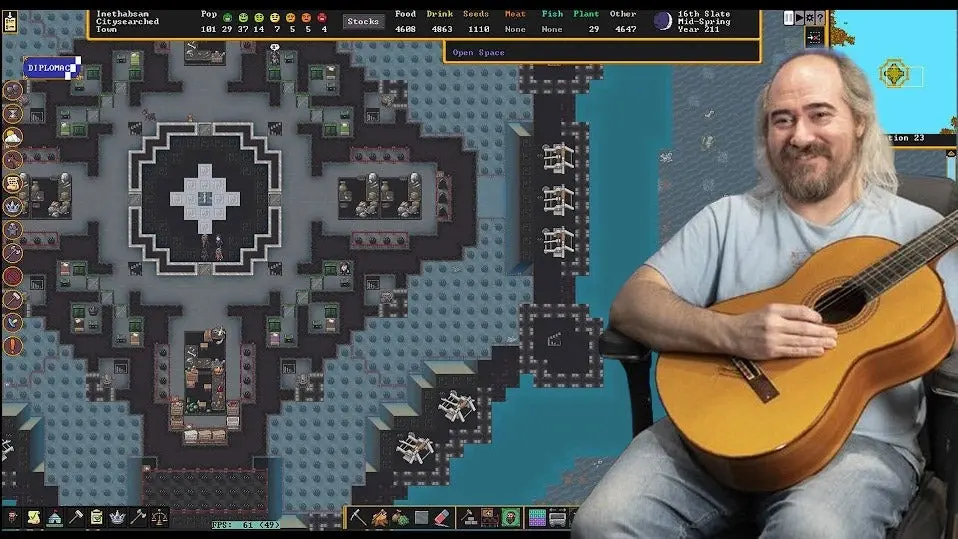
To speak with Tarn Adams is to encounter a rare sort of infectious optimism in an industry often defined by high-stakes pressure and corporate anxiety. Alongside his brother, Zach, Adams has been the architect behind Dwarf Fortress since 2002, a project that has evolved from a niche, text-based experiment into a global cultural phenomenon. Even after more than two decades of constant development, the passion he brings to the simulation remains undimmed. If anything, his excitement for the future of his world-generating engine is more profound than ever.
"There’s just so many cool things to work on when you’re writing a sort of expansive, scope-bloated simulation game," Adams explains. The "scope-bloat" he refers to is not a negative trait in his eyes, but rather the engine of his creativity. Currently, he is pouring that energy into the game’s latest evolution: procedurally generated magic systems.
For years, Adams has envisioned a "giant web of knowledge that relates to generated cosmological facts and some sort of mythological history." He describes the upcoming Myth and Magic update not merely as a set of mechanics, but as a deep, procedural narrative framework. When he discusses the mind-bending, chaotic interactions that this system will allow, it is clear that his love for the project is as vibrant as it was on day one. "That’s how art should be, right?" he muses. "I mean, I could be morose and stuff. I sometimes am, maybe when we’re talking about AI."
The AI Shadow and the "Vibe-Coded" Problem
The mention of Artificial Intelligence is the one topic that noticeably shifts the atmosphere of the conversation. While Adams has been a pioneer in procedural generation—essentially building his own forms of algorithmic intelligence for over twenty years—he finds the current obsession with generative AI deeply concerning. He notes a pervasive anxiety across the game development sector, where talented individuals fear being displaced by systems that, in his view, cannot yet replicate the nuance of human work.
Adams observes that this is a systemic issue extending well beyond gaming. "I have friends working in medical UI stuff; it’s also just sweeping through there," he says. "They’re like, ‘Are you using AI enough in your job? Can we fire these two people now and replace them with a robot?’ And it’s like, no, but then they do it anyway."
For Adams, the term "AI" has been tainted by the current gold rush. He has even changed his own vernacular to avoid the association, preferring to speak about "dwarf behavior" rather than "dwarf AI." He is adamant that he has no interest in integrating generative AI into the development of Dwarf Fortress. "I don’t think it would really boost my productivity at this point," he notes.
His critique of modern AI-assisted development is blunt, focusing on the quality of the output. "You can tell when you grab a ‘vibe-coded’ game and your computer fan starts spinning," he says, criticizing the bloated, inefficient nature of code generated by current models. "It’s not good enough. But even if it were, I’d still have reasons not to do it."
Adams does acknowledge one grim scenario where he might be forced to shift his stance, though it would be entirely against his will. If major distribution platforms like Windows were to mandate the use of generative tools to achieve visibility or compatibility—a "Copilot-ass thing," as he puts it—he would be forced to reconsider. "Because all my players are there," he explains. "And they can strongarm you; they’ve done it in the past with other stuff."
Limitless Possibilities in Simulation
Stepping away from the controversies of the industry, Adams’ natural enthusiasm returns the moment the conversation drifts back to the internal mechanics of his world. His design document is effectively a bottomless pit of potential. He speaks at length about his desire to implement a complex economic simulation and the introduction of boats, which would serve as a vital mechanism for the cheaper transfer of goods across the game’s sprawling, procedurally generated geography.
"It doesn’t close things off, it just adds more," he says of his iterative design process. "I’m excited about a great many things, the world’s an amazing place."

This appetite for complexity is exactly what has fueled the game’s longevity. When Dwarf Fortress launched on Steam in 2022 with a new graphical tileset, it addressed the single most requested feature from the community: a visual representation beyond the classic ASCII characters. The transition was a massive success, with the game selling nearly 500,000 copies in its first month and surpassing the one-million-copy milestone by April 2025.
The success of the Steam version has allowed a dedicated community to push the game’s boundaries even further. Adams is constantly surprised by the ingenuity of his players, noting that they have built fully functional, logic-based computers within the game. One of the most legendary examples is a computer powered entirely by vampires—creatures that live forever but grow increasingly frustrated by their inability to feed. Players have industrialized this, creating "vampire operating systems" by manipulating the game’s fluid and health systems.
"These things all spring up without any input or encouragement from me," Adams says. "I just watch it happen." This philosophy of player empowerment extends to the upcoming magic update, which is built on a Lua-based generator, inviting modders to create their own intricate, "weird" systems.
Sustaining the Ship
Despite the million-copy milestone, Adams remains pragmatic about the financial realities of running an independent studio. While the success of Dwarf Fortress has provided a level of security that was unimaginable during the game’s early years—specifically by covering healthcare and providing steady pay for a team of around 15 people—Adams avoids calling the studio "flush."
"It was enough to make us not worry about health care now, and it’s enough to continue paying artists and audio people, but not more," he clarifies. The costs of sustaining a professional operation are significant. With a core team of five, plus the support of Kitfox Games for marketing and publishing, and various external contractors for trailers and assets, the revenue is continuously reinvested into the project. "The money goes pretty quickly," he notes.

The business model of Dwarf Fortress also presents a unique challenge in the modern gaming landscape. With no microtransactions, no paid DLC, and a one-off purchase price of $30, the game relies on a steady influx of new players to keep the lights on. Adams acknowledges that the price point, which once felt substantial, carries less weight in today’s economy. While he suggests that some form of "navigating" the monetization model may eventually be necessary to keep the studio afloat, he remains committed to the principle that major updates should be free for existing owners.
For now, the focus is on growth through visibility. In an era where thousands of games are released annually, Adams and his team are in a constant battle for attention on Steam. "We’re just right at the threshold where we occasionally get a little pop-up," he says, referring to Steam’s algorithm-driven store features. "It makes a difference, because when we have a sale, we sell ten times as many copies as the normal background. So even if you’re on sale for a week, that’s two and a half months of business."
After years of surviving on donations through the Patreon model, the shift to a larger, more structured operation has been a journey of adaptation. Adams laughs when comparing his current role to his previous life, likening the studio to a pirate ship where the crew must be supported through every success. As long as the updates continue to draw in new players, he is content to keep the ship sailing into the infinite, procedural horizons of his own creation.