
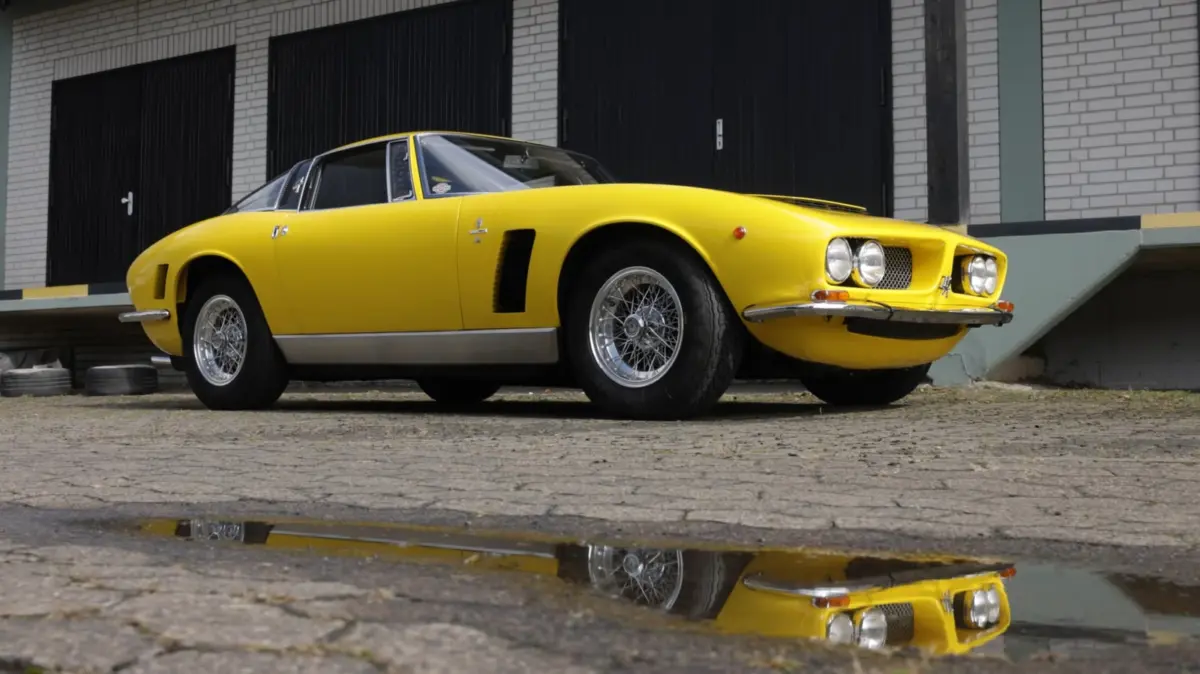
The Iso Grifo was not technically the first Italian exotic automobile to borrow its muscle from the United States. That hybridization of European styling and American firepower is a concept that has been executed on numerous occasions throughout automotive history, perhaps most notably in celebrated models like the Facel Vega HK500, the Jensen Interceptor, and De Tomaso’s fierce Mangusta and Pantera. However, automotive historians and enthusiasts would find it difficult to argue against the notion that the Iso Grifo executed this ambitious cross-continental marriage better than almost anyone else.
The low-slung grand tourer seamlessly combined drop-dead gorgeous Italian design lines with enough American brute force to leave even the fastest elite sports cars of the era struggling to maintain their positions on the open road. Across a near ten-year production run, only around 400 examples were ever manufactured before the automaker ultimately closed its doors for good. Yet, more than half a century after the Grifo first lifted its cover to reveal Giugiaro’s breathtaking curves at the 1963 Turin Motor Show, the car remains every bit as worthy of celebration today.
To fully understand this remarkable Italian exotic from decades long gone, it helps to examine the defining elements of its legacy. From the six-figure valuations these machines command in modern collector markets to how the Grifo’s heavy-hitting V8 engines stacked up against the legendary powerplants coming out of Maranello and Sant’Agata Bolognese, the Iso Grifo represents a fascinating chapter in high-performance automotive history.
The Iso Grifo Was Powered by Numerous American V8s
When buyers purchased a Ferrari 365 GTB/4 in period, they received a 4.4-liter Colombo V12, regardless of the model year. Lamborghini Miura buyers all received a 3.9-liter V12, and every Aston Martin DB5 rolled out of the factory equipped with a 4.0-liter inline-six designed by Tadek Marek. By comparison, Chevrolet Corvettes of the late 1960s were available with a multitude of small-block and big-block V8 engines, and the exact same flexible philosophy was true for the Ford Mustang and other iconic American performance models of the era.
Interestingly, while Iso was intentionally taking on the entrenched European elite, the boutique Italian manufacturer adopted not only an American heart for its flagship car, but also an American attitude regarding powertrain customization. Throughout the Grifo’s production run, buyers were given the choice of a wide range of engines to suit their specific driving preferences.
The base Grifo in Series I guise sported a Chevrolet-sourced small-block 327-cubic-inch engine, with factory output comfortably sitting between 300 and 350 horsepower. The option of an updated 350-cubic-inch Chevy small block was also integrated into the lineup for Series I cars as production progressed.
For later Series II vehicles built from 1972 onward, known internally as IR-8 cars, Ford stepped in to supply its 351 Cleveland powerplant, producing approximately 330 horsepower. These Ford-powered variants are exceptionally uncommon, with only 37 examples ever finding homes.
For those demanding extreme performance, big-block options arrived in the form of Chevrolet’s legendary 427-cubic-inch engine. This configuration unleashed up to 435 horsepower and 460 pound-feet of torque, channeled through a Tri-Power setup utilizing a trio of two-barrel carburetors. Certain models pushed boundaries even further by sporting a massive 454-cubic-inch Chevrolet engine, which saw horsepower outputs sitting at 395 alongside nearly 500 pound-feet of crushing torque.
Only 402 Examples Were Ever Made
While Iso clearly liked tackling certain aspects of vehicle production with an American mindset, other operational facets remained decidedly European in their approach. That traditional European philosophy was particularly evident in the company’s ultra-exclusive production numbers.
Naturally, with sky-high asking prices that placed the car far beyond the reach of the average consumer, the Iso Grifo was never intended to be a volume seller. Only 402 total examples were manufactured. Even though this production span stretched across nearly a decade—from 1965 through 1974—the low total demonstrates just how tiny Iso’s manufacturing capacity truly was.
That manufacturing history can easily be broken down into various distinct eras. In 1963, the very first prototype was displayed at the Turin Motor Show before the first production Series I cars hit public roads in 1965. A Targa open-top variant followed shortly after in 1966, and the thunderous big-block models made their inaugural public appearance in 1968. Series II cars featuring subtle stylistic updates debuted for the 1970 model year, followed by the arrival of the Ford 351C-powered cars in 1972.
Grifo production officially ceased in 1974 when Iso closed its corporate doors. It is widely acknowledged that the global Oil Crisis of 1973 heavily influenced the Grifo’s ultimate demise, although after a decade in action, the Grifo’s unique production run was likely nearing a natural conclusion regardless of external economic pressures.
Pinpointing exact historical production numbers remains a notoriously tricky endeavor for marque historians. Factory chassis numbers reportedly ran up to 412, but numerous cars were sent back to the facility over the years and substantially reworked. These modified cars received fresh chassis numbers during the process, which inevitably invites confusion into modern registry records. Today, automotive experts generally agree that the most accurate breakdown consists of 321 Series I cars, 79 Series II cars, and a pair of unique prototypes, culminating in that final figure of 402 units.
Iso Also Offered a Targa Version of the Grifo
While the Iso Grifo is overwhelmingly remembered as a sleek, low-slung, curvaceous fastback coupe, a select number of open-top models were also produced for sun-seeking clientele. The open-air lineage began with the Iso Grifo A3/L Spider Prototype, a stunning one-off vehicle proudly displayed at the Geneva Motor Show in 1964.
This specific prototype changed hands several times over the decades before eventually winding up in the possession of renowned collector Rudi Klein. It sat quietly inside his famous junkyard collection until it was finally brought to the open market and auctioned off by RM Sotheby’s, where it fetched a scarcely believable $1.875 million. At that exact same high-profile sale, a similarly weathered and dilapidated Series I Grifo coupe achieved $162,400, vividly demonstrating the immense financial premium placed on the Spider’s one-of-one prototype status.
Aside from that singular prototype, Iso went on to manufacture a total of 13 Series I Targa models, which took their mechanical motivation exclusively from the aforementioned Chevrolet small-block engines. During the subsequent Series II production run, just four additional Targa models were assembled, with these rare variants also boasting reliable Chevy small-block powerplants beneath their hoods.
The Grifo Offered Extraordinary Performance for the Era
Iso engineered far more than just a visually stunning machine when it developed the Grifo. Given its diverse range of high-displacement V8 engine options, the grand tourer was a genuinely formidable performer on both straight-line sprints and twisting country lanes.
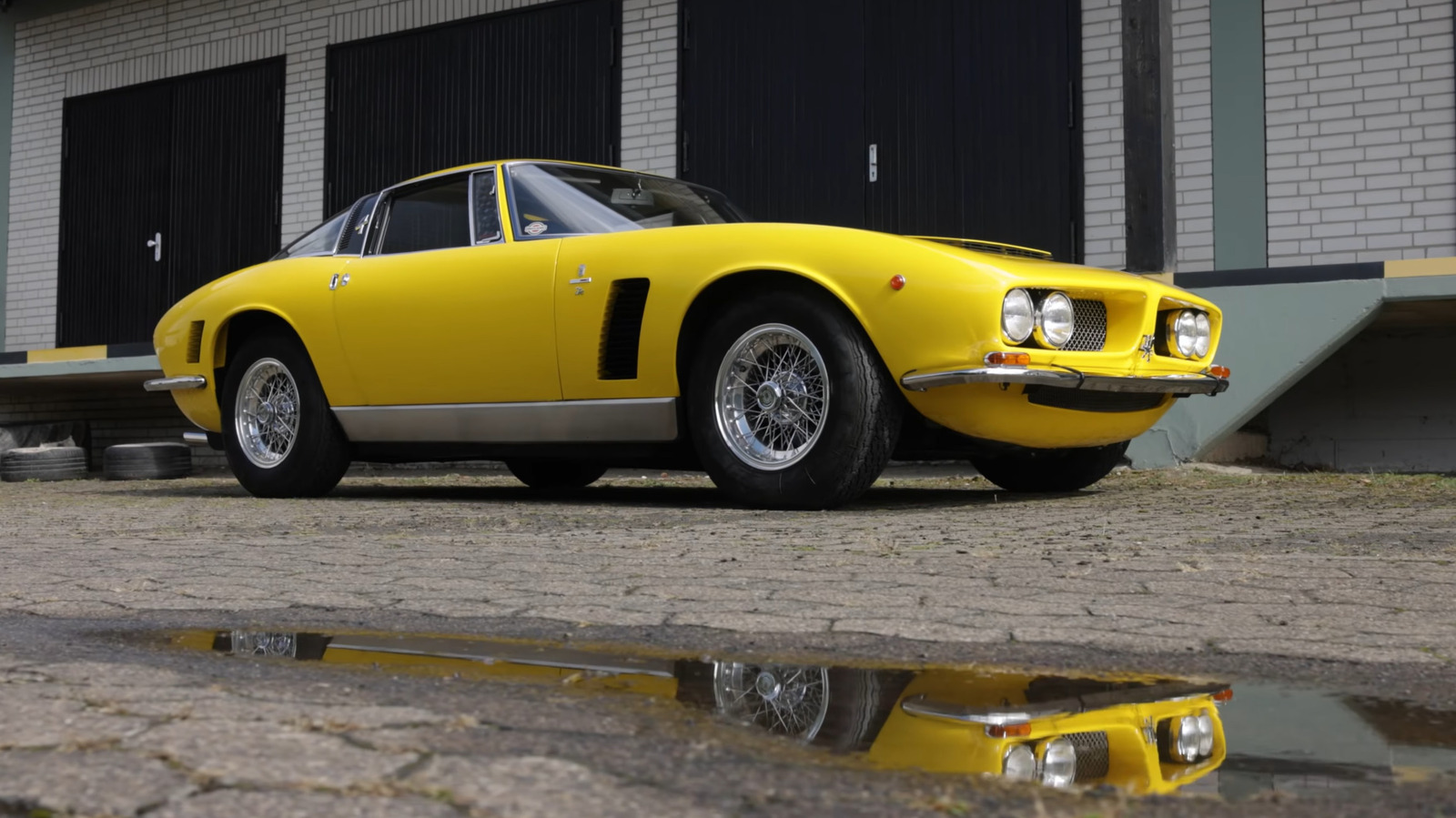
Period road test data confirms that even the earlier small-block-powered cars were a force to be reckoned with. They were capable of accelerating from zero to 60 miles per hour in 7.2 seconds, reaching 100 miles per hour in 19.4 seconds, and covering the standing quarter-mile in the low 15-second range. All of this performance was achieved while geared for a top speed comfortably north of 150 miles per hour. Notably, the British publication Autocar managed to record an impressive top speed of 161 miles per hour in a 327-powered Series I car—a performance benchmark that sat largely unchallenged until Lamborghini’s Miura arrived on the scene.
While those initial figures were undoubtedly respectable, they were not quite sprightly enough to consistently outpace Ferrari’s 330 GTC or big-block Corvettes. That performance gap was precisely where the big-block Grifo proved invaluable. Automotive reports indicate that later Series II cars, equipped with the 395-horsepower, 454-cubic-inch big-block unit, were able to dart from zero to 60 miles per hour in a blistering 5.5 seconds, while pushing top speeds to approximately 165 miles per hour.
As for the even more aggressive 427-powered models, Iso made the bold marketing claim that these particular Grifos were capable of hitting an astonishing 186 miles per hour. While concrete records of this exact velocity being officially achieved in period are sparse, automotive historians believe these machines possessed more than enough raw horsepower to easily crack 170 miles per hour, representing the absolute pinnacle of what was technologically possible for a production road car in the late 1960s and early 1970s.
The Grifo Was Developed by Italian Legends of the Industry
The elite trio of Italian automotive icons who collaborated to bring the Grifo from a blank sheet of paper into full production stands among the most celebrated minds in twentieth-century motoring history. With visionary entrepreneur Renzo Rivolta, legendary designer Giorgetto Giugiaro, and master engineer Giotto Bizzarrini collaborating on the project, it is hardly surprising that the resulting automobile emerged as sublime as it did.
Renzo Rivolta was the founder and guiding force behind Iso. Naturally, he was entirely responsible for funding, directing, and championing this exciting industrial venture, which successfully merged Italian aesthetic elegance with raw American muscle. The other two principal figures, Giugiaro and Bizzarrini, were the master craftsmen tasked with seeing Rivolta’s ambitious vision through to physical reality.
Giorgetto Giugiaro remains one of those foundational car designers that every dedicated gearhead should instantly recognize. Beyond the Grifo’s mesmerizing, timeless lines, his legendary portfolio includes iconic shapes like the BMW M1 and the original Volkswagen Golf. Giugiaro stands as one of the most decorated automotive stylists of the 20th century, and many design historians argue that the Grifo ranks securely among his finest aesthetic achievements.
Giotto Bizzarrini spearheaded the rigorous engineering side of the enterprise. Having previously worked directly for Ferrari, where he contributed significantly to the development of the firm’s most important competition and road models—including the legendary Ferrari 250 GTO—Bizzarrini was an undisputed master when it came to engineering world-class Italian sports car chassis. He provided the Grifo with a structural foundation fully capable of handling and exploiting Iso’s heavy American powerplants, enabling the boutique firm’s flagship to compete directly against the very best machinery Europe had to offer.
Big-Block Examples Required Body Modifications to Fit the Engine
As previously detailed, a wide variety of powerplants were utilized throughout the Grifo’s production run. For driving enthusiasts blessed with a heavy right foot, however, the 427-equipped variants undoubtedly stand out as the most desirable iterations ever built. The corporate decision to slide Chevrolet’s venerable L71 big-block engine under the hood arrived for the 1969 model year, largely serving as a direct tactical response to aggressive new releases from competing European manufacturers.
Lamborghini had recently updated its iconic Miura with the new P400 S specification, which boasted an impressive 370 horsepower courtesy of updated camshafts, while Ferrari’s then-new 365 GTB/4 Daytona was churning out 352 horses. Standard small-block Grifos made do with between 300 and 350 horsepower, meaning a 435-horsepower L71 update was necessary to ensure the Iso could successfully pace the competition.
There was, however, a significant physical complication: The massive engine simply would not fit beneath the standard low-slung hood line. To resolve this clearance issue, a very distinct and pronounced hood scoop had to be integrated, as the L71 was simply too tall for the factory bonnet. Fortunately, this added hardware makes a genuine 7.0-liter Grifo instantly identifiable among lesser small-block models.
So distinctive was this raised intake that it quickly attracted colorful nicknames among enthusiasts, including "pagoda" or "penthouse." This unique hood design turned the big-block variant into an instant visual icon. Beyond simply bolting on the prominent scoop, Iso’s engineering team also had to structurally reinforce the chassis on all 7-liter cars to handle the added mass. While these variants naturally produced significantly more grunt than their small-block stablemates, the extra physical heft of the 427 engine reportedly resulted in slightly altered handling characteristics. Ultimately, just 66 examples of the 7-liter Grifo were ever built, with a mere six units delivered new to the United States, making them exceptionally scarce collector items today.
They Were Exceptionally Expensive When New and Remain Costly Today
It should come as little surprise that the Iso Grifo was extraordinarily expensive when new, nor that it continues to command massive sums in the modern classic car market. After all, the underlying recipe—a sleek, beautifully proportioned 1960s Italian coupe powered by thunderous, reliable American muscle—remains an intensely desirable combination for serious automotive collectors.
When it debuted in showrooms, purchasing a new Iso Grifo required a substantial financial commitment, setting buyers back around $14,000 in 1967. To put that figure into proper perspective, a standard 1967 Chevrolet Corvette commanded just $4,388 in its base coupe configuration, and specifying the ultra-powerful 430-horsepower L88 engine option only added an extra $947.90 to the window sticker.
Clearly, the Iso was marketed directly toward an elite, well-heeled clientele capable of shopping in the highest automotive tier. For further context, Ferrari’s 365 GTB/4 Daytona started at $19,500 in 1968, while the earlier 330 GTS commanded financial figures very similar to what Iso was asking for its flagship. Adjusted for inflation, a $14,000 price tag in 1967 is equivalent to roughly $141,000 in modern currency.
Unfortunately for prospective collectors entering today’s market, $141,000 will not come anywhere near securing an authentic Iso Grifo. Professional automotive appraisers and classic car market analysts suggest that today’s buyers can expect to pay anywhere from roughly $290,000 to over $350,000 for a well-maintained 1967 Coupe GL.
Slightly later, ultra-rare 7.0-liter big-block models from 1969 regularly command prices ranging well past $400,000. Similar high-water marks are commanded by the scarce open-top Targa variants, while competition-spec A3/C models and one-off prototypes command million-dollar price tags that easily eclipse the $1.5 million threshold when crossing the auction block.