
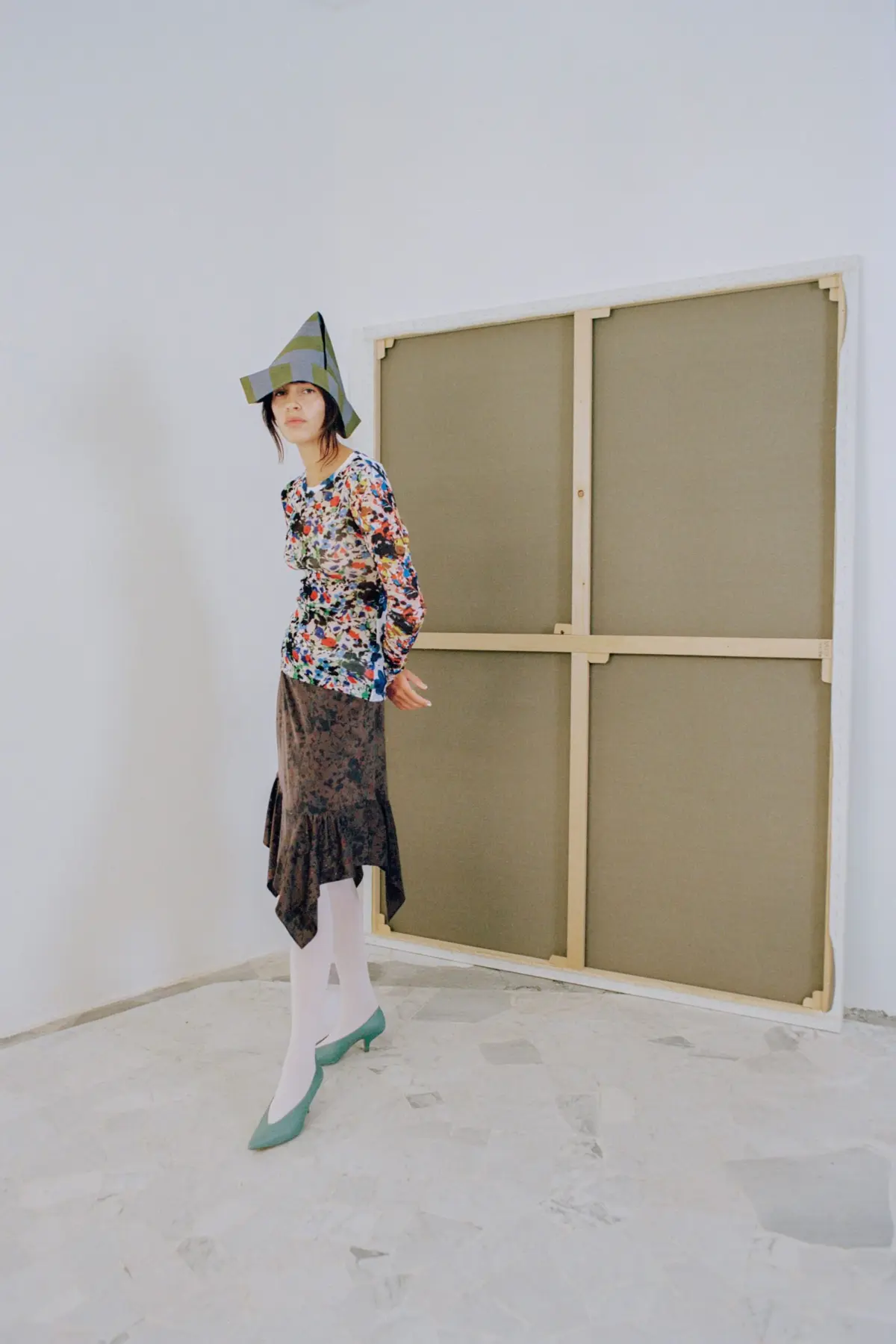
In the fast-paced, often relentless cycle of the global fashion industry, the pressure to produce something entirely "new" each season can sometimes obscure the value of what already exists. For his Fall 2026 collection, Arthur Arbesser has chosen to pivot away from the traditional concept of seasonal novelty, opting instead for a deeply personal, introspective approach that echoes the ancient Japanese philosophy of kintsugi. Much like the art of repairing broken pottery with seams of gold to highlight the beauty of the damage, Arbesser’s latest collection treats his brand’s past not as a burden to be shed, but as a fractured history to be mended, celebrated, and transformed.
Presented once again through the designer’s preferred "see-now, buy-now" format, the collection marks a pivotal moment for the label. The garments presented are not just clothes; they are physical manifestations of a transitional year in the designer’s personal and professional life. "2026 has been a year of major changes in my life, and inevitably in the life of the brand too," Arbesser explained during a preview of the collection. "In a way, I needed to put some pieces back together, and I did it using only fabrics we already had in the archive. It was exciting to realize that we were sitting on a pile of old fabrics that could become something new."
A Commitment to Circularity and Resourcefulness
The genesis of the Fall 2026 collection was born out of a rigorous, weeks-long inventory process. Arbesser and his team systematically combed through every corner of their studio, evaluating the remnants and rolls of fabric that had accumulated over years of production. The guiding principle was one of radical resourcefulness: the team was determined that not a single scrap of material would be discarded.
This logistical challenge quickly became the primary driver of the collection’s aesthetic. Where there was enough yardage, pieces were designed for traditional production; where the fabric quantities were too small to create full garments in multiples, the material was repurposed with ingenuity. The design team channeled these smaller remnants into a range of accessories, including whimsical scarves inspired by the triangular bunting often seen at children’s parties, and delicate finishing details that provide a tactile richness to the larger pieces.
This "Revival" approach allowed Arbesser to revisit the visual vocabulary of his previous seasons, effectively weaving a narrative thread through the brand’s history. Observers of the brand will recognize the return of the baroque print from Fall 2022, the crisp striped cottons utilized in Spring 2025, and the playful, multicolored checks and photographic prints of drinking glasses that defined his Fall 2024 aesthetic. By integrating these recurring geometric patterns—now a cornerstone of his brand identity—alongside these specific archival prints, Arbesser has created a collection that feels both like a retrospective and a forward-looking evolution.
The Alchemy of Garment-Dyeing
If the archival fabric provided the soul of the collection, the finishing process provided its body. A significant portion of the garments underwent an intensive dyeing process at a specialized boutique dye house located just outside Milan. Unlike large-scale industrial facilities, this small, artisanal operation relies on a modest set of just six washing machines, allowing for a level of control and nuance that is difficult to achieve in mass production.
This choice of venue reflects the collection’s overall philosophy of intimacy and human touch. By garment-dyeing finished pieces, Arbesser has managed to imbue the recycled fabrics with a unified, contemporary color palette, effectively bridging the gap between disparate patterns and textures. The resulting aesthetic is one of intentional layering and unexpected combinations. The collection thrives on the interplay of light and substance: diaphanous, lightweight fabrics—including polka dot, diamond, and striped mesh, alongside multicolored check tulle—are layered over more substantial materials.
The juxtaposition is striking. The ethereal nature of the tulle and mesh finds a grounded counterpoint in the inclusion of cobra-print satin, structured jacquard viscose, classic gingham, and the tactile, rippled texture of zigzag crinkle crepe. By mixing these heavy and light elements, Arbesser encourages the wearer to experiment with volume and silhouette, moving away from rigid styling toward a more fluid, personal interpretation of how the clothes should be worn.
An Atmosphere of Creative Continuity
The presentation of the collection was as much about the process as it was about the final product. Inside the creative space that has served as the heartbeat of the brand for the past few years, the atmosphere was one of quiet, focused energy. While guests viewed the collection, the artist Marcela Gutiérrez was at work in the center of the studio, painting on a massive canvas. Her creative labor was not merely a backdrop but an active part of the brand’s forward momentum; the artwork she produced during the show is destined to be scanned and translated into a print for Arbesser’s next collection.
The soundtrack to this scene was as idiosyncratic as the clothes themselves. An old boom box played classical music, providing a slightly surreal, nostalgic layer to the contemporary studio environment. Reflecting on the juxtaposition of the high-brow musical selections and the rugged, DIY nature of the production, Arbesser offered a characteristically candid assessment. "It feels like a horror movie," he joked, laughing at the clashing aesthetic of the scene. "But I’m always looking for something that clashes, so I’m happy with that."
This willingness to embrace the clash—between the old and the new, the refined and the repurposed, the classical and the contemporary—is what defines the Fall 2026 collection. It is a testament to the idea that creativity does not always require the consumption of new resources, but rather a new way of looking at what is already at hand. By "putting the pieces back together," Arthur Arbesser has managed to synthesize his brand’s past into a coherent, sustainable vision for its future. In a year defined by change, he has found beauty in the act of mending, proving that with enough intention, even the remnants of the past can be forged into something entirely, and uniquely, new.