
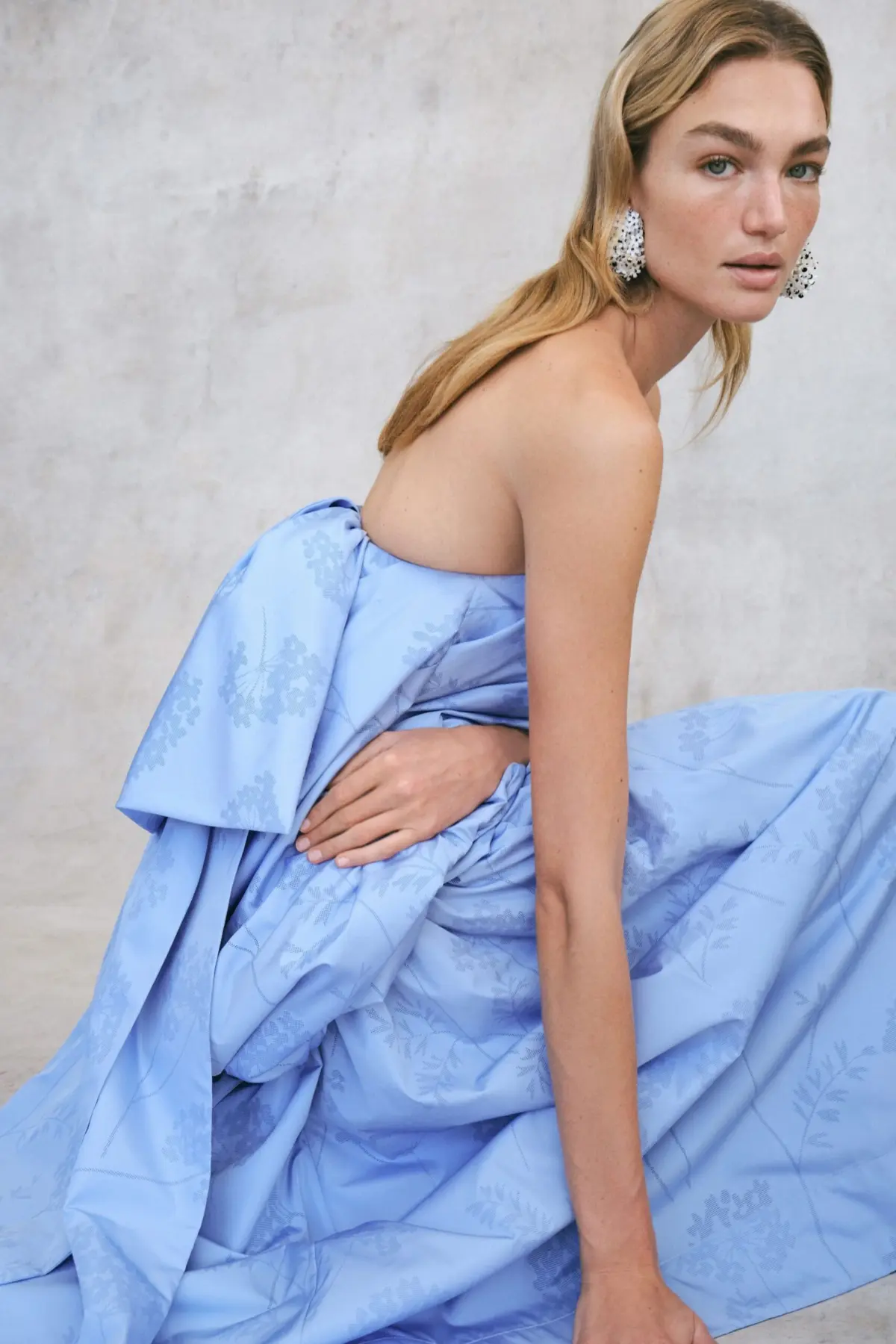
"I’m all about beauty—but with some sense of ruggedness and adventure." These words, spoken by Lela Rose during the unveiling of her Spring 2027 collection, serve as the definitive mission statement for a designer who has spent three decades refining the balance between high-fashion sophistication and the lived-in reality of a modern woman’s life. As a model waltzed into the designer’s sun-drenched showroom, the embodiment of that philosophy was immediately apparent: a hand-embroidered, lace-hemmed linen dress that commanded attention while suggesting it could withstand a night of spirited dancing.
The garment was a masterclass in contradiction. It was elegant, form-fitting, and undeniably refined, yet it possessed a tactile, grounded quality that invited movement. It was, as Rose intended, an outfit designed for someone who is the life and soul of the party—someone who refuses to sacrifice comfort for style, or style for practicality. This fusion of the ornate and the utilitarian is not merely a stylistic choice for Rose; it is a recurring motif that defines her current design trajectory.
Though the juxtaposition of humble fabric—specifically linen—with high-touch embellishment felt fresh and contemporary, the Texan designer was quick to point out that this was not a new fascination. In fact, the idea of elevating linen gowns to bridal and formal status harks back to her very first collection in the early aughts. Reflecting on her career trajectory with a laugh, Rose summarized the evolution of her aesthetic as: "Romantic, rustic, revisited." This circularity in her work suggests that while the industry is obsessed with the "next big thing," Rose finds profound inspiration in returning to the foundational materials that first sparked her interest in design, now viewed through the lens of a much more experienced eye.
Three decades into her career, the challenge for Rose remains consistent: how to "Lela Rose-ify" a fabric, effectively making it her own through technical innovation and artistic application. This season, that effort centered on light-as-air taffeta. Eschewing the stiff, traditional associations of the fabric, she introduced it in vibrant, optimistic shades of cornflower blue and "lucky green." The innovation, however, was in the texture. The fabric was punched with tiny, precise dots, mimicking the intricate appearance of needlepoint.
The technique was unexpected and modern, turning a traditional textile into a contemporary texture. During the presentation, Rose gestured toward a perforated wall sconce of her own design, which echoed the punctured aesthetic of the garments. The parallel was striking. "It reminds me of how I used to hole-punch my mom’s luminaria when she was entertaining," she noted, highlighting the deeply personal roots of her creative process. "When I’m in the showroom, I can really see the shared visual language everywhere." This insight into her design philosophy reveals that for Rose, the runway is not a detached space; it is an extension of her home, her memories, and the environments she curates.
The application of this "shared visual language" was further demonstrated through a tea-length linen frock that acted as an ideal canvas for three-dimensional floral detailing. By utilizing cut and frayed chiffon trimmed with delicate beads, Rose managed to transform a fabric historically considered unpretentious—even utilitarian—into a show-stopping piece. The effect was not limited to the frock; it was carried over to the bodice of an ethereal tulle gown, where the juxtaposition of raw, frayed edges and fine beadwork added depth and movement. Even on a dance floor-ready black mini, the technique served to elevate the garment, proving that the marriage of the rustic and the refined can yield surprisingly versatile results.
Observers of Lela Rose’s recent work might have noted the absence of overt Westernwear, a genre that has become something of a signature since the designer relocated from the bustling streets of Manhattan to the expansive landscapes of Jackson Hole, Wyoming. In previous seasons, the influence of the American West was often explicit, manifested in silhouettes, patterns, and accessories that leaned into her new surroundings. However, for Spring 2027, that influence was significantly more subtle.
Rather than relying on literal interpretations of Western aesthetics, Rose opted for a more sophisticated, internalized approach. A keen eye could spot the ever-present ode to Americana in the details: the ribbon saddle-stitching that adorned the sleeve of a blazer, for example. It was a whisper rather than a shout, a design choice that grounded the collection in her personal geography without turning the runway into a caricature of frontier life.
This restraint was equally visible in her exploration of professional attire. An all-navy ensemble, which at first glance appeared destined for the corporate boardroom, was revealed to have a hidden layer of complexity. The outfit was equipped with a detachable utility belt, a functional addition that functioned like a chic, wearable tool kit. When asked about the piece, Rose described it as "just a fun way to mix things up, and make it your own." It was a quintessential Lela Rose moment: the recognition that the modern woman’s day is rarely one-dimensional. A woman might start her day in a boardroom and end it at an art opening or a dinner party, and her clothing should possess the flexibility to transition between those worlds without losing its identity.
By offering this level of utility, Rose is ensuring that her muse remains perpetually ready for her next adventure, whether that adventure is professional, social, or personal. The collection succeeds because it does not ask the wearer to choose between beauty and utility; it offers both in equal measure. It is a testament to a designer who, after thirty years in the business, has stopped chasing trends and instead focused on the intersection of her own history and the realities of the women she dresses.
As the presentation concluded, the overarching sentiment was one of enduring relevance. The Spring 2027 collection does not feel like a departure for Lela Rose, but rather a maturation. By revisiting the rustic materials of her early career and applying them with the technical confidence she has built over decades, she has created a body of work that feels both nostalgic and distinctly forward-looking. It is a collection that honors the history of her brand while firmly planting its feet in the "rugged adventure" of the present. Through these garments, Rose continues to prove that the most compelling fashion is often found in the tension between where we have been and where we are going, all while ensuring that we look—and feel—extraordinary along the way.