
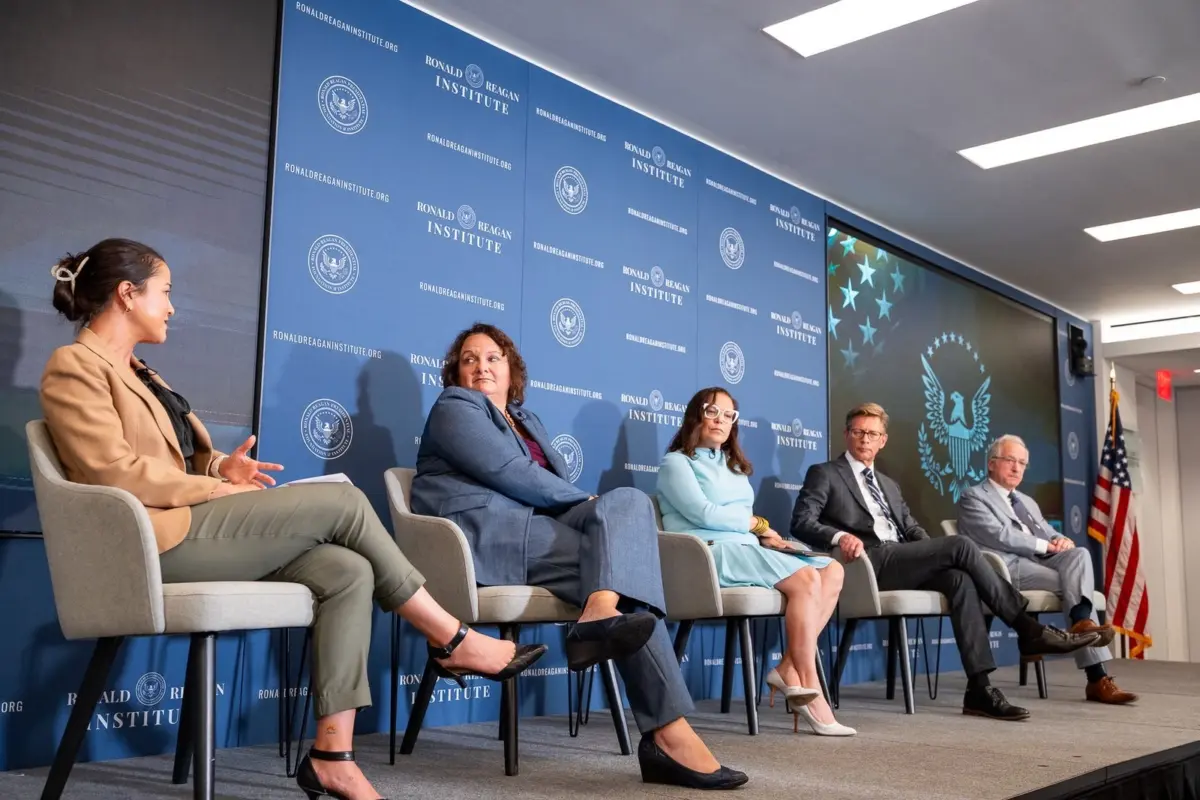
At the ninth annual Reagan Institute Summit on Education (RISE) held in Washington, D.C., policymakers, prominent business leaders, and education advocates from across the political spectrum converged to address a fundamental question that has increasingly occupied the American public: What is the true purpose of education in the United States today?
Against the backdrop of a rapidly shifting economic and technological landscape, discussions at the gathering ranged widely. Attendees grappled with rising college tuition costs and what many described as a form of "cognitive surrender" fueled by the rapid proliferation of artificial intelligence. Yet beneath these individual challenges lay a broader, overarching goal: fostering an informed, capable, and resilient citizenry prepared for the realities of the twenty-first century.
During a prominent panel discussion titled "Beyond Achievement: Knowledge, Skills, and Human Flourishing," Maria Flynn, the president and CEO of Jobs for the Future (JFF), took center stage to zero in on a critical systemic challenge. She emphasized the urgent importance of aligning what students learn inside the classroom with the practical demands that the workforce will place upon them over the next five, ten, and fifteen years.
Following her session, EdSurge sat down with Flynn to explore the intricacies of school-to-workforce connections, the necessity of prioritizing broad career awareness over overly prescriptive job readiness, and the practical realities of preparing students for an increasingly uncertain future.
The Growing Disconnect Between Schools and Real-World Readiness
The urgency of these discussions is underscored by shifting public sentiment. A recent Gallup poll highlights a stark reality: while 51 percent of surveyed parents express trust in K-12 schools to adequately prepare students for new technologies, far fewer parents harbor confidence in schools’ ability to prepare children for the current world of work, with only 27 percent expressing optimism. Confidence levels remain similarly subdued regarding critical thinking and problem-solving skills at 29 percent, and effective artificial intelligence use at just 34 percent.
When asked whether these figures serve as a warning sign of misaligned educational priorities, Flynn acknowledged that the system is falling short of preparing students for an unpredictable future. She noted that while this gap has persisted for quite some time, the rapid acceleration of artificial intelligence and shifting business practices have made the disconnect glaringly apparent.
Flynn expressed little surprise that parents are picking up on these deficiencies, noting that the situation raises a critical question about how society can address such a systemic problem at scale. Regarding the low confidence surrounding AI preparation, she pointed out that parents are currently learning at the exact same pace as—or perhaps even slower than—their children, meaning that adult education must happen in parallel as these technologies continue to roll out.
Furthermore, Flynn observed that educational systems across both K-12 and higher education are currently scrambling to support educators, while state governments and local districts attempt to chart a coherent path forward. The fact that these conversations have successfully migrated from academic policy debates straight to the household kitchen table, she argued, is a telling sign of their urgency.
Defining AI Literacy and Navigating Institutional Progress
As artificial intelligence reshapes industries overnight, education systems face mounting pressure to define what foundational knowledge graduates must possess. When asked what understanding of AI every high school graduate should master before entering college or the workforce, Flynn maintained that basic AI literacy should be as standard as learning how to type once was in school typing classes. Whether delivered through a formal credential or integrated organically into classroom experiences over time, employers increasingly expect these foundational proficiencies. However, Flynn stressed that checking a box is not enough; the ultimate goal is building genuine fluency so that students can apply AI tools seamlessly to day-to-day tasks.
While many institutions are still catching up, Flynn pointed to several promising models of AI education already taking root across different sectors. Higher education, in particular, has seen innovative approaches. For instance, Ohio State University is intentionally embedding AI horizontally across its various academic majors. Meanwhile, Miami Dade College is spearheading groundbreaking work in applied artificial intelligence education through initiatives funded by the National Science Foundation. Within the K-12 space, organizations like InnovateEDU are pioneering creative approaches to classroom integration. Flynn noted that while many good things are currently happening, the primary priority now lies in achieving absolute clarity regarding the distinct roles that states, districts, and local communities must play in synthesizing these effective practices.
Realigning Academics with Durable Human Skills
When evaluating the broader misalignments between current school practices and employer demands, Flynn cautioned against hyper-specialization. Because the skills of the future will inevitably evolve at a rapid pace, she argued that educators should avoid teaching young people about one specific job with one specific employer. Instead, the baseline must consist of strong core academics paired with durable human skills—such as adaptability, resilience, and the capacity to continuously learn and relearn.
The core misalignment, Flynn explained, lies in how early and how broadly educational institutions expose students to different career possibilities. Traditional high schools often remain intensely focused on college admissions above all else. If schools instead introduce comprehensive career exploration much earlier—embedding it directly into the middle school curriculum—students can make significantly more informed educational and professional choices by the time they reach the eleventh grade.
Equipping K-12 schools to better help students connect their personal interests and passions to viable career pathways ultimately comes down to providing robust structural tools and resources. Flynn highlighted the expansion of summer teacher externships as an effective method to give educators direct access to real-world work experiences, which they can subsequently use to inform their classroom instruction.
In addition, Flynn emphasized the necessity of providing school counselors with the resources required to showcase opportunities that extend far beyond the traditional four-year college degree. She pointed to free exploration tools designed specifically for teenagers, such as the GoZig platform developed by Brightbound in partnership with JFF, which helps students match their personal interests to a diverse array of pathways, including community college programs and structured apprenticeships.
Employer Adaptability and the Entry-Level Labor Market
As educational institutions navigate these seismic shifts, employers are likewise adjusting their strategies. Flynn noted that significant changes are occurring on the early rungs of the labor market, demanding close attention. With frequent headlines detailing how artificial intelligence is altering entry-level roles and leaving recent college graduates facing underemployment, society must proactively get ahead of these changes to ensure that the initial rungs of the career ladder are not eliminated entirely.
In response, forward-thinking employers are beginning to reevaluate their standard entry-level requirements. Initiatives like Opportunity@Work and its "Tear the Paper Ceiling" campaign have successfully encouraged numerous companies to remove unnecessary four-year degree requirements for jobs that do not genuinely require them. Simultaneously, young people are increasingly seeking out "earn-and-learn" models, such as formal apprenticeships, which allow individuals to earn a living without having to choose between working full-time and pursuing education.
While significant progress has been made, Flynn reiterated that the ultimate solution circles back to ensuring that young people fully understand the broad spectrum of options available to them as they step out into the modern world.