
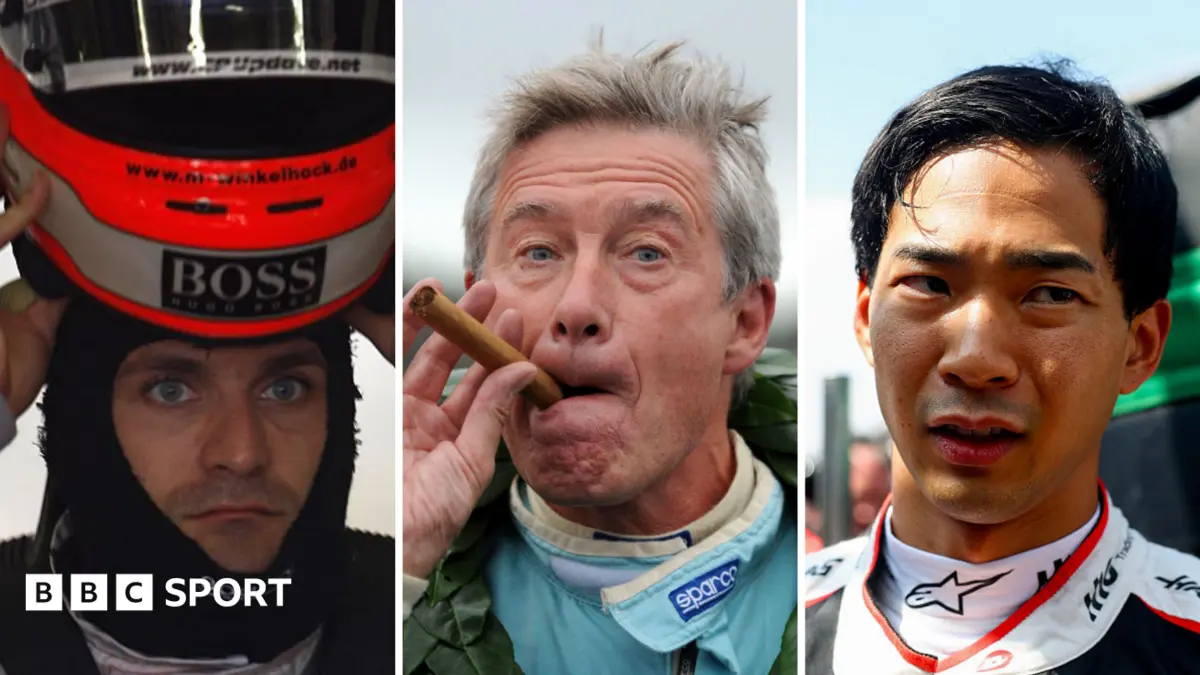
You have been handed the chance of a lifetime. A chance to sit in the cockpit, on the grid, at motorsport’s absolute top table: Formula 1. It is the very pinnacle of everything you have strived for in your whole life, the ultimate destination for anyone who has ever strapped themselves into a racing seat.
What would you do?
"I sang the Grand Prix theme tune while I was sat on the grid. I thought I was watching it on telly," says Tiff Needell—one of just 166 drivers, depending on your standing in the often unforgiving world of motorsport, who have graced an official Formula 1 World Championship race precisely once.
There are countless reasons why a driver might get only a single fleeting opportunity to race elite sport’s fastest and most sophisticated machines. And while F1’s legendary "super subs" were far more common as a feature of the paddocks in the 1960s and 1970s, the modern helmet-for-hire phenomenon remains very much alive and driving in ultra-professional, contemporary Formula 1.
Just ask Japan’s Ryo Hirakawa, who achieved his lifelong dream when he got behind the wheel of a Haas at the Mexican Grand Prix following Esteban Ocon’s controversial and abrupt departure from the team.
"I just need to taste this moment. I’m really happy," Hirakawa said after scoring a crucial championship point, which admittedly came after a handful of post-race demotions for other competitors. "Just enjoy this moment and see what we can do."
Yet, within the space of a single week, there was ultimately very little the Toyota factory driver could do. With Haas locking in their long-term plans, 2027 driver Rafael Camara was drafted into the American team early, taking over the seat for the remainder of the 2026 season. Hirakawa’s sudden appearance had been a product of his role as a reserve driver for Haas, a position born out of the team’s growing association with Toyota. He was, quite simply, a driver in the right place at the right time.
The statistical reality is stark: the percentage of F1 test and reserve drivers who successfully make it to a full-time grid is typically minuscule. Those who do break through are usually drafted in for one high-stakes shot at a deeply unlikely brush with glory.
Gone are the days of the wealthy aristocrat who simply fancied a casual afternoon pootle around the track for a local grand prix. Today, years of grueling physical preparation, junior category success, and simulator work are required just to stand with a chance of stepping into a pit garage.
Injuries, sudden sponsorship collapses, and outright financial or contractual disputes are just some of the volatile variables that can abruptly end a hopeful’s dream before it truly begins.
The Old-School Road to the Grid
Tiff Needell, who is far better known to the wider public for his illustrious television career behind the wheel on Top Gear and various other automotive programs, secured his own massive break at the 1980 Belgian Grand Prix. However, his highly unorthodox journey to the Formula 1 paddock actually began in the media.
"I won a car in a magazine competition," Needell recalls. "I was the kid on the terraces, on the fences—and made it on to the grid. We had no money at all in our family, so I was a working civil engineer five days a week and a mechanic in my garage five nights a week. At the weekend I was the van driver, the mechanic and the racing driver."
"I bumbled my way up to the top of the national scene and then got offered a professional drive in Formula 3. And after two years of that I moved up into the Formula 1 British championship."
The call to the big leagues came under circumstances that would be almost unimaginable in today’s corporate Formula 1 paddock.
"I was out at the Nurburgring trying to get an F1 drive when I got the call. I was hanging around the paddock trying to chat up an F2 team, trying to say I had a sponsor, which of course I didn’t," Needell says.
"Ensign called me and said: ‘This weekend would you like to drive?’ I rushed home from the Nurburgring in my orange Ford Capri, had half a day’s test at Donington and on to qualifying for the Belgian GP at Zolder."
"I got my chance because Clay Regazzoni crashed and hurt his back at Long Beach. A lot of that in the olden days was due to injuries—chances would come up when someone had crashed and got injured. It was dangerous back then."
Needell found himself thrust into an era of Formula 1 where drivers routinely had to battle through pre-qualifying sessions just to prove they were fast enough to earn a spot on the actual Grand Prix starting grid.
"There was something like 30 drivers trying to pre-qualify, and somehow I made it to the back of the grid—23rd in the Ensign. It was so much cheaper then—aluminium chassis and a Cosworth DFV engine and away you go."
Even from the back of the grid, a 29-year-old Needell found himself rubbing shoulders racing royalty. Double world champion Emerson Fittipaldi was having a difficult weekend in his Skol Fittipaldi machine, placing the seasoned champion right alongside the rookie.
"I found myself on the back row of the grid, sitting by one of my big heroes. It was all a bit of a dream," Needell says.
Unlike the heavily managed, high-security VIP treatment afforded to modern drivers, Needell’s parents and his girlfriend—who is now his wife—simply drove to Belgium in the family car and watched the race unfold from the general admission crowd as he prepared to line up on the grid.
"When the mechanics started the engine and left me sitting there—me and Emerson—I actually started humming the theme tune to Fleetwood Mac’s The Chain," Needell shares.
"For 12 laps I battled with Emerson for the honour of being last place at the 1980 Belgian Grand Prix. Then the engine broke."
A subsequent failed attempt to pre-qualify for the prestigious Monaco Grand Prix just a week later effectively put the brakes on his fleeting F1 aspirations, ultimately steering Needell toward a highly successful and enduring career as a Le Mans endurance racer and prominent motorsport broadcaster.
When Desperation Leads to Disqualification
Frequently, the reason Formula 1 careers proved to be so remarkably fleeting was entirely of the driver’s own making.
Hans Heyer famously failed to qualify for his one and only grand prix appearance—the 1977 German Grand Prix at Hockenheim. Undeterred by the timing screens, Heyer decided to contest the race anyway, brazenly starting from the pit lane for the ATS team in a car that was never authorized to be on the grid.
The German driver may have fulfilled a lifelong ambition to race at his home grand prix, but the stunt resulted in immediate disqualification, compounded by the fact that he had already retired due to a gearbox failure on lap nine.
Then there is the cautionary tale of Marco Apicella. It took 73 years—ever since Alberto Ascari famously triumphed—for Italy to finally celebrate another of its own Formula 1 world champions, with Kimi Antonelli securing the 2026 title in Mexico. For a nation and a Ferrari team so deeply intertwined with the sport’s identity, that was a staggering duration to wait. Apicella’s brief stint stands as a prime example of how quickly an F1 dream can evaporate.
Rushed into the cockpit at the last minute after a mere two hours of testing to replace a disgruntled Thierry Boutsen in the underwhelming 1993 Jordan, Apicella lasted approximately 800 metres of his home race before getting caught up in a multi-car collision on the very first lap of the Italian Grand Prix at Monza.
That chaotic flashpoint marked the definitive end of Apicella’s Formula 1 career, leading him down a path that included five unsuccessful attempts to conquer the legendary 24 Hours of Le Mans.
The Ultimate One-Hit Wonders
What is the highest achievement managed by a driver during their solitary grand prix appearance?
While there have been a smattering of minor points finishes over the decades, Dorino Serafini’s shared second-place podium finish alongside the legendary Alberto Ascari at Monza, during the final round of Formula 1’s inaugural championship season in 1950, remains arguably the gold standard for an F1 one-shot.
However, Germany’s Markus Winkelhock certainly stands out as one of motorsport’s ultimate modern-era super-sub icons.
Drafted in as a last-minute replacement in the newly acquired, yet severely uncompetitive, Spyker team’s car at the 2007 European Grand Prix at the Nurburgring, the seasoned touring car specialist naturally slotted into the traditional super-sub qualifying position: dead last on the grid.
Racing was in Winkelhock’s blood; his father, Manfred, contested 56 grands prix during the 1980s before tragically losing his life in a sportscar crash in 1985. Meanwhile, Markus went one step further than his uncle Jo, who infamously never contested a grand prix despite attempting to qualify seven times.
Yet, by his own honest admission, Markus was vastly underprepared for the physical demands of a modern F1 car.
"I had one day testing in Silverstone and one day in Paul Ricard," Winkelhock told Motorsport magazine. "The first couple of laps it felt like a PlayStation—so unreal, everything was so fast. You’re accelerating till you reach the braking point. But after all the practice sessions I could feel my neck already."
"I told my mechanics to put some beddings on the side of the headrest, in case the neck is completely done, to lean on with the helmet."
Then, the weather intervened. Sudden, heavy rain poured down from the Eifel mountains, prompting an inspired strategic gamble from the pit wall of a team that had virtually nothing to lose.
Winkelhock was bolted onto precisely the right tyres at exactly the right moment as the torrential downpour hit. While championship contenders like Lewis Hamilton and Jenson Button slid helplessly into the gravel traps alongside several other front-runners, Winkelhock’s orange Spyker danced gracefully through the standing water. He suddenly found himself leading the race by an astonishing 33 seconds—a massive margin in the high-speed world of Formula 1.
"I didn’t know it was for the lead. I was just driving," Winkelhock recalled. "At the point they told me, ‘You’re P1’, I really didn’t understand anything that was going on because this race was really crazy."
When the rain eventually subsided and the track began to dry, the limitations of the Spyker caught up with him. He was steadily swallowed up by faster, better-resourced machinery before a hydraulic failure ended his race on lap 15, bringing a breathtaking six-lap stint in the lead to a premature halt.
While a brief or aborted Formula 1 career can often be heartbreaking for those involved, it frequently paves the way for glittering, highly successful professional careers in endurance sportscars at Le Mans or on the high-speed ovals of American IndyCar.
Even in decades past, when rival motorsport disciplines such as rallying’s terrifyingly fast Group B monsters were at the absolute height of their cultural popularity, Formula 1 remained the undisputed mountain top.
"Being a grand prix driver was where you wanted to go," Needell reflects. "Pero I always had my eye sideways for any other drives."
"Single-seaters are the best cars to drive and they are made and designed to race. And the ultimate is the grand prix car. Everything else is second best."
"I was so proud I got there on no sponsorship and no money. I suppose I was a bit annoyed I couldn’t stay for longer. But as I always say, ‘unluckier than a few, but luckier than millions’."