
An enormous, silent storm of invisible particles is constantly sweeping through the Earth, traversing our bodies and continuing unimpeded into the vastness of space as though nothing stands in their way. Known as neutrinos, these mysterious entities rank among the most elusive objects in the entire universe to detect. Yet, after decades of theoretical physics and engineering ingenuity, scientists are successfully capturing definitive evidence of their passage. This milestone is opening unprecedented opportunities to investigate the cosmos, probe its most extreme environments, and catch a rare glimpse of the universe’s earliest moments.
Neutrino research has played a foundational and transformative role in shaping modern physics. Over the decades, discoveries involving these unusual particles have directly contributed to five Nobel Prizes in Physics. Adding to this prestigious legacy, physicist Francis Halzen was recently awarded the Nobel Prize for his decisive contributions to the IceCube Neutrino Observatory and the landmark discovery of high-energy neutrinos originating from deep astrophysical sources.
George Fuller, a Distinguished Professor of Physics at the University of California San Diego, has spent decades studying nuclear physics, particle astrophysics, and cosmology. Having previously collaborated with Halzen on an early scientific paper outlining the theoretical framework for IceCube, Fuller offers deep expertise on what makes neutrinos so uniquely challenging to study and why researchers ultimately decided to build a massive observatory deep within the unforgiving ice of the Antarctic.
What Makes Neutrinos So Mysterious?
Neutrinos belong to a fundamental class of matter known as elementary particles, which physicists widely believe have no smaller internal components. They manifest in three distinct types, or "flavors": electron neutrinos, muon neutrinos, and tau neutrinos. Unlike electrically charged particles such as protons or electrons, neutrinos possess no electric charge whatsoever. While they do have mass, that mass is extraordinarily small—potentially around ten million times less than the mass of an electron. Their exact masses remain one of the lingering mysteries of modern physics, alongside the precise mechanisms responsible for producing them in the first place.
Another remarkable characteristic is their astonishing ability to traverse dense matter with almost zero resistance. Because neutrinos interact so rarely with other particles, they can cross vast cosmic distances at speeds approaching the speed of light, carrying pristine information across the universe.
Neutrinos originate from a multitude of diverse sources, including our own Sun, distant and violent regions of deep space, and yet-to-be-identified astrophysical phenomena. They are also present in the universe in staggering abundance. Current scientific estimates suggest the universe contains roughly $10^89$ neutrinos, an astronomical figure equivalent to approximately one billion neutrinos for every single atom in existence.
"Neutrinos are truly ghost-like particles," Fuller stated, summarizing the core challenge of studying them. "It’s hard to stop them. It’s hard to catch them. How do we even know they exist or where they are?"
Ghost Particles That Pass Through Almost Anything
Despite their famously elusive nature, neutrinos occasionally interact with ordinary matter through a fundamental force of nature known as the weak interaction. This force is approximately 20 orders of magnitude weaker than electromagnetism. When these rare interactions occur, they can cause neutrinos to scatter or be absorbed, providing scientists with a fleeting window of opportunity to detect them. However, these events happen so infrequently that observing them requires exceptionally sensitive, large-scale equipment shielded from background noise.
Their unique ability to move unhindered through dense material also makes neutrinos exceptionally valuable cosmic messengers. They can escape directly from the turbulent environments surrounding collapsing stars, supernovae, and black holes, carrying vital information that traditional forms of radiation, such as light or X-rays, simply cannot reveal because they would be blocked or scattered.
The daily scale of this invisible activity passing through the human body is staggering. Approximately 100 billion neutrinos pass through every single square centimeter of your body each second, entirely unnoticed and without leaving a physical trace.
"Because the interaction is so weak, neutrinos can get through almost anything," Fuller explained. "Light years of lead—depending on their energy, they would go right through it."
How Scientists Learned to Detect Neutrinos
The quest to find and understand neutrinos began long before the technology required to observe them had even been invented. During the 1930s, physicist Wolfgang Pauli proposed that an unknown, uncharged particle might be the solution to why energy appeared to be missing during certain types of radioactive decay. In his initial proposal, he used a different name for the hypothetical particle, referring to them as "neutrons" at the time.
Pauli fully understood how profoundly difficult it would be to verify his theoretical idea experimentally. He famously acknowledged the frustration of his proposition by stating, "I have done a terrible thing, I have postulated a particle that cannot be detected."
For decades, neutrinos remained entirely beyond the reach of laboratory experiments. That barrier finally broke in 1956, when physicists Clyde Cowan and Frederick Reines successfully detected them for the first time in a landmark undertaking known as "Project Poltergeist."
That initial breakthrough confirmed that neutrinos were genuine physical entities, but detecting them consistently remained an immense technological challenge. Over subsequent years, scientists realized they would need increasingly sophisticated, massive instruments to investigate the rarest and most energetic neutrinos arriving from deep space.
Why Antarctica Is Ideal for Hunting Cosmic Neutrinos
During the 1990s, Francis Halzen recognized that the South Pole offered an extraordinary, unmatched natural environment for advancing neutrino research. Far beneath the surface of the Antarctic ice sheet, immense volumes of deep ice are exceptionally clear, containing relatively few air bubbles or chemical contaminants that might otherwise scatter or interfere with the detection of faint flashes of light.
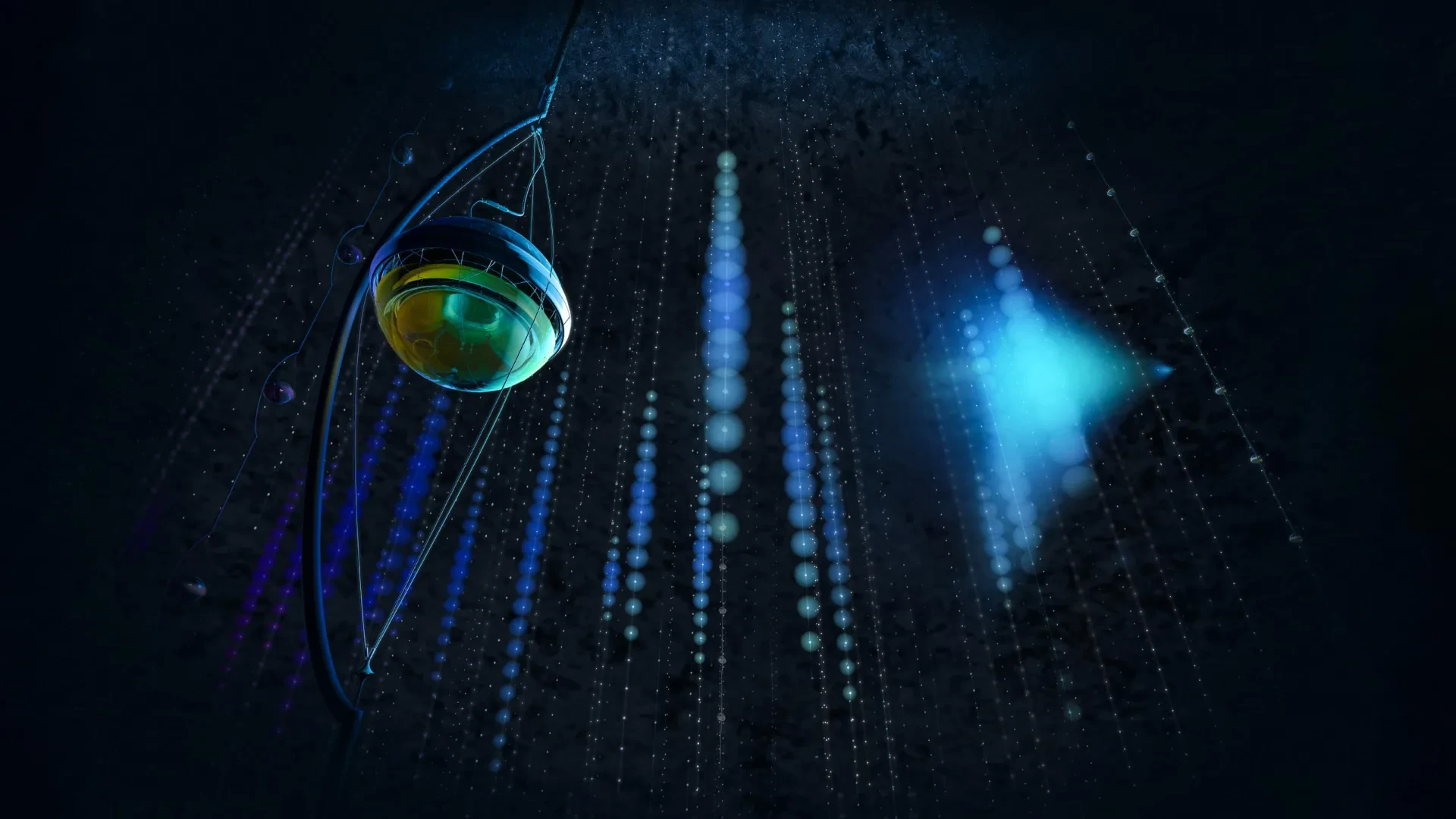
His visionary approach ultimately led to the construction of the IceCube Neutrino Observatory, a gigantic scientific instrument embedded deep within roughly one cubic kilometer of pristine Antarctic ice. To build this unprecedented facility, researchers utilized specialized hot-water drills to melt deep holes in the ice, into which they lowered long strings of sensitive light detectors known as photomultiplier tubes.
These specialized instruments continuously monitor the dark ice, searching for brief, characteristic flashes of blue light produced through a phenomenon called Cherenkov radiation. This faint light is emitted when a high-energy neutrino interacts with matter inside the ice, producing a charged particle that travels faster than light can move through that specific medium.
By recording and timing these directional flashes of light, researchers can reconstruct the trajectories and identify the undeniable evidence of neutrinos that would otherwise pass straight through the Earth without leaving a single detectable trace.
Extraordinary Particles From Deep Space
The IceCube facility holds particular importance for studying neutrinos that arrive from distant, extragalactic sources with extraordinarily high energy levels. Unlike the massive quantities of relatively low-energy neutrinos continuously produced by nuclear fusion within our Sun, these powerful cosmic visitors are exceedingly rare, with the observatory detecting only a few dozen of the most energetic examples each year.
When one of these ultra-high-energy neutrinos interacts with the surrounding ice, it can generate a rapidly moving electron or muon. A high-energy muon, for instance, generates a distinct cone of Cherenkov light as it cuts through the ice. Scientists then analyze the resulting pattern and intensity of that light to calculate the neutrino’s energy and precisely trace the direction from which it arrived in the sky.
For researchers like Fuller, these exceptionally energetic neutrinos represent some of the most thrilling discoveries made by IceCube, largely because their exact cosmic origins and the powerful physical mechanisms responsible for accelerating them to such velocities remain deeply mysterious.
"Some ultra-high-energy neutrinos detected at IceCube have roughly 10 billion times the energy of a typical neutrino from the Sun. One detected by a similar experiment has an energy 200 times higher than that. We don’t really know where that neutrino came from," Fuller stated. "The fact that it got here at all may be saying something profound about the universe. In that sense, Halzen really is at the frontier of experimental fundamental particle physics."
Neutrinos Could Reveal Secrets of the Big Bang
The broader scientific campaign to understand neutrinos extends far beyond the frozen expanses of Antarctica. Researchers at UC San Diego are also actively involved in another major astronomical observatory designed to offer unprecedented insights into these elusive particles alongside the earliest history of the universe.
Situated high in the arid landscapes of Chile’s Atacama Desert, the Simons Observatory is currently gathering vast amounts of data regarding the cosmic microwave background—the ancient, faint radiation left over from the formation of the early universe. Frequently described by astronomers as the oldest light in the cosmos, this residual radiation provides an invaluable historical record of the physical conditions that existed mere moments after the Big Bang.
UC San Diego helped establish the observatory, and Brian Keating, a Distinguished Professor of Physics at the university, serves as its principal investigator.
Although the facility’s primary mission is to study this ancient light, its sensitive measurements can also uncover critical information about neutrinos originating from the earliest epochs of cosmic history. The ambitious project is expected to yield an enormous volume of new data related to these primordial particles, potentially uncovering secrets about cosmic evolution that conventional experiments cannot access.
Fuller remains confident that these anticipated observations will significantly refine our understanding of the Big Bang, the subsequent evolution of the universe, and other fundamental questions concerning how the cosmos developed into the structured reality we observe today.
"Halzen’s work, and the work of those he inspired with his vision, was foundational in giving humanity a new window on the universe and on the mysterious and notoriously slippery neutrino," Fuller concluded.