
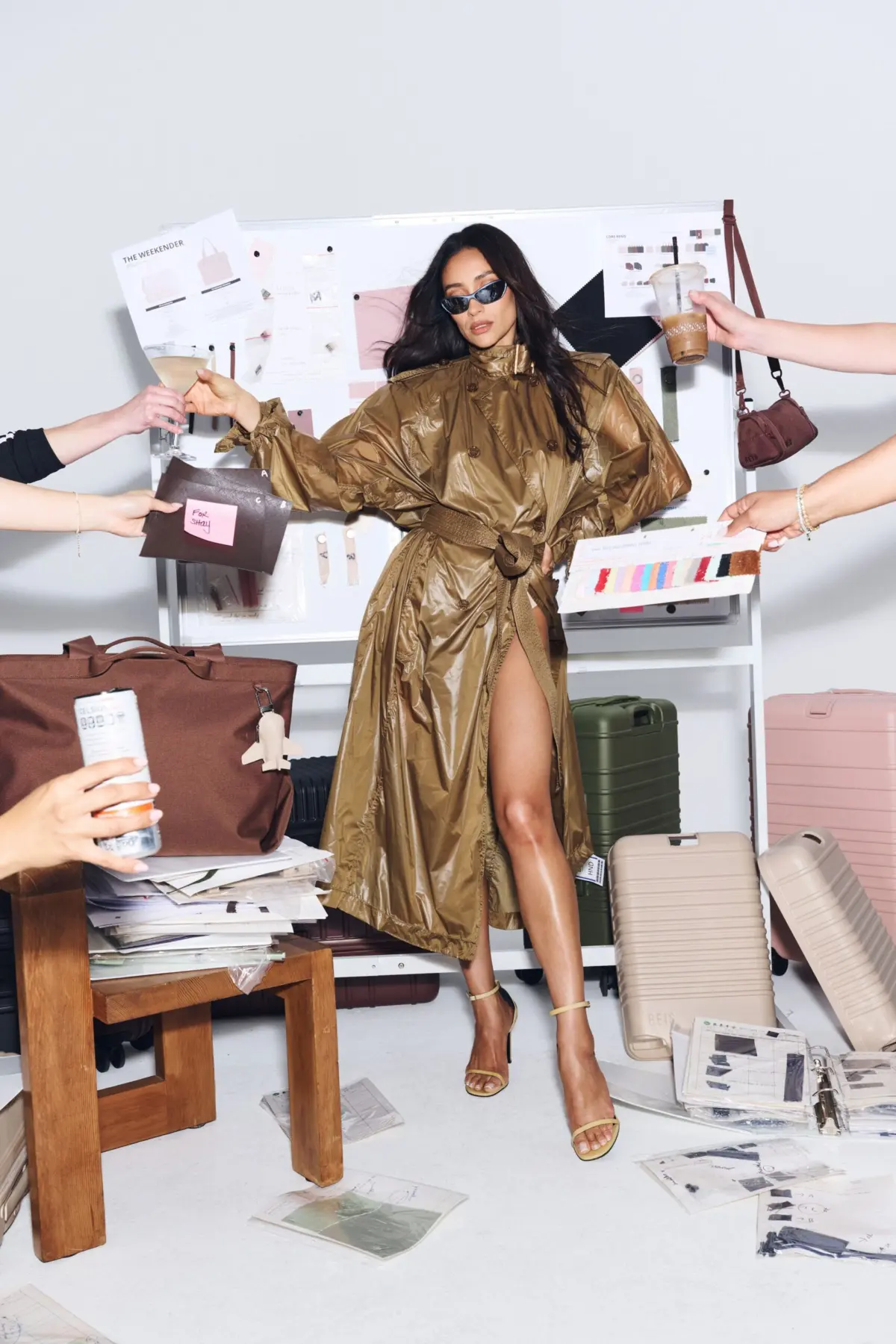
Two weeks after the ink dried on a landmark acquisition, Shay Mitchell, the actor turned entrepreneur known for her breakout role in Pretty Little Liars, is finally reflecting on a milestone that marks a new chapter for her travel brand, Béis. On October 1, the global luggage giant Samsonite finalized an agreement to acquire an 85% stake in Béis for $178.5 million. The deal values the eight-year-old company at approximately $210 million, cementing its status as one of the few celebrity-founded labels to successfully transition from a social-media-driven startup to a major corporate acquisition.
For Mitchell and Béis CEO Adeela Hussain Johnson, the partnership feels less like an exit and more like an ignition. Speaking over Zoom, both are palpably enthusiastic about the future, noting that the brand—which began as a modest suite of duffel bags and weekenders—is now positioned for a new level of global influence.
“I’ve had Samsonite on my vision board and my lock screen for a while,” Mitchell says. “It’s very surreal. We’ve done a lot over the past eight years, but there is so much more that we have planned now that we know we can do.”
The origin of Béis is rooted in a simple, pragmatic observation. Mitchell, an avid traveler, identified a distinct “white space” in the market: a lack of travel accessories that were both highly functional and aesthetically pleasing, specifically designed for the modern, busy woman. In the early days, Mitchell leveraged her massive social media following to cut through the noise of a crowded retail landscape. She famously invited her former Pretty Little Liars cast members to help promote the brand, creating a sense of community around the launch.
“Getting the word out there at the beginning was super important,” she recalls. “I brought in cast members from the show to be like, ‘Hey, come in here, help me do this.’ I truly have believed in this from the beginning. I would have screamed from any mountain.”
In an era defined by celebrity brand saturation, Béis stands out as a rare success story. Many celebrity-backed labels struggle to sustain momentum once the initial wave of influencer marketing fades, but Béis has managed to cultivate a loyal customer base built on utility rather than just star power. Mitchell is quick to point out that while her celebrity might have brought customers to the site initially, it is not what keeps them there.
“Maybe you buy a Béis bag one time because you like the show that I’ve been on, but the repeat purchases aren’t because of that,” Mitchell explains. “It’s because you’re genuinely finding the bag to make your life easier. And I always say, if I were to step down or walk away, this brand could stand on its own.”
As Chief Creative Officer, Mitchell remains deeply involved in the design process. The products are engineered to solve specific pain points she and her community encounter on the road. Features like cushioned handles designed for heavy cases, integrated weighing systems that warn users if their luggage exceeds 50 pounds, dedicated compartments for wet laundry, and internal key leashes reflect a "user-first" design philosophy. The brand’s pricing, ranging from $108 for a weekender bag to $394 for a large check-in roller, positions it as an aspirational yet accessible choice for the contemporary traveler.
The brand has also masterfully utilized high-profile collaborations to remain part of the cultural zeitgeist, partnering with major names like Rare Beauty, Gap, KidSuper, Barbie, and Wicked. Mitchell continues to serve as the face of these campaigns, but her most effective content strategy has been the "walkthrough"—informal, transparent videos on YouTube or TikTok where she and her team break down the technical features of the luggage.
Before the Samsonite deal, the Los Angeles-based brand incubator Beach House Group owned 70% of Béis, with Mitchell holding the remaining 30%. As part of the new acquisition, Mitchell sold half of her stake, though she will remain in her role as founder and creative director. Adeela Hussain Johnson, who took the helm as CEO in 2024, will also remain in her position. The company reported roughly $210 million in net sales in 2025, with the vast majority of that revenue coming from its domestic direct-to-consumer channel.
“We’re at a team offsite right now,” Johnson notes, two weeks after the acquisition. “And I said to the team, ‘Raise your hand if you feel like things are different,’ and nobody did. That’s the point. That’s Samsonite’s intention, and that’s our intention as the leadership team.”
For Samsonite, which manages a prestigious portfolio including Tumi, Hartmann, and American Tourister, Béis fills a strategic void: the young, female consumer. With group revenues reaching $3.5 billion in fiscal 2025, Samsonite saw Béis as a highly attractive target due to its clear focus and brand identity.
“Shay and I were very intentional in shaping what role Béis plays in the market and what role it doesn’t play,” Johnson says. “We have very clear consumer centricity in our business. That makes you very attractive to a strategic company like Samsonite.”

A core pillar of Béis’s strategy is its diversification. Only 50% of its revenue is derived from luggage; the rest comes from lifestyle categories, ensuring the brand remains relevant through all stages of a customer’s life. “We didn’t launch with the roller, and I think that is a very intentional strategy for us as a business,” Johnson adds. “How do we meet her in all the different stages of her life, however she’s moving and grooving? I think that’ll be where we continue focusing on innovation.”
This consumer-centricity is fueled by an ongoing, real-time dialogue. Mitchell famously maintains a "little black book" of customer feedback that she brings to every design meeting. “I may read a lot more comments than I should,” she admits. “But I feel like our next idea, our next product, is in the DMs. And when we put something out there, we get instant feedback. That’s incredible knowledge for us.”
This agility was on full display recently when the company revamped its popular Weekender bag. After receiving social media feedback that the new version was causing shoulder discomfort, the team acted quickly. They filmed a "surgery" video to address the design flaw and invited top customers to their Los Angeles headquarters to stress-test the "Weekender 2.0" before its official launch. The brand also uses pop-up events, such as its "luggage wash" in Los Angeles, to foster in-person connections and solve maintenance issues for travelers.
Post-Acquisition Plans and Global Expansion
With the backing of Samsonite’s global infrastructure, Béis is now set to transition from a US-centric success story to an international player. While bricks-and-mortar retail remains a long-term ambition, the immediate focus is on scaling operations and refining product development.
“We can now take advantage of Samsonite’s global infrastructure in a way that we probably weren’t ready to at a certain point earlier in our journey,” Johnson explains. “From a scale standpoint, we already know what works domestically, and I think we do it really well. So now it’s how do we make this global? And I think having a partner like Samsonite gives us legs that we otherwise wouldn’t have.”
Mitchell is eager to tap into the 116 years of expertise Samsonite brings to the table. “I can now call someone and ask, ‘Can you take a look at this before we go into development? Is there anything you would change?’” she says. “I feel like Samsonite is the ultimate teacher—they really are so open to helping us learn, specifically in design, but also with factories and suppliers.”
The data suggests that the demand for Béis is already waiting in international markets. “We have a lot of data showing that the demand is there globally, and we actually have consumers abroad that spend as much as the product costs just to get it delivered,” Johnson notes.
As the brand eyes expansion into the UK and Asia, it plans to deploy its pop-up model as a cultural bridge. “I want to be able to do pop-ups in London. I want to be able to pop-up in Asia in a cool and special way, and hit those markets that maybe haven’t heard of us yet,” Mitchell says.
Despite the rapid growth, the brand has remained remarkably lean, operating with a team of about 50 people. Both Johnson and Mitchell acknowledge that the challenge ahead is to "professionalize" the brand without losing the scrappy, innovative spirit that defined its early years.
“There is a scrappiness that’s sort of ingrained, and we hire for that,” Johnson says. “We want people with different mindsets and backgrounds, but also who have grit and treat the business like it’s their own. But there are pain points like capital investment and infrastructure, too. Growth requires investment, and I think we’re with a partner who understands that.”
As the company prepares for its next phase, Mitchell remains focused on maintaining the brand’s authenticity. Whether it’s developing diaper bags inspired by her own experience as a new mother or refining existing products based on community feedback, the core mission remains the same: solving the problems of the modern traveler.
“This year was a big one for us,” Mitchell says, looking toward the horizon. “So to feel like we can top it in the next few years is a lot, but we will. We keep talking about Béis being on a rocket ship. But we’ve only just closed the door on the gate, and now we’re about to move off. We haven’t even taken off yet.”