
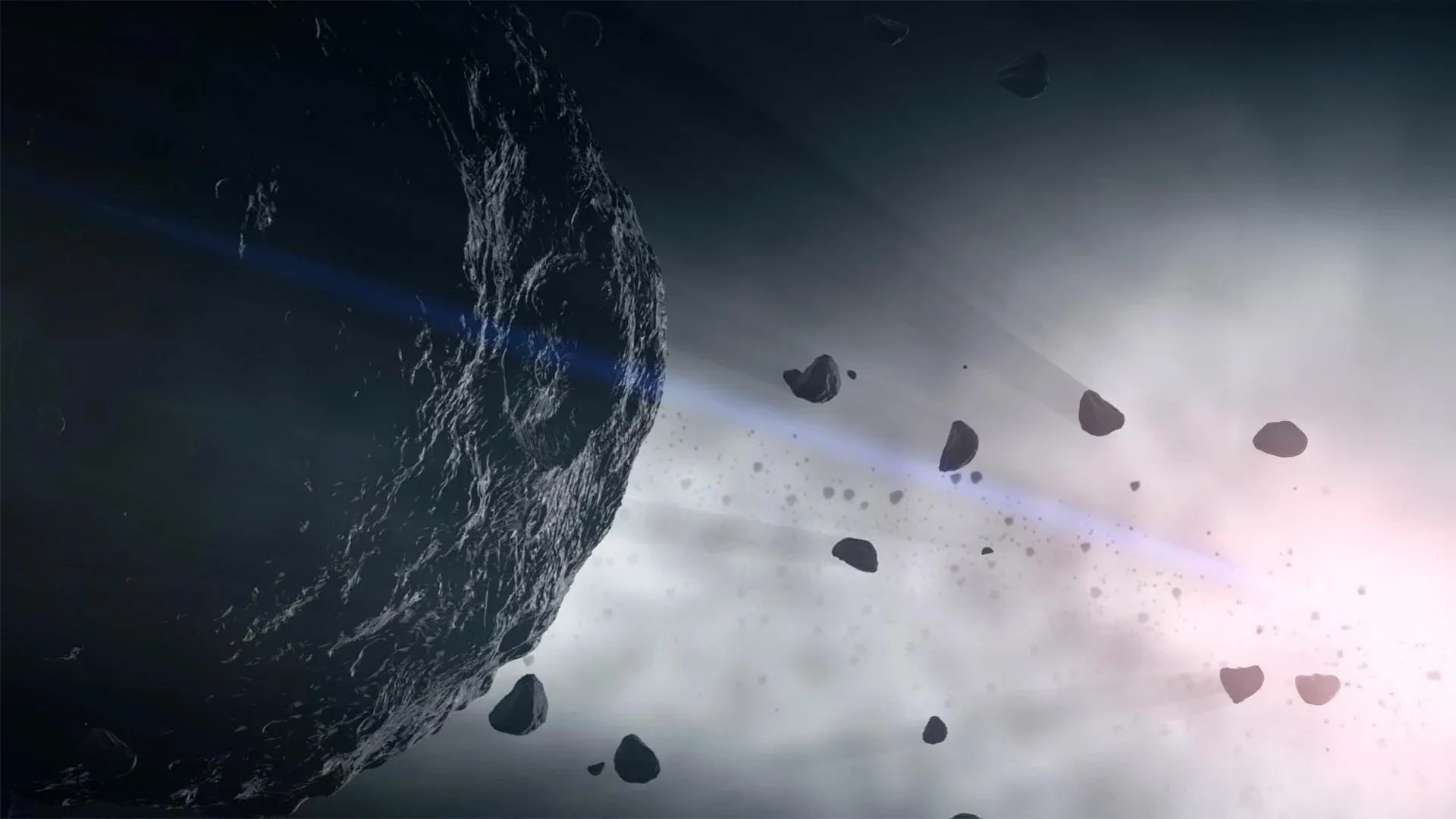
Meticulous laboratory analysis of pristine material collected from the near-Earth asteroid Bennu is yielding unprecedented insights into the genesis of our cosmic neighborhood some 4.5 billion years ago. A groundbreaking study featuring advanced chemical profiling challenges longstanding orthodoxies regarding where primitive asteroids originated, pointing directly to the monumental gravitational architect of the early Solar System—Jupiter—as a primary force in shaping the building blocks of the planets.
The journey of discovery began when NASA’s OSIRIS-REx spacecraft successfully rendezvoused with Bennu, scooped up precious regolith from its rugged surface, and dispatched a specialized return capsule on a trajectory toward Earth. On September 23, 2023, that capsule successfully parachuted into the remote desert of Utah, carrying approximately 120 grams of untouched asteroid material. This delivery marked the culmination of a multi-year mission designed to secure pristine samples from an ancient world, largely unaltered by the intense geological processing that has reshaped larger planets like Earth over billions of years.
Following the landing, small, highly guarded portions of the extraterrestrial cargo were distributed to laboratories across the globe for intensive multidisciplinary investigation. Among the primary recipients was Maria Schönbächler, Professor of Isotope Geochemistry at ETH Zurich, whose laboratory was entrusted with half a gram of the precious Bennu material. Working swiftly to decode the sample’s hidden history, Schönbächler and her research team initiated a rigorous analytical campaign, the results of which have now been published in the scientific journal Science Advances. Their findings reveal a distinctive chemical signature that not only clarifies Bennu’s true birthplace but also casts new light on the chaotic and dynamic processes that governed the infancy of the Solar System.
Bennu’s Chemical Fingerprint Reveals Its Cosmic Relatives
To unlock the secrets encoded within the asteroid’s composition, the ETH Zurich researchers focused their investigative lens on the precise isotopic variations of three key transition elements: iron, titanium, and chromium. Isotopes are distinct atomic variants of a single chemical element that possess identical numbers of protons but differing quantities of neutrons, resulting in subtle variations in mass. By measuring the exact ratios of these isotopes within a sample, geochemists can establish a definitive chemical fingerprint. This unique signature functions much like a genealogical record, preserving indelible clues regarding where an asteroid’s constituent ingredients originated and the chronology of their initial assembly.
The resulting data demonstrated that iron and titanium are distributed with remarkable uniformity throughout Bennu’s structural matrix. Furthermore, the analysis uncovered an extraordinarily close chemical affinity connecting Bennu, the asteroid Ryugu—which was previously sampled by the Japan Aerospace Exploration Agency’s Hayabusa2 mission—and a fiercely rare class of primitive space rocks known as CI meteorites.
CI meteorites represent carbon-rich remnants dating back to the dawn of the planetary system, having weathered the aeons with remarkably little chemical modification. Recovering these delicate fragments on Earth is an exceptionally uncommon event because their fragile, volatile-rich structures tend to disintegrate or weather rapidly upon atmospheric entry. However, the striking isotopic concordance shared by Bennu, Ryugu, and CI meteorites implies that their foundational materials coalesced from a singular, homogenous reservoir of primordial cosmic dust. Their collective chemical signatures diverge sharply from those identified in other known asteroid families, meteorite groupings, and the fully formed terrestrial planets, establishing a distinct cosmic lineage that demands a reevaluation of early solar history.
Scientists Discover Bennu’s Unexpected Birthplace
For decades, planetary scientists operated under the prevailing consensus that primitive carbonaceous asteroids like Bennu were born in the cold, distant expanses of the outer Solar System, sharing a common nursery with the icy parent bodies of comets. Conventional models also assumed that the physical materials constituting these objects aggregated relatively late in the developmental timeline of the circumsolar disk.
The comprehensive isotopic analysis of the Bennu samples challenges both of these foundational assumptions. Instead of an exclusively outer-solar-system pedigree, the researchers propose that the raw ingredients that eventually formed Bennu, Ryugu, and the CI meteorites accumulated near a critical thermal transition zone known in planetary science as the water-ice line.
This boundary marked the precise radial distance from the young, warming Sun where ambient temperatures dropped low enough for vaporized water to freeze into solid ice crystals. Approximately 4.5 billion years ago, this dynamic frontier served as a bustling crossroads where drifting dust particles and volatile gases converging from disparate sectors of the nascent solar nebula met and interacted. Dust grains originating from both the blazing inner regions and the frigid outer zones mingled extensively near this thermal threshold. As water ice condensed out of the vapor phase, it acted as a sticky binding agent, facilitating the rapid agglomeration of microscopic grains into increasingly robust rocky bodies.
Professor Schönbächler notes that Bennu defies simple categorization, describing the asteroid as a true hybrid whose physical components do not neatly align with either a strictly inner or outer solar system origin. Its idiosyncratic chemical composition strongly implies a genesis forged from an intricate amalgamation of diverse source materials rather than a localized, isolated accretion zone.
Jupiter May Have Played a Crucial Role in Bennu’s Formation
To account for how this complex mixing of disparate materials could occur so efficiently, the research team developed a comprehensive dynamical scenario that places Jupiter in the role of a primary architect. The gas giant began its monumental growth remarkably early in the history of the Solar System, emerging within the first million years following the ignition of the Sun. During this epoch, the infant star was encircled by a massive, rotating disk composed of gas, dust, and ice.
Within this protoplanetary disk, countless microscopic particles continuously collided and adhered to one another through a protracted mechanism known as accretion, gradually scaling up from dust motes to pebble-sized objects, and ultimately forming planetesimals and protoplanets. As Jupiter rapidly swept up gas and escalated in mass, its immense gravitational field exerted a profound structural influence over the surrounding disk, fundamentally altering the migration patterns and distribution of raw materials.
According to the researchers, the rapidly growing gas giant functioned effectively as a massive gravitational and physical barrier. While this barrier obstructed the inward and outward migration of larger, pebble-sized objects, it permitted finer, microscopic dust particles to drift past its orbit. This fine-grained material, swept in from various zones across the disk, accumulated and mixed vigorously in the vicinity of the water-ice line. The parent bodies of Bennu and Ryugu, along with the elusive CI meteorites, subsequently coalesced from this thoroughly blended cosmic slurry. Jupiter’s early emergence may thus have dictated not only the precise geographical coordinates where these ancient asteroids took shape, but also the specific molecular ingredients that were incorporated into their structures.
Ancient Dust and Ice Reveal the Ingredients That Built Earth
This proposed formation mechanism provides a compelling explanation for two of Bennu’s most prominent characteristics: its extraordinary abundance of hydrous, water-bearing minerals and its remarkably close chemical resemblance to the bulk composition of the Sun. Near the water-ice boundary, thermal fluctuations could induce ice to sublime into vapor, which would subsequently re-condense as temperatures shifted in cooler micro-environments. This continuous cycle of evaporation and condensation effectively concentrated water within the particulate matter that eventually accreted into Bennu.
Concurrently, Jupiter’s gravitational vetting of the disk restricted the influx of larger debris, leaving the asteroid’s precursor material dominated by extremely fine dust. Because these microscopic particles were capable of circulating and mixing with high efficiency throughout the disk, they successfully preserved an elemental inventory that closely mirrors the overall chemical composition of the Sun itself. This process bears a functional resemblance to how fine household dust disperses broadly across multiple surfaces rather than remaining confined to a single origin point.
This extensive homogenization ensures that Bennu’s material retains an exceptionally representative archive of the exact chemical ingredients present during the dawn of the planetary system. Professor Schönbächler emphasizes that Bennu offers scientists an optimal window into the original chemical mix that ultimately served as the foundational building blocks for the rocky terrestrial planets.
Because Bennu is classified as an exceptionally primitive body—having formed roughly 4.5 billion years ago and experienced minimal thermal or chemical alteration since its inception—its samples hold disproportionate value for reconstructing the physical conditions that preceded the completion of Earth and its planetary neighbors. By examining the precise chemistry of these pristine grains, researchers can refine their models of planetary evolution and identify the specific physical mechanisms that governed the composition of the inner planets. Furthermore, the presence of indigenous water-bearing minerals and complex organic compounds on Bennu supplies crucial context for investigating how the early Earth acquired volatile substances and chemical prerequisites essential for the eventual emergence of life. While these findings do not definitively trace the precise pathway by which such ingredients were delivered to our planet, they provide rigorous empirical constraints regarding where those precursors originated and how they were distributed through the young solar nebula.
A New Mission to Mars’ Moon Could Reveal More
Despite the significant breakthroughs yielded by the analysis of the Bennu samples, planetary scientists recognize that many fundamental questions remain open. Researchers are eager to determine whether other carbonaceous asteroids share the exact isotopic fingerprints identified in Bennu and Ryugu, and to model more definitively how Jupiter’s early gravitational perturbations regulated the transport and accumulation of fine-grained cosmic dust. Acquiring additional asteroid samples will be vital for testing the broader validity of the proposed formation scenario.
Building on the successful conclusion of the primary Bennu analyses, Professor Schönbächler is already preparing for the next major frontier in extraterrestrial sample return. The Japan Aerospace Exploration Agency is pressing forward with preparations for the Martian Moons Exploration mission, scheduled for launch in late October 2026. This ambitious undertaking aims to rendezvous with Phobos, one of the two natural satellites orbiting Mars, collect subsurface material, and return the capsule safely to Earth.
Expressing enthusiasm for the upcoming endeavor, Schönbächler indicates her intention to formally apply for access to the Phobos samples upon their eventual return. However, the scientific community faces a prolonged wait; the return capsule carrying material from the Martian moon is not anticipated to touch down on Earth until 2031. When those future samples finally arrive in terrestrial laboratories, they are expected to provide yet another critical piece of the planetary puzzle, illuminating how disparate regions of the early Solar System interacted and ultimately gave rise to the complex array of planets, moons, and asteroids observed today.