
What does going on a date have to do with fossil fuels? Everything, according to the petroleum industry.
An advertisement from the pipeline company Energy Transfer follows two people getting ready for a date—the man primping with hair gel, the woman applying lipstick—before they meet at a bar. “That connection was brought to you by petroleum products,” the narrator says. “But what if we lived in a world without oil and natural gas?”
The story rewinds to the beginning, except this time, the woman looks bewildered as her phone with the dating app evaporates in her hands. She gets lipstick all over her cheek when the car she is riding in hits the pavement without its tires. As his hair gel disappears, the man looks into the mirror, baffled. When they sit down across from each other, makeup, hair dye, and glasses fade away. In the game playing on a TV in the bar, a football disintegrates a second before the kicker swings his leg at empty air.
The commercial, which has racked up 7.4 million views since it appeared four years ago, taps into the fact that fossil fuels have become deeply embedded in American life. Oil and gas not only influence how people get around town, but also where they live, how they dress, and how they cook food in their kitchens. This all feels so ordinary that most people do not notice how pervasive petroleum is, powering our lives while hiding in plain sight. Though it might seem inevitable that we live this way, a Grist investigation found that this idea of what is “normal” was shaped by decades of advertising, public relations propaganda, and broader efforts to sway American culture, from radio programs to Hollywood films.
“Our dependence on oil didn’t just happen,” said Robert Brulle, an environmental sociologist at Brown University.
This campaign started about a century ago, when companies began strategizing how to create long-term demand for fossil fuels and the products that ran on them. Billboards showcased happy families on the road in their cars, films showed stylish women cooking over the flame of a gas stove, and magazines featured men pushing their gas-powered mowers across soon-to-be perfectly manicured lawns. The message was often left unsaid: The American way of life runs on fossil fuels.
There is a well-documented history showing that Exxon and other oil giants understood the dangers of global warming by the 1970s based on their own research and still spent decades publicly downplaying, or outright denying, the science. But the story of how oil and gas companies coaxed Americans into accepting—even desiring—a life built on fossil fuels has largely escaped attention, buried in the pages of obscure trade journals.
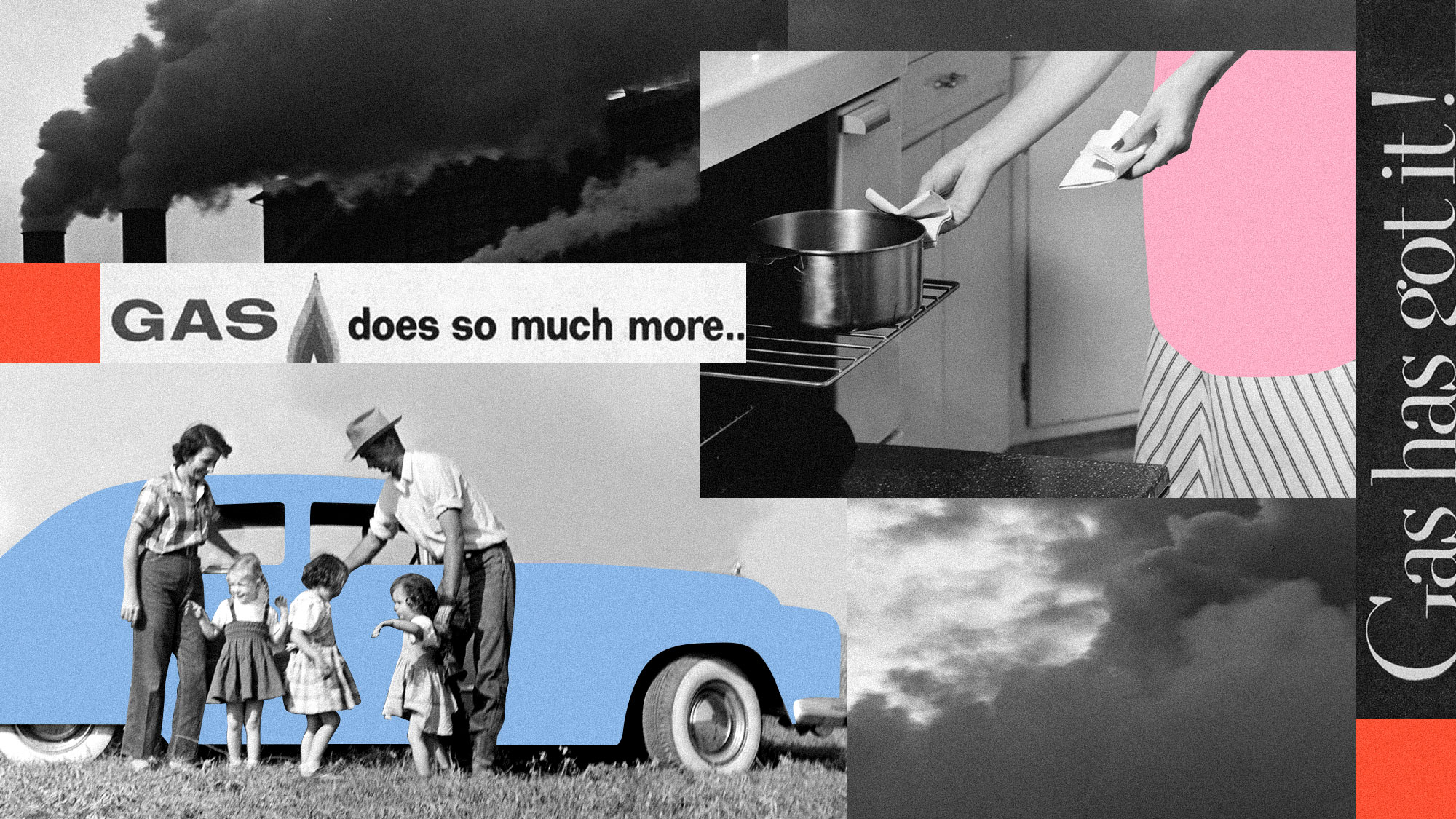
In the 1940s and 1950s, the oil industry spent millions of dollars a year on campaigns to “educate” the public about the wonders of petroleum and how it advanced the “American way.” The natural gas industry promoted all-gas “dream kitchens” and paraded them in front of the editors of Better Homes and Gardens, Good Housekeeping, and The Ladies’ Home Journal. They sold a vision of the American Dream that required their products—a cultural legacy that has been devastating for efforts to rein in climate change and shift to a cleaner future.
This history offers an explanation for why Americans have had such a strong reaction to the idea of banning polluting gas ranges or requiring more sales of electric vehicles over gas-powered cars. Is this debate really just about technology, or about what the burning of fossil fuels represents—freedom and a sense of identity? President Donald Trump’s Make America Great Again agenda is deeply nostalgic for what oil once promised: economic might, a higher standard of living, the chance to rise above your station and maybe make a fortune. In his inauguration speech, Trump promised a return to these ideals. “We will be a rich nation again, and it is that liquid gold under our feet that will help to do it,” he said.
As the world enters an “age of electricity” powered increasingly by solar, wind, and other low-carbon energy sources, the United States often appears to be stuck in the past. The administration has prolonged the life of coal plants and opened up new areas to oil drilling, while paying companies to stop offshore wind projects. The explanation, when it is offered, often returns to the same theme. When the administration scrapped rules to cut emissions from cars, along with the Environmental Protection Agency’s authority to regulate climate change, it touted the effort as “restoring the American Dream.” White House spokesperson Taylor Rogers summed up the sentiment: “President Trump was given a mandate to roll back the radical climate policies that are burning a hole through taxpayers’ wallets and jeopardizing the American Dream for future generations.”
The words echo what the oil industry has been telling Americans for a century: Without fossil fuels, there is no “good life,” only sacrifice.
How oil became the ‘American way’
Before highways, parking lots, and suburban sprawl took over the United States, people moved about very differently. Americans traveled between cities by railroad; towns bustled with horses, buses, bicycles, and trolleys. Then the automobile rolled in, and forests, meadows, and swampland became pavement, changing the scenery forever.
It wasn’t a sure bet that automobiles would run on gasoline. At the turn of the 20th century, electric vehicles were quieter and easier to drive, and they quickly became a popular choice, making up a third of vehicles on the road. But Henry Ford’s cheaper, mass-produced Model T, unveiled in 1908, was the vehicle that took off, powered by gasoline.
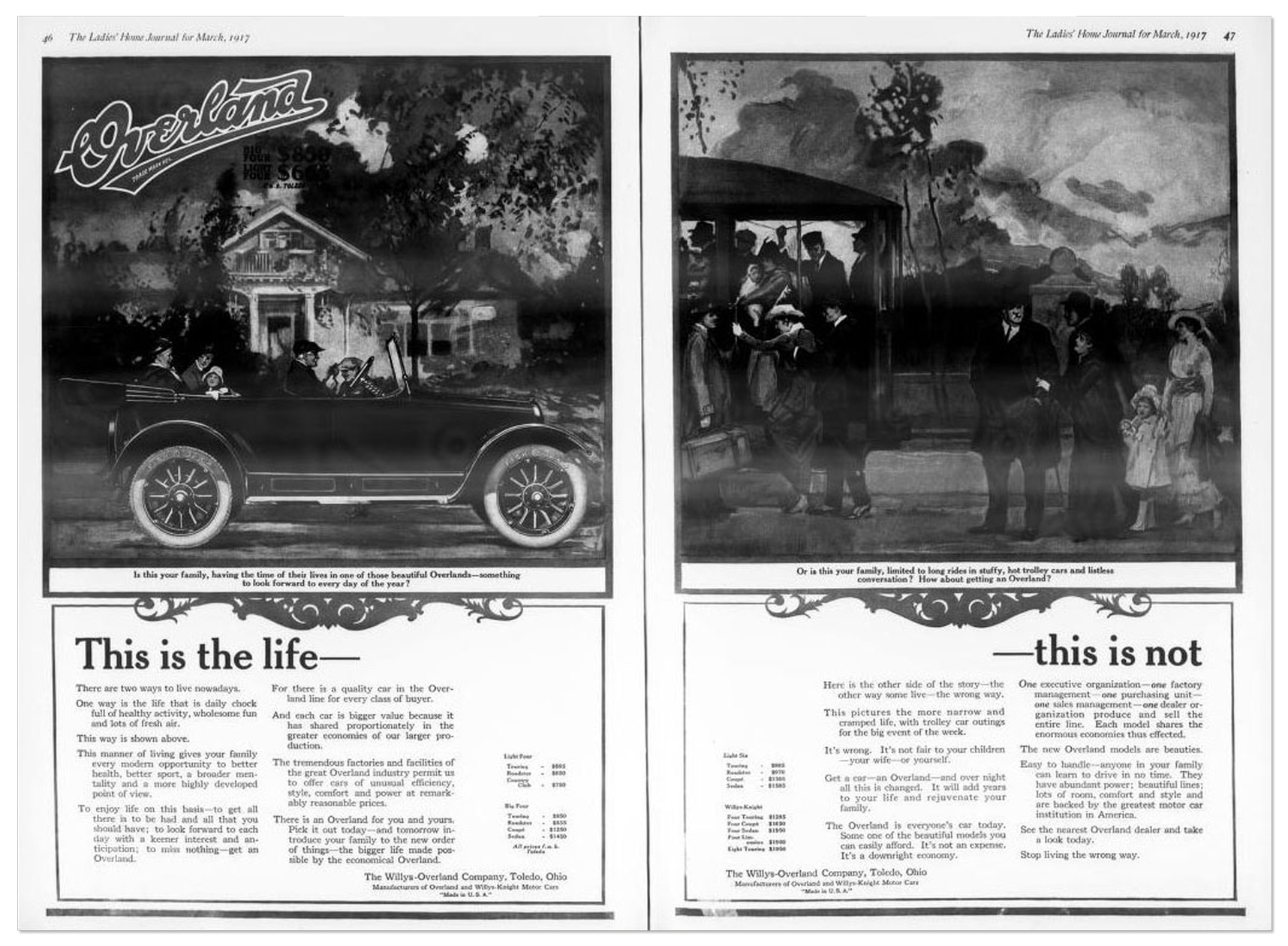
Up to that point, gasoline was basically a useless byproduct of kerosene, but the new automobile industry gave it a market. Automakers promoted their vehicles as superior to public transit, offering a step up in social status. In an advertisement that appeared in The Ladies’ Home Journal in 1917, the Willys-Overland Company, an Ohio automaker, sold its automobiles as “chock full of healthy activity, wholesome fun, and lots of fresh air”—which would make for “a bigger life.” That was supposedly in contrast to the “wrong way,” where families were subjected to suffering through “long rides in hot trolley cars and listless conversation.”

It was a preview of a major shift in marketing leading up to the 1930s. Previously, advertisements for cars had touted their features: the “favorable” ratio of their light weight to their horsepower, their seats upholstered with “fine, long-grain French leather.” But companies began marketing the benefits of using their products instead, painting situations in which a car could improve your life and status. Selling the American Dream meant selling leisure, enjoyment, beauty, good taste, and popularity along with the “mundane product,” as cultural historian Roland Marchand once wrote.
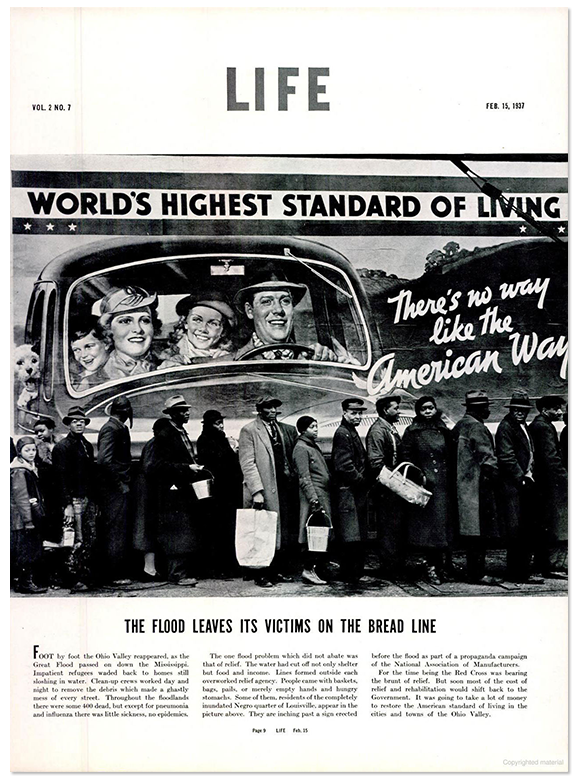
Most advertisers were aiming to reach Americans with means, and the everyday luxuries they depicted clashed with reality as the Great Depression set in. The photographer Margaret Bourke-White captured that sort of contrast after the Ohio River flood in Louisville, Kentucky, in 1937. A billboard ad from the National Association of Manufacturers showed a white family smiling as they drive through the countryside, while Black people waited for Red Cross relief under a sign proclaiming “There’s no way like the American way.”
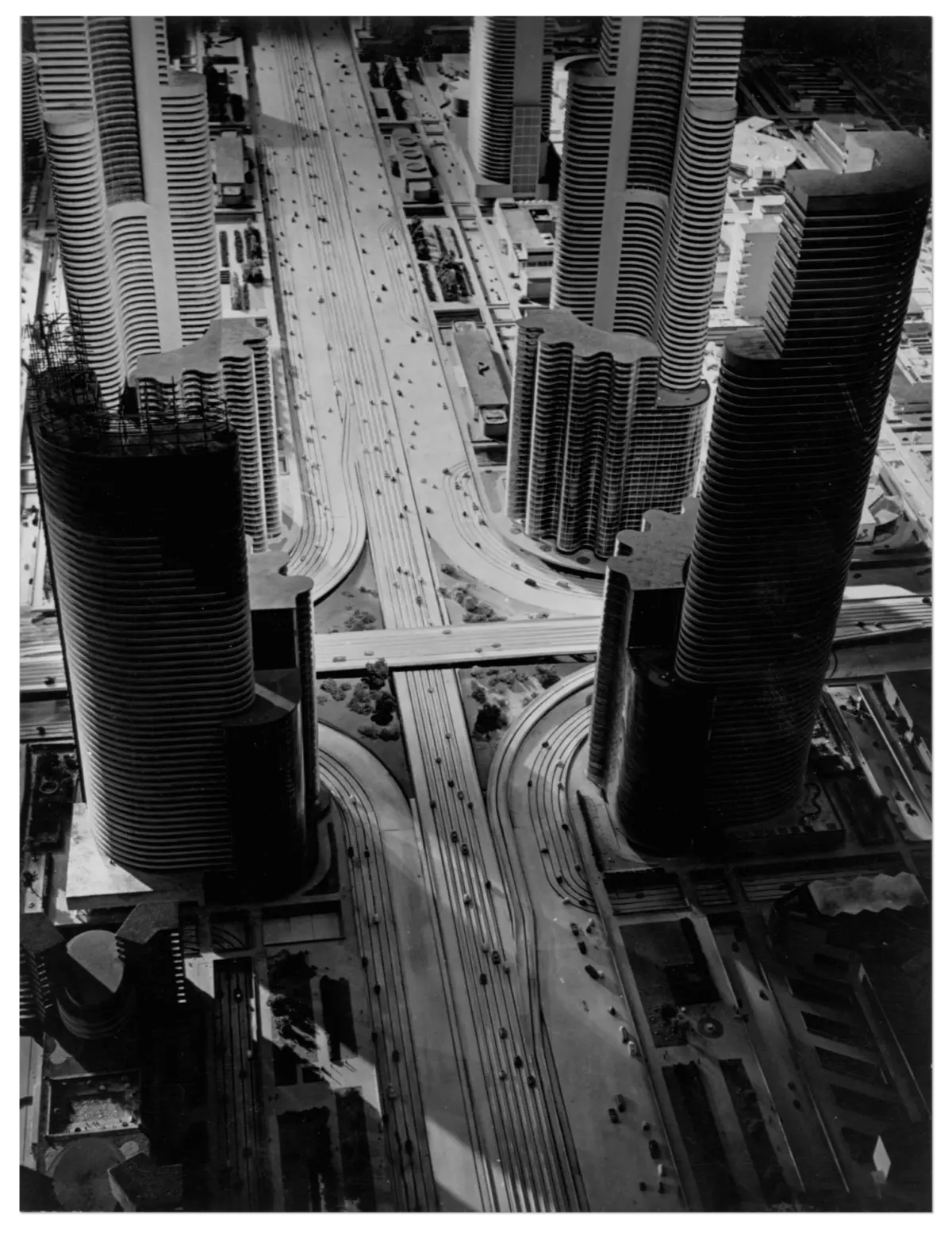
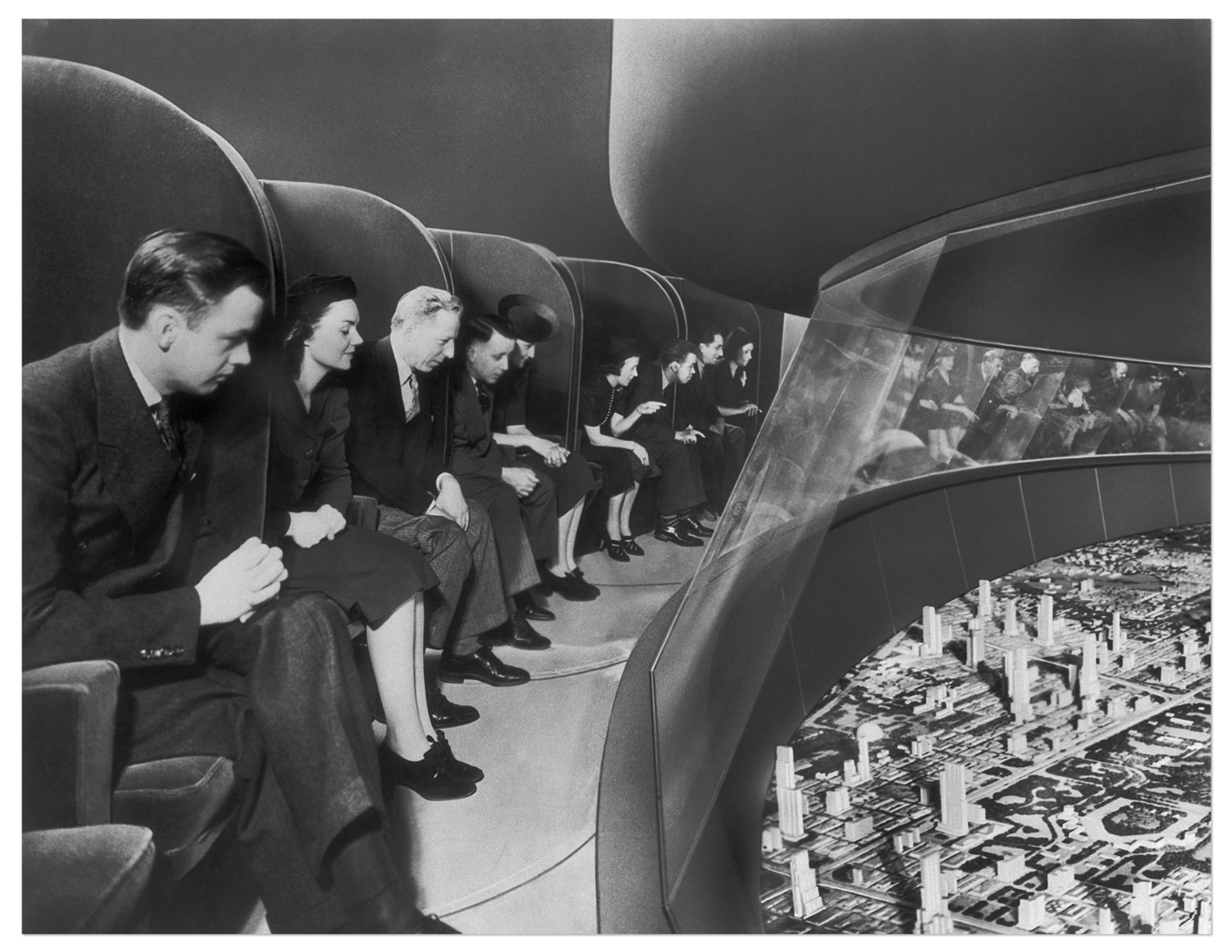
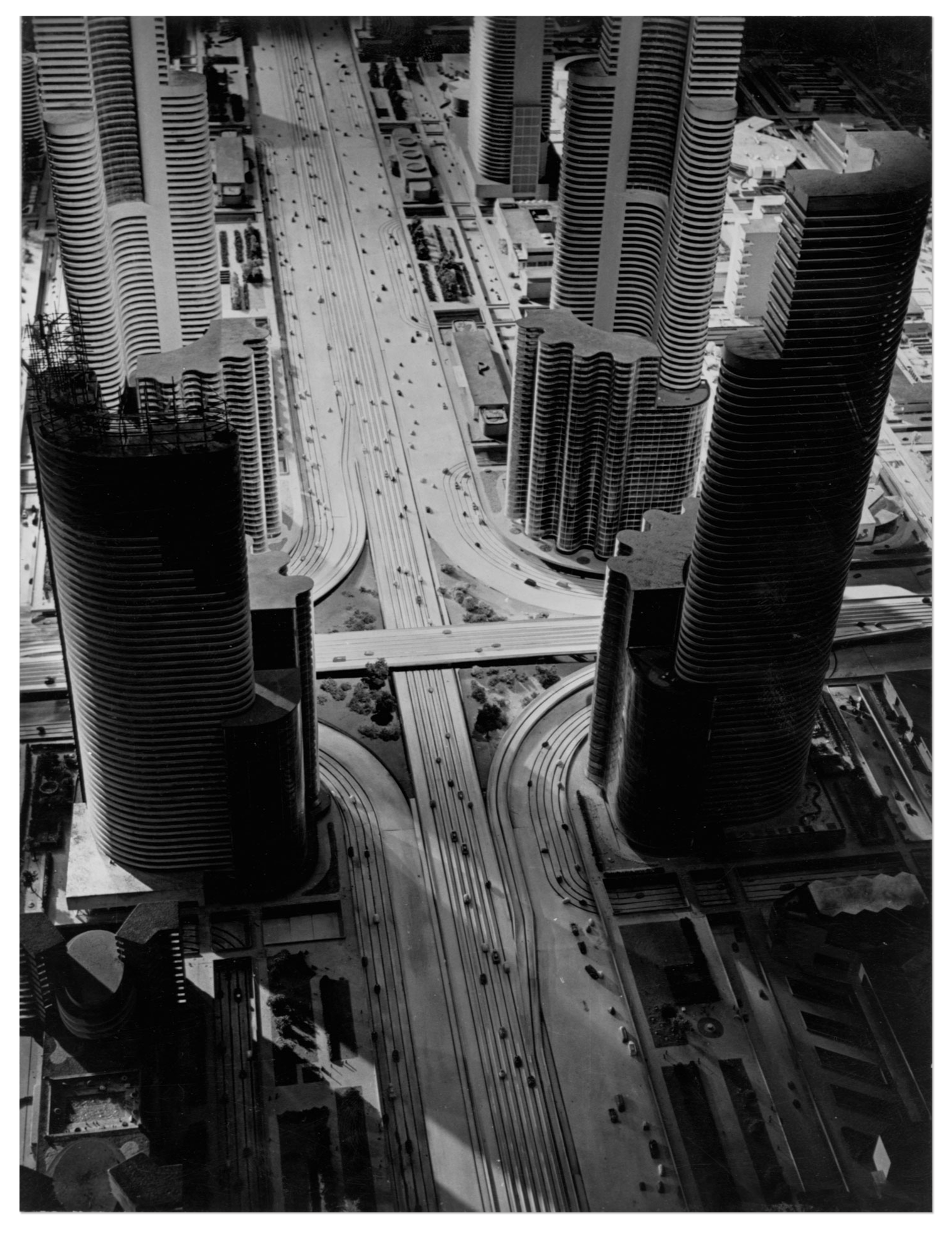
As the Great Depression began to recede, automakers saw an opportunity to pitch Americans on a brighter future—one that relied, of course, on cars. At the 1939-1940 World’s Fair in New York City, where the theme was “The World of Tomorrow,” General Motors had the most popular exhibit, seen by millions of people: the seven-acre “Highways and Horizons.” Its centerpiece, “Futurama,” was a sprawling diorama of a futuristic city in far-off 1960, covering 35,000 square feet, complete with skyscrapers and 14-lane highways. People looked down on the display from moving chairs on a conveyor-belt ride, as if they were viewing it from an airplane. It was the visual representation of a new American mindset—a Futurama booklet promised that highways would “set the pace for advancing civilization” and improve “welfare and happiness.” Afterward, visitors were handed pins saying, “I Have Seen the Future.”
From automobiles to oil, industry leaders grasped that appealing to a sense of national identity could legitimize their business. When the United States entered World War II in 1941, the oil industry boomed, producing fuel for planes and explosives. The wider public had been deeply suspicious of big corporations ever since the Depression, but the oil industry had a new way to defend itself, painting itself as patriotic and essential to the success of the broader American project.
“The petroleum industry deserves a better public opinion,” James H. Tanham, an executive at the Texas Company, wrote to a member of the Petroleum Industry War Council in 1943. “If properly handled, there probably never was a better time to undertake this work. There is nothing inimical about the prosecution of this war and this job. Both have to do with protection of a way of life, wholly American, against enemies without and within the country.”
That same year, the Union Oil Company of California launched an initiative specifically to “sell [the] public on [the] American way of life,” according to the trade journal National Petroleum News. Within five years, it was spending 30 percent of its advertising budget on the effort, promoting how a “free enterprise” economic system contributed to a higher standard of living. A Union Oil advertisement in Central Oregon’s Bend Bulletin in 1944 celebrated how American factory workers could afford more cigarettes and bread with an hour’s wages than those in Germany, Great Britain, or Russia. This success, the ad claimed, came down to “two fundamental principles: PROFIT and COMPETITION.”
After the war ended, the “American way” increasingly required a car. Suburbanization started taking off in earnest after 1946, when the Levitt family began acquiring 4,000 acres of potato farms outside Long Island. They leveled the land, had trucks drop building materials every 60 feet, and eventually built more than 17,000 cookie-cutter homes. Other “Levittowns” soon followed suit, built across the country as developers converted orchards and desert into neat subdivisions. From the end of World War II to 1954, some 9 million people settled into suburbs, becoming locked into a car-dependent lifestyle that consumed vast amounts of petroleum.
“Oil is basically the fuel that allows this dispersal of the population,” said Matthew Huber, a professor of geography and the environment at Syracuse University.
Yet oil companies worried that the public still didn’t properly appreciate how the fuel had transformed their lives. In response to a survey finding an “opinion vacuum” on the oil business, the American Petroleum Institute formed the Oil Industry Information Committee in 1948 to fill the void. “There is a great vacuum represented by men’s minds,” George H. Freyermuth, who led the public relations department for Standard Oil Company of New Jersey, said at the time. “We can’t let others fill the vacuum. We have got to create the knowledge to fill people’s minds.”
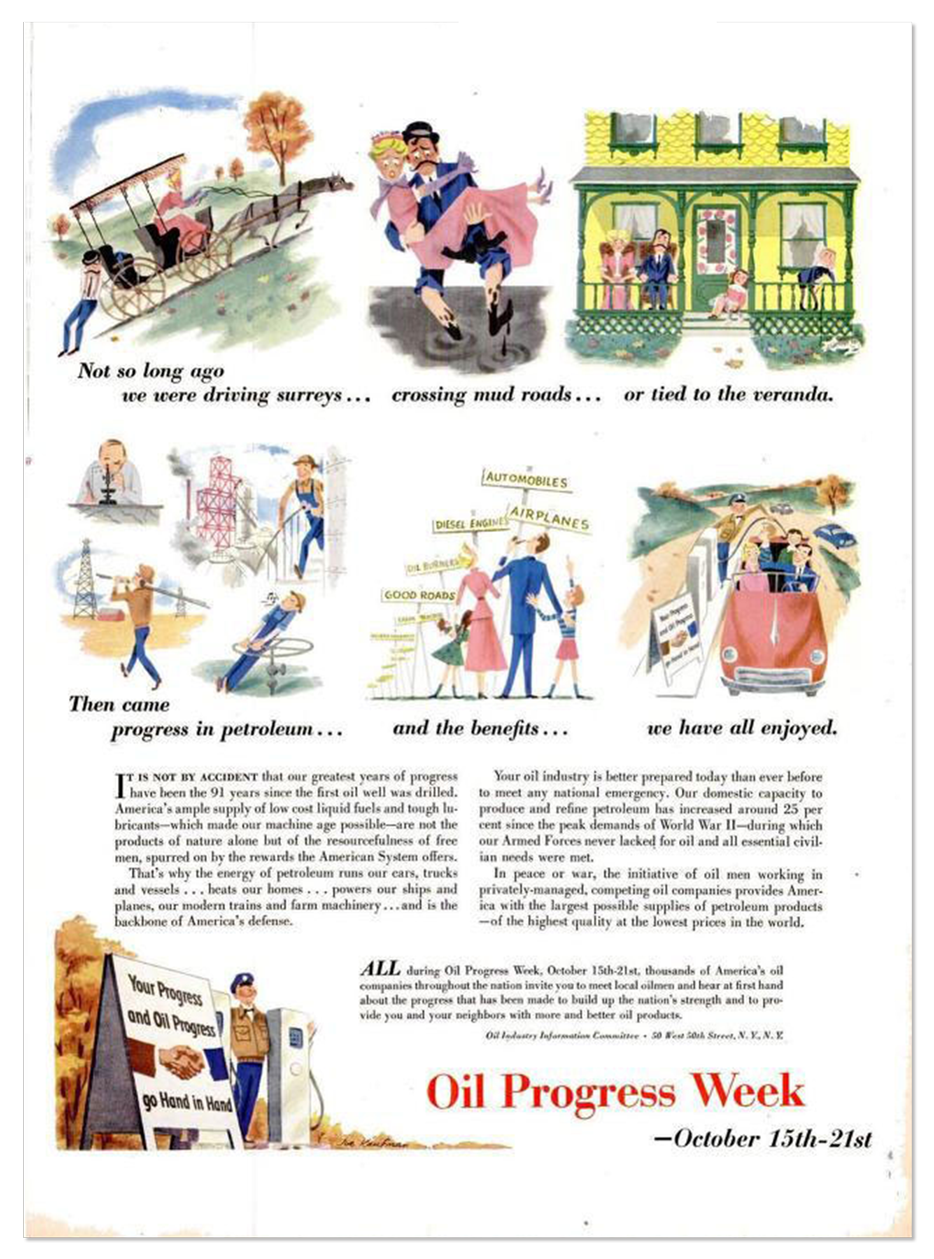
It was much more than an advertising campaign: The group built the infrastructure for promoting petroleum through schools, community parades, and exhibits. The committee produced pamphlets, sponsored films, radio programming, and educational materials for classrooms, but its signature initiative was Oil Progress Week: a national ad blitz that encouraged local events celebrating how oil fueled innovation and modern life.
As much as Americans were already driving, they could be driving more. Automakers and oil companies had been working together to promote highway construction for decades. In the 1950s, advertisements urged families to see the U.S. by car, framing the road trip as a matter of national pride. In the iconic jingle “See the USA in a Chevrolet,” TV star Dinah Shore urged viewers to get on the road to take in everything America had to offer, singing, “Life is complete-r in a Chevy.”
After the success of freeways in Los Angeles and a turnpike in New Jersey, President Dwight D. Eisenhower signed the Federal-Aid Highway Act in 1956, calling for a 41,000-mile superhighway system across the country. Futurama was becoming reality, roughly on schedule.
The Oil Industry Information Committee, meanwhile, had been busy making sponsored films glorifying oil’s contributions to American prosperity. The films were shown all over the country, from small towns to Texas oil country, at Rotary Club luncheons, school classrooms, and on TV. The committee claimed its films had been screened 92,500 times and seen by more than 12 million people in 1955 alone.
Its 1956 film, Destination Earth, followed a cartoon Martian who visited the United States and concluded that “the big secret is, of course, oil!” and that this substance provided “a whole galaxy of things to make a better life on Earth.”
During the postwar boom, profits from 14 big petroleum companies tracked by the Federal Reserve more than tripled, rising from $269 million in 1946 to $917 million in 1956. All that money brought scrutiny. Critics in Congress and the media wondered if the committee’s education efforts should be considered propaganda. Henry Stewart McKenzie Burns, president of Shell Oil Company, admitted there was “a little ulterior motive” to the work. “I have had a good deal of experience in public relations,” Burns said during questioning, “and you never can stop telling people that you are good. They might forget.”
‘A Word to the Wives’: Fossil fuels invade the home
An unusual performance took place on Atlantic City’s Steel Pier in 1923, during an American Gas Association convention. The wives and sisters of the assembled delegates settled in to watch “Progress,” a play that pitted an old-fashioned kitchen against a modern one, starring “Miss Polly Old Time” and “Miss Mary Modern Way.” As charming as the old ways were, there was no doubt whose vision would win.
Miss Mary was played by Ada Bessie Swann, home services director for the Public Service Electric & Gas Company of New Jersey. She led the industry’s push to introduce women to appliances powered by manufactured gas, the predecessor to natural gas. In the early 20th century, most women weren’t familiar with expensive stoves, refrigerators, and washing machines. They were used to cooking on wood or coal stoves and doing laundry by hand. So gas and electric utilities performed a service, showing homemakers how these appliances worked and convincing them of their benefits.
By 1925, these kinds of industry-sponsored lectures, demonstrations, and classes were reaching thousands of women every day. In Connecticut, utilities visited nearly 13,400 homes that year to instruct residents on the proper use of gas ranges. A daily radio show from a St. Louis utility aided the “home manager” with recipes and cooking advice while showing off a model gas-powered kitchen.
It was a clever strategy to speed up adoption and lock in future demand for gas. “Teaching [women] the art of home management as it has become today, is a duty of the gas company,” Swann wrote in a trade journal in 1925, “because by so doing it must reap for itself the profit of such service — Profits in goodwill. Profits in increased gas consumption.”
Electric competitors were also selling their “flameless fuel” as superior, and gas companies saw this as an existential threat. By 1930, gas executives were aggressively promoting their stoves. To do so, gas companies embarked on a decades-long campaign to influence the influential. Utilities recruited newspaper staff and heads of home economics departments of colleges to advertise the modern gas kitchen. The industry also worked to get favorable coverage in women’s magazines.
When the phrase “now you’re cooking with gas” started taking off on radio routines in 1939, the industry quickly capitalized on the free advertising, recruiting radio stars such as Jack Benny and Fred Allen. A representative of the American Gas Association also launched an effort to establish gas appliances as standard props in Hollywood films. By 1941, motion pictures had featured 202 all-gas kitchens, along with 360 gas ranges and 238 gas-powered refrigerators.
As World War II came to a close, the gas industry latched onto the patriotic mood with its “New Freedom Gas Kitchen” campaign, promising freedom from the drudgery of cooking. The actual model kitchens varied, but they had streamlined layouts built around gas-powered ranges, fridges, and automatic water heaters that could speed up clean-up by providing endless hot water.
A short film sponsored by the American Gas Association in 1955, A Word to the Wives, showcased a modern home equipped with gas appliances. When a busy homemaker visits her friend’s home filled with this technology, she is sold on how gas appliances can provide freedom from unnecessary drudgery.
Soon, it seemed like almost everything in the American dream house was made from petrochemicals, which some oil executives had predicted would be the most dramatic future field of development. As chemists experimented with petroleum derivatives, plastics began taking off, and Tupperware containers, polyester clothes, and synthetic carpets arrived in households. Shell’s alphabetical ad campaign pointed out that oil research helped with quick-drying paints, no-polish floor tiles, and weather-defying asphalt-shingled roofs. “In many ways,” the ad said, “your home is a house that oil built.”
‘The American lifestyle is not up for negotiation’
As the years passed, people forgot where this version of the fossil-fueled American Dream had come from. Like most successful propaganda, it simply became taken for granted. The country’s growing reliance on petroleum was seen as a sign of progress for much of the 20th century.
In the 1960s, however, the pollution from fossil fuels and all the products companies were pumping out was increasingly visible. Smog blanketed Los Angeles; an oil spill off the California coast washed sludge onto beaches; the polluted Cuyahoga River in Ohio caught on fire. The decade saw the federal government’s first serious effort to crack down on pollution, starting with the Clean Air Act in 1963. The environmental movement was born on Earth Day in April 1970, when an estimated 10 percent of the country’s population joined demonstrations demanding political action.
Then, the cheap, plentiful fuel that had enabled the American way of life was suddenly no longer cheap and plentiful. In 1973, oil-producing Arab countries stopped exporting petroleum to the United States because of its support for Israel during the Yom Kippur War, and oil prices nearly quadrupled. President Richard Nixon instituted a rationing program, and gas stations started running out of fuel.
The oil crisis threatened the car-powered American way of life, and “freedom” became a hot talking point. One advertisement from the New Car and Truck Dealers of America in 1979 asked readers to help protect their freedom to drive from people in government whose only answer to environmental problems was to restrict the automobile.
Another challenge arrived when the American public grew concerned over global warming. During an unusually hot summer in 1988, NASA scientist James Hansen warned Congress that the greenhouse effect had already been detected. Global warming became front-page news, and climate bills proliferated in Congress. President George H.W. Bush went into office declaring himself the environmental president, but as soon as it became clear that doing something about climate change meant curbing fossil fuels, his administration reversed course. By 1992, when countries met to sign a global climate treaty at the Earth Summit in Rio de Janeiro, Bush refused to commit to emissions reductions targets, and U.S. delegates insisted that “the American lifestyle is not up for negotiation.”
The idea that addressing climate change required a sacrifice of American values came up whenever the country considered limits on fossil fuels. In 1997, President Bill Clinton stood prepared to sign the Kyoto Protocol, which required countries to cut carbon emissions. But Mobil responded with alarm, warning in a New York Times ad that lifestyles and living standards would be altered, with carpooling in and sport utility vehicles out.
A pattern was established: Oil companies ramped up their PR campaigns whenever there was a push for climate action in Congress. They poured money into political campaigns and lobbying, played up doubts about climate science, and argued that cutting fossil fuels would threaten the American way of life.
But as fossil fuel emissions continued to rise, and hurricanes and wildfires grew more severe, Americans became increasingly worried about climate change. In the late 2010s, progressives channeled their energy into proposals for a Green New Deal, calling for bold investment in a clean economy. The ascendant right wing of the Republican Party had a ready-made response: The Green New Deal was an attack on freedom.
After years of failed climate proposals, politicians knew that mandates and regulations would be politically tricky. When President Joe Biden took office in 2021, the energy behind the Green New Deal was whittled down into a less ambitious project. In 2022, Congress passed the Inflation Reduction Act, full of tax credits and incentives to switch to clean energy. The administration instituted regulations mandating more efficient technology for household appliances, and conservatives keyed in on the upfront costs, arguing that the government was trying to control household decisions.
As Republicans geared up for the 2024 presidential run, they leaned into this narrative. Kevin Roberts, president of The Heritage Foundation, told an audience that the climate agenda was ending the American Dream.
Another way of looking at it, though, is that climate change itself is threatening the American Dream. Global warming pushes up the cost of food and energy, causes spikes in home insurance rates that can price people out of owning a home, and destroys homes with floods and fires. Fossil fuels, long sold as the key to achieving comfort and prosperity, have now begun pushing those goals further out of reach.
Can a ‘petroculture’ dream up something new?
The idea that climate advocates want to get rid of hamburgers, pickup trucks, and other iconic American standbys is often dismissed as culture war nonsense. But it begins to make sense if you see it as the result of a century-long campaign tying fossil fuels to the good life.
From the cars we drive to the plastics that surround us, oil has become part of daily life. Brulle, the sociologist at Brown, says the MAGA movement taps into a cultural belief in the rightness of petroleum in the American imagination more broadly.
The rise of MAGA Republicans has coincided with a sharp shift among members of the party toward embracing fossil fuels. Polling from the Pew Research Center shows that while 65 percent of Republicans supported prioritizing wind and solar development over oil, coal, and gas in 2020, that picture has flipped, with 71 percent now preferring fossil fuels. Scholars call the United States a “petroculture”—an oil society through and through.
So how does a country begin to rid itself of a century’s worth of oil and gas propaganda? It might start with understanding that none of this was predestined. The early 20th century began with electric cars and electric stoves; things might have stayed that way with a different PR campaign.
From the Green New Deal to more recent focus on abundance, parts of the left have tried to move past the narrative that tackling global warming requires sacrifice. But it will take more than catchy slogans to convince people that a comfortable life is possible without fossil fuels. Oil helped deliver a higher standard of living, and the fossil fuel industry spent decades reaching ordinary Americans with that message across movie screens and through public events.
Petroleum runs so deep in American culture that building another, cleaner version of the good life will take time and substantial investment. “Crafting the American Dream is the thing that advertisers have been doing for decades,” said Duncan Meisel, former executive director of Clean Creatives.
The American Dream was invented, so maybe it can be invented again.