
As guests took their seats for the latest runway presentation by Shushu/Tong in Shanghai, they were greeted by a charming, intentional harbinger of the collection’s aesthetic: a colorful umbrella placed neatly on every chair. The prop served as an immediate, tactile bridge to the inspiration behind the Spring 2027 collection, titled "Darling Melancholy." The title and the accessories were direct nods to Jacques Demy’s 1964 cinematic masterpiece, The Umbrellas of Cherbourg, a film celebrated for its vibrant color palette and bittersweet emotional weight. Yet, as the show unfolded, it became clear that designers Liushu Lei and Yutong Jiang were less interested in the heavy, lingering sorrow of Demy’s classic and more focused on the playful, sartorial possibilities of the era it represented.
By channeling the French New Wave, the designers infused their Shanghai runway with a distinctively nostalgic spirit. The collection acted as a stylistic collage, blending the structural minimalism of André Courrèges and the youthful, rebellious energy of Mary Quant with the contemporary, off-kilter sweetness that has become a hallmark of the Miu Miu aesthetic. The result was a sophisticated, multi-layered homage to the 1960s, passed through what the designers described as an "Asian lens." This perspective allowed the brand to strip away the historical grit of the period, leaving behind a polished, candy-coated vision of the past that felt entirely current.
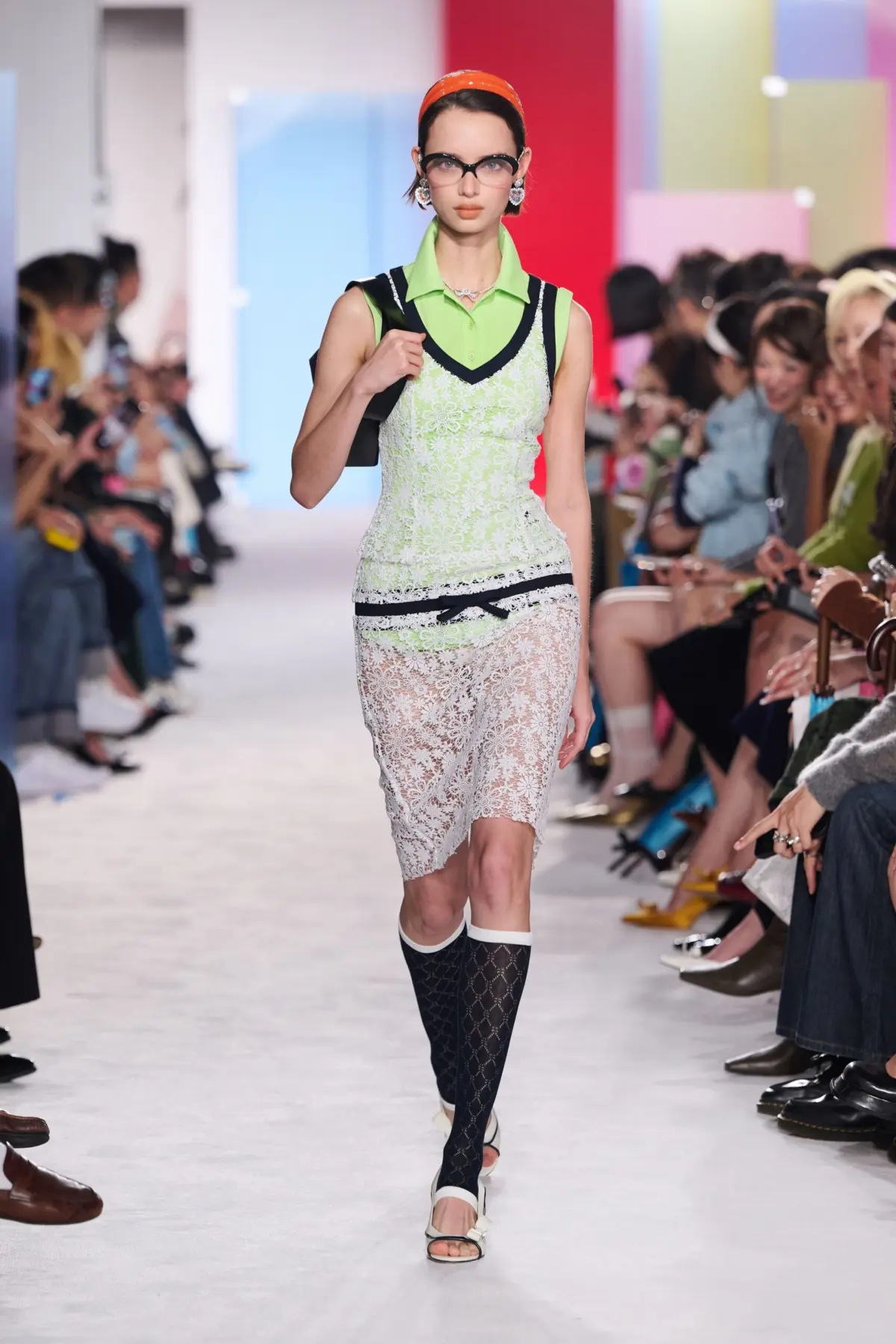
The garments themselves were a testament to the brand’s commitment to "unreal prettiness." Silhouettes were kept intentionally short and youthful, emphasizing a girlish charm that has long defined the Shushu/Tong DNA. Petal-edged details appeared as delicate accents, while balloon skirts provided volume and bounce, creating a dynamic silhouette that moved beautifully as the models walked. The texture play was equally deliberate; macramé lace was woven into candy-colored combinations, offering a tactile softness that contrasted with the architectural rigor of the boxier pieces. To round out the aesthetic, the designers applied a "drizzle" of embellishments, including beaded daisies that caught the light and served to keep the overall mood of the collection resolutely upbeat.
For those expecting the "melancholy" promised by the collection’s title, the runway offered a surprising, albeit delightful, subversion. Where the original film might have centered on heartbreak and the transient nature of love, Shushu/Tong’s version of these themes had been given a pink umbrella and told to smile. There was no room for brooding in the collection; instead, the designers embraced a kind of hyper-optimistic aesthetic that translated the complexity of the 1960s into something exceedingly pretty and neatly proportioned. The clothes felt disarmingly wearable, managing to balance high-concept fashion references with a level of comfort and functionality that modern consumers demand.
The designers, Liushu Lei and Yutong Jiang, have long drawn inspiration from their childhood fascinations with Japanese anime. This influence is not always literal, but rather manifests as a specific sensibility—a commitment to a schoolgirl uniform code that feels both nostalgic and slightly surreal. In this collection, that anime-inflected prettiness was the foundation upon which the 1960s references were built. By filtering the mod-era styles of Europe through their own unique design language, the pair successfully created a bridge between the past and their specific, stylized present. The "melancholy" might have been the thematic anchor of the title, but it was conspicuously absent from the skirts, which were designed for movement, joy, and visibility rather than reflection.
The show was not without its moments of contrast. Just as the sweetness of the lace and the floral beads reached a crescendo, the rhythm of the presentation shifted with the introduction of sporty details. These elements—crisp, athletic-inspired cuts or perhaps more utilitarian fabric choices—served as a necessary, if brief, disruption to the sugary flow of the show. It was a calculated move that prevented the collection from becoming purely decorative, reminding the audience of the brand’s ability to balance its signature "cuteness" with a more grounded, active aesthetic.
However, the final word on the collection’s narrative belonged to the accessories. Each model clutched a ladylike, boxy handbag in the crook of her arm, carrying them with the careful precision one might use when holding a delicate, cherished toy. These bags, which felt more like Pop Art objects than mere utility items, perfectly encapsulated the brand’s mission for the season: to treat fashion as a form of play. They were the perfect companion to the candy-colored skirts and macramé tops, providing a structured, geometric counterpoint to the softer elements of the clothing.
The reception from the front row was as focused as the designs themselves. The brand’s well-groomed, dedicated followers—many of whom are Very Important Clients (VICs)—watched with a distinct, laser-like intensity. Their engagement was not merely appreciative; it was analytical. Throughout the show, one could sense the audience mentally cataloging the looks, already deciding which of the balloon skirts or daisy-beaded pieces would earn a place in their upcoming wardrobes. For a brand that has built its reputation on a specific, recognizable aesthetic, this level of anticipation is the ultimate validation.
Ultimately, the Spring 2027 collection was a testament to the growth of Shushu/Tong. By grounding their whimsical, anime-inspired, and 60s-referential world in such high-quality execution, Lei and Jiang have solidified their place as designers who can synthesize complex cultural references into something that is both intellectually grounded and inherently wearable. They have managed to take the "melancholy" of a classic film and transform it into a collection that celebrates the present, proving that even the most bittersweet of inspirations can be turned into a joyful, vibrant statement of style. As the models made their final pass, it was clear that the brand’s "Darling Melancholy" was, in reality, a triumphant, unapologetic embrace of the playful and the pretty.