
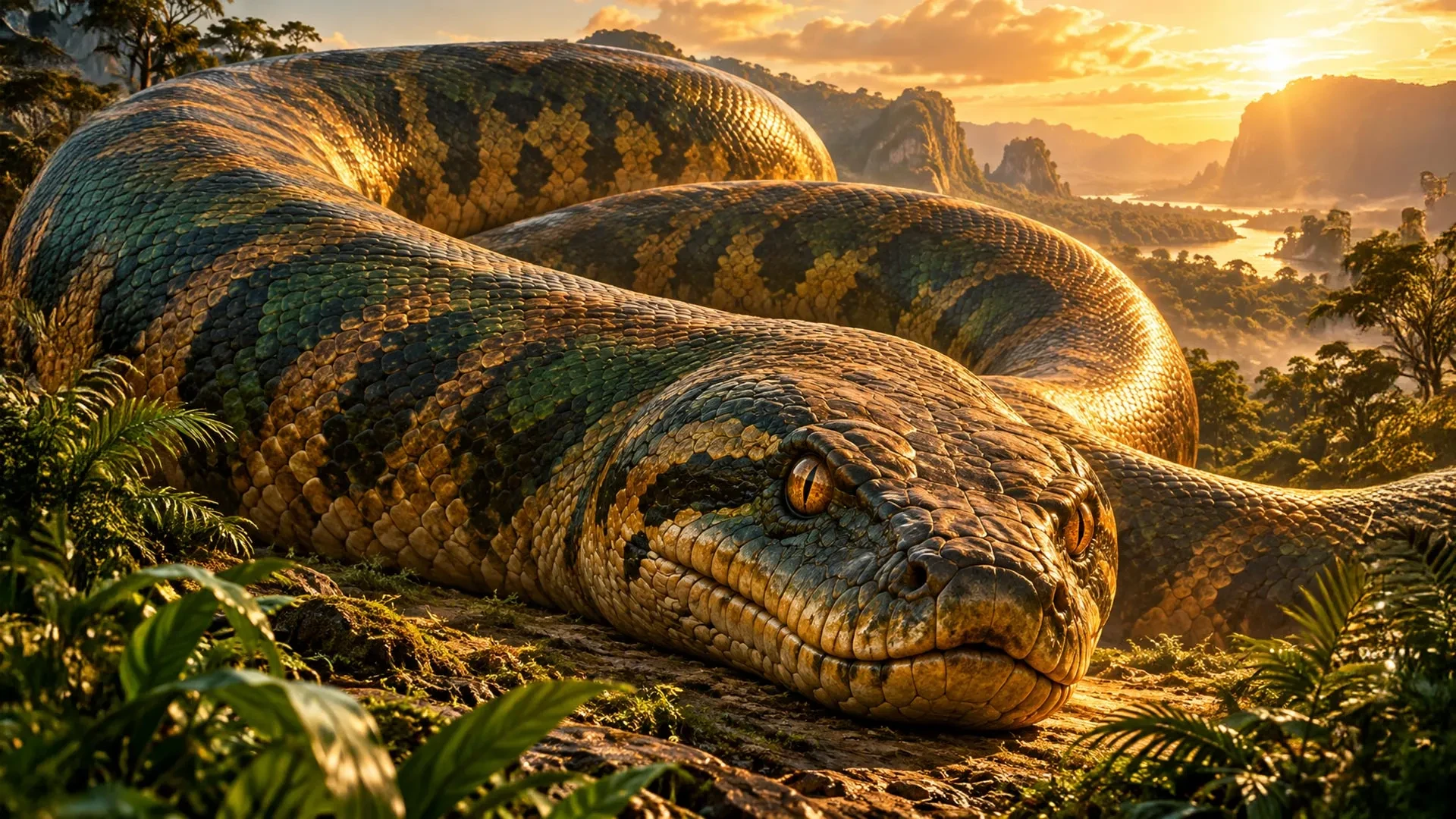
A colossal prehistoric snake that slithered across the landscapes of India approximately 47 million years ago may rank among the largest snakes to have ever existed on Earth. Named Vasuki indicus, this ancient reptile could have reached an astonishing length of 15.2 meters, or about 50 feet. This unprecedented scale places the creature in the same elite league as Titanoboa, the famously massive extinct snake that has long been regarded as the largest serpent ever discovered by science.
The remarkable paleontological discovery was formally described in 2024 in the academic journal Scientific Reports. It stems from a series of exceptional fossil excavations conducted at the Panandhro Lignite Mine, located in the Kutch region of Gujarat in western India. Researchers estimate that Vasuki measured anywhere between 10.9 and 15.2 meters long, spanning 36 to 50 feet, though its exact maximum size remains a subject of ongoing scientific inquiry and estimation. The creature’s immense physical proportions and unique evolutionary lineage provide a fascinating window into a bygone era when giant snakes dominated the warm, tropical environments of the Indian subcontinent.
Giant Snake Fossils Unearthed in India
The groundbreaking discovery was led by paleontologists Debajit Datta and Sunil Bajpai from the Indian Institute of Technology Roorkee. They successfully identified the new prehistoric species after analyzing fossilized remains recovered directly from the Kutch district of Gujarat. These ancient remains date back to the Middle Eocene epoch, a critical interval in Earth’s geological history occurring roughly 47 million years ago, during which global temperatures were considerably higher than they are today.
During their excavation and analysis, the researchers closely examined 27 individual fossilized vertebrae, which are the fundamental structural bones making up a snake’s vertebral column. Many of these bones were found to be remarkably well preserved, with several remaining physically connected in their original anatomical arrangement. Based on the degree of bone fusion and structural maturity, the scientific team concluded that these remains belonged to a fully grown, adult animal rather than a juvenile.
In keeping with paleontological tradition, the species was formally named Vasuki indicus. The genus name pays homage to Vasuki, the legendary and mythical serpent deeply rooted in Hindu mythology, who is traditionally depicted intimately wrapped around the neck of the deity Shiva. The species identifier, indicus, honors India, the country where the prehistoric fossils were successfully unearthed and identified.
How Big Was This Prehistoric Snake?
Although the scientific team did not recover a complete and unbroken skeletal frame, the meticulously preserved backbone offered vital anatomical clues regarding the snake’s staggering proportions.
The individual vertebrae recovered from the site measured between 37.5 and 62.7 millimeters in length, translating to roughly 1.48 to 2.47 inches. Furthermore, their widths spanned from 62.4 to 111.4 millimeters, or about 2.46 to 4.39 inches. The unusually broad and robust architecture of these bones strongly indicates that Vasuki possessed a thick, heavy, cylindrical body capable of supporting an immense amount of physical weight.
To calculate the total potential length of the animal, the researchers conducted comparative analyses, measuring the fossilized bones against corresponding vertebrae taken from modern snake species whose exact body lengths are thoroughly documented. By applying two distinct mathematical and comparative methods, the team generated two sets of estimates. The first method produced length ranges from 10.9 to 12.2 meters, equivalent to 36 to 40 feet, while the second method yielded projections stretching from 14.5 to 15.2 meters, or 48 to 50 feet.
These impressive calculations immediately position Vasuki securely among the largest snakes ever identified in the fossil record. Its estimated size directly rivals that of Titanoboa, the legendary giant snake that inhabited the tropical ecosystems of what is now Colombia approximately 60 million years ago, and which is generally calculated to have reached lengths of around 13 meters, or 43 feet.
Nevertheless, the researchers maintain a degree of scientific caution, emphasizing that their calculations involve considerable uncertainty. Different statistical methods can yield substantially divergent length estimates, especially when scientists are forced to reconstruct an extinct mega-predator using an incomplete vertebral column. Consequently, it remains undetermined whether Vasuki definitively surpassed Titanoboa in terms of overall length.
A Massive Predator That Likely Hunted by Ambush
Despite its profoundly intimidating dimensions and sheer physical presence, Vasuki was likely not a particularly fast or agile hunter.
The research team suggests that its exceptionally massive body mass and distinctive vertebral architecture would have favored relatively slow, deliberate movement. Rather than actively pursuing and chasing down fleet-footed prey across open terrain, the ancient serpent likely relied on traditional ambush tactics, remaining completely concealed within its environment until an unsuspecting animal wandered within striking distance.
This proposed hunting methodology bears a striking resemblance to the predatory behaviors exhibited by modern-day anacondas and large pythons. These contemporary constrictors utilize their immensely powerful, muscular bodies to seize and tightly coil around captured animals, applying relentless pressure that interferes with blood circulation until the prey ultimately succumbs.
Scientists strongly suspect that Vasuki employed a comparable strategy to secure its meals, although its exact dietary preferences and specific hunting habits cannot be definitively reconstructed from the surviving fossil evidence alone.
Anatomical indicators also suggest that the snake may have spent a significant portion of its life moving across land or navigating shallow, swampy aquatic environments, rather than residing exclusively in deep water. The ancient landscape surrounding the Gujarat fossil site was characterized by extensive wetlands and dynamic marshes, providing an ideal, resource-rich habitat for a colossal ambush predator.
Ancient India’s Warm Climate May Have Helped Snakes Grow Enormous
The discovery of Vasuki also revives long-standing scientific debates regarding the environmental catalysts that allowed certain prehistoric snakes to evolve sizes vastly exceeding those of any species alive today.
During the Middle Eocene epoch, the specific geographic region where Vasuki thrived experienced intense tropical climatic conditions, with average annual temperatures estimated to have hovered around 28 degrees Celsius, or 82 degrees Fahrenheit.
Snakes are ectothermic organisms, meaning they rely almost entirely on external ambient thermal sources to regulate their internal body temperatures. Persistently warm environments directly support higher metabolic activity, efficient digestion, and accelerated growth rates in large reptiles. This thermal abundance potentially explains why exceptionally giant snakes frequently appeared during some of the warmest greenhouse periods in Earth’s geological history.
However, researchers stress that ambient temperature alone does not dictate the maximum potential size of a snake. Critical ecological variables, including abundant food availability, suitable and expansive habitats, unique evolutionary histories, and other complex environmental pressures, all play vital roles in shaping and limiting animal body sizes over evolutionary time scales.
A Lost Lineage of Giant Snakes That Spread Across Continents
Beyond its sheer extraordinary size, Vasuki offers profound empirical evidence supporting the existence of a largely forgotten branch of snake evolution.
The species belonged to the Madtsoiidae family, an ancient and now-extinct lineage of snakes that successfully persisted for roughly 100 million years, spanning from the Late Cretaceous period all the way through to the Late Pleistocene. Members of this remarkably successful group inhabited diverse regions across the globe, including the Indian subcontinent, Africa, Europe, South America, and Australia.
Unlike modern anacondas and pythons, Vasuki represented a distinctly separate evolutionary lineage within this long-extinct family tree.
Upon conducting detailed comparative analyses, the researchers discovered that its closest evolutionary relatives included Madtsoia pisdurensis, another fossil snake previously recovered from ancient India, and Gigantophis garstini, a similarly massive prehistoric snake known from fossil deposits in North Africa.
These phylogenetic relationships strongly indicate that a specialized lineage of giant madtsoiid snakes originated directly on the Indian subcontinent before subsequently dispersing into other major parts of the world.
As the Indian tectonic plate drifted steadily northward and eventually collided with the Asian continent roughly 50 million years ago, shifting geographic land bridges and changing continental connections likely enabled these massive reptiles to disperse through southern Eurasia, extending into southern Europe and eventually migrating into Africa during the Eocene epoch, roughly 56 to 34 million years million years ago.
Later Fossil Discoveries Reveal an Ancient World Filled With Snakes
Subsequent research published in 2025 has provided crucial broader context for the initial discovery of Vasuki.
In a study published in the Journal of Paleontology, Datta and Bajpai described additional fossil snake specimens recovered from Eocene geological deposits in western India. Their findings revealed a surprisingly rich and diverse community of ancient reptiles inhabiting the region, which included specialized aquatic snakes, another large representative of the madtsoiid family, and several other now-extinct snake lineages.
Among these subsequent finds was Pterosphenus rannensis, an ancient aquatic snake species that significantly enhances scientific understanding of how these diverse reptiles evolved, adapted, and spread across aquatic niches.
The researchers also successfully identified another madtsoiid snake that appears to have coexisted directly within the same marshy environment alongside Vasuki. This discovery suggests that the giant predator was merely one prominent member of a broader, thriving community of snakes occupying various ecological roles, rather than standing alone as an isolated evolutionary oddity.
Physical evidence gathered from these fossil deposits clearly indicates that while some of these ancient snakes adapted to tidal coastal environments, others preferred inland swamps and marshes. Together, these cumulative discoveries paint an increasingly detailed portrait of the complex, multifaceted ecosystems that flourished across India tens of millions of years ago.
What Modern Anacondas Reveal About Giant Snakes
Additional empirical insights concerning snake gigantism emerged from a separate 2025 study published in the Journal of Vertebrate Paleontology.
During this investigation, researchers analyzed newly discovered fossilized anaconda vertebrae originating from deposits in Venezuela. Their findings revealed that these enormous modern lineages had already evolved large bodily proportions by approximately 12.4 million years ago. These ancient anacondas reached estimated lengths of around 5.2 meters, or 17 feet, closely matching the dimensions of many living anacondas seen today.
These findings suggest that anacondas successfully maintained their impressive size parameters across millions of years, enduring major climatic and ecological shifts without significant reduction. Furthermore, the data demonstrates that prehistoric snakes did not necessarily evolve massive bodies simply because the global climate happened to be warmer at the time.
Although modern anacondas are evolutionarily distinct from Vasuki, this comparative research provides scientists with a useful framework for understanding the diverse ways in which separate snake lineages achieved gigantism and successfully adapted to changing environments.
For Vasuki indicus, the complete historical narrative remains partially unwritten. Its precise external appearance, behavioral patterns, and definitive maximum size limits remain open to ongoing scientific debate, but the preserved fossil evidence firmly cements its status as an extraordinary testament to prehistoric gigantism.
Alongside subsequent fossil discoveries retrieved from the same region, this ancient serpent continues to assist researchers in reconstructing a largely forgotten epoch when massive, apex-predator snakes ruled the sprawling tropical landscapes of ancient India.