
Niku Argane’s farm sits on a steep hillside in central Ethiopia’s semi-mountainous Gurage Zone, where years of relentless flooding have carved deep, jagged gullies through the earth. Soil that once produced enough barley and potatoes to feed his wife and four children—while leaving a healthy surplus to sell at the local market—has steadily eroded away. Meanwhile, worsening droughts have made the land that remains remarkably difficult to cultivate.
“We have never stopped farming, but our production declined because of land degradation,” the 32-year-old farmer said from his land in Ambele Kebele.
Over the course of the last century, Ethiopia nearly eradicated its native forests as trees were systematically cleared to clear room for expanding agriculture, livestock grazing, and wood fuel. The devastating loss of tree cover and intricate root systems allowed seasonal winds and heavy rains to wash away fertile topsoil, directly contributing to declining crop yields across the nation. Today, that historic vulnerability is being severely compounded by accelerating climate change.
Ethiopia is widely recognized as one of the countries most vulnerable to the impacts of global heating. Heavier and more erratic downpours are sluicing away already depleted soils and triggering deadly landslides, while more intense droughts, combined with the loss of cooling shade that mature trees once provided, rapidly dry out the landscape.
The economic and human toll of this crisis is immense. Land degradation costs the country an estimated $4.3 billion every year through smaller harvests and lost income for smallholder farmers, translating directly into critical food shortages. With more than 100 million Ethiopians dependent on agriculture for their daily livelihoods, the consequences reach far beyond the natural environment. Climate shocks and recurring crop losses stand among the primary drivers of acute hunger in the region. In 2024 alone, an estimated 15.8 million Ethiopians—roughly 12 percent of the national population—required emergency food assistance.
Now, the country is undertaking an unprecedented effort to reverse this dangerous trajectory. Argane recently planted 80 tree seedlings on his own farmland and another 50 in a communal area—representing his small, localized contribution to a vastly larger national undertaking.
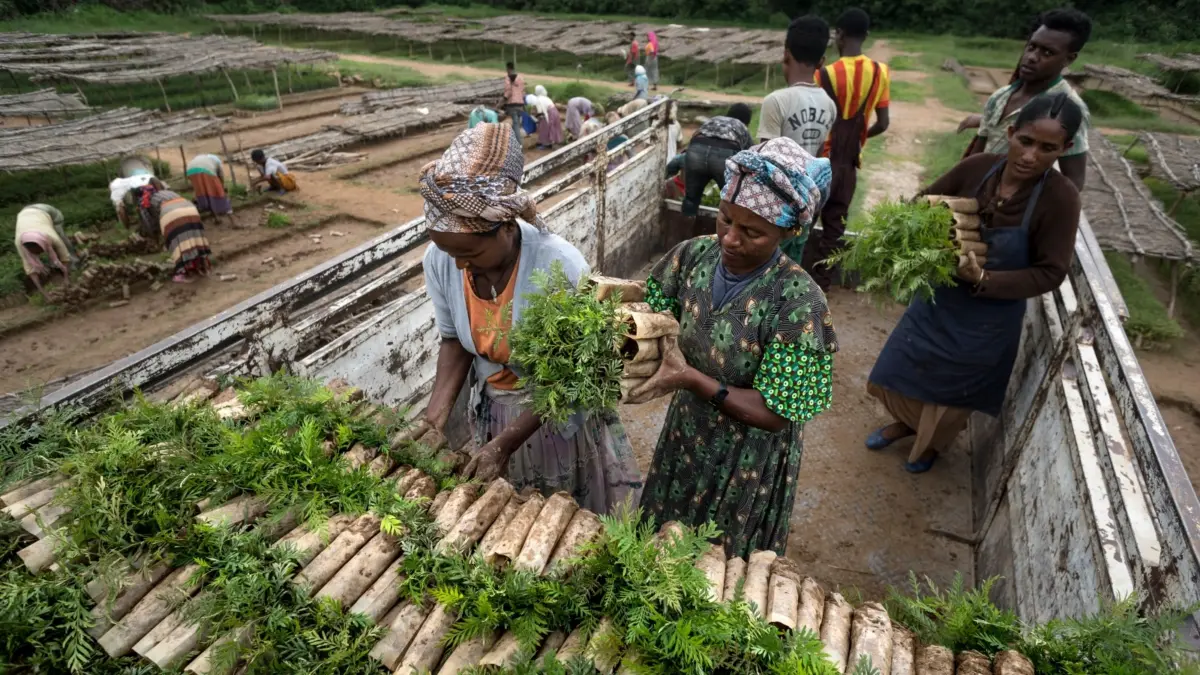
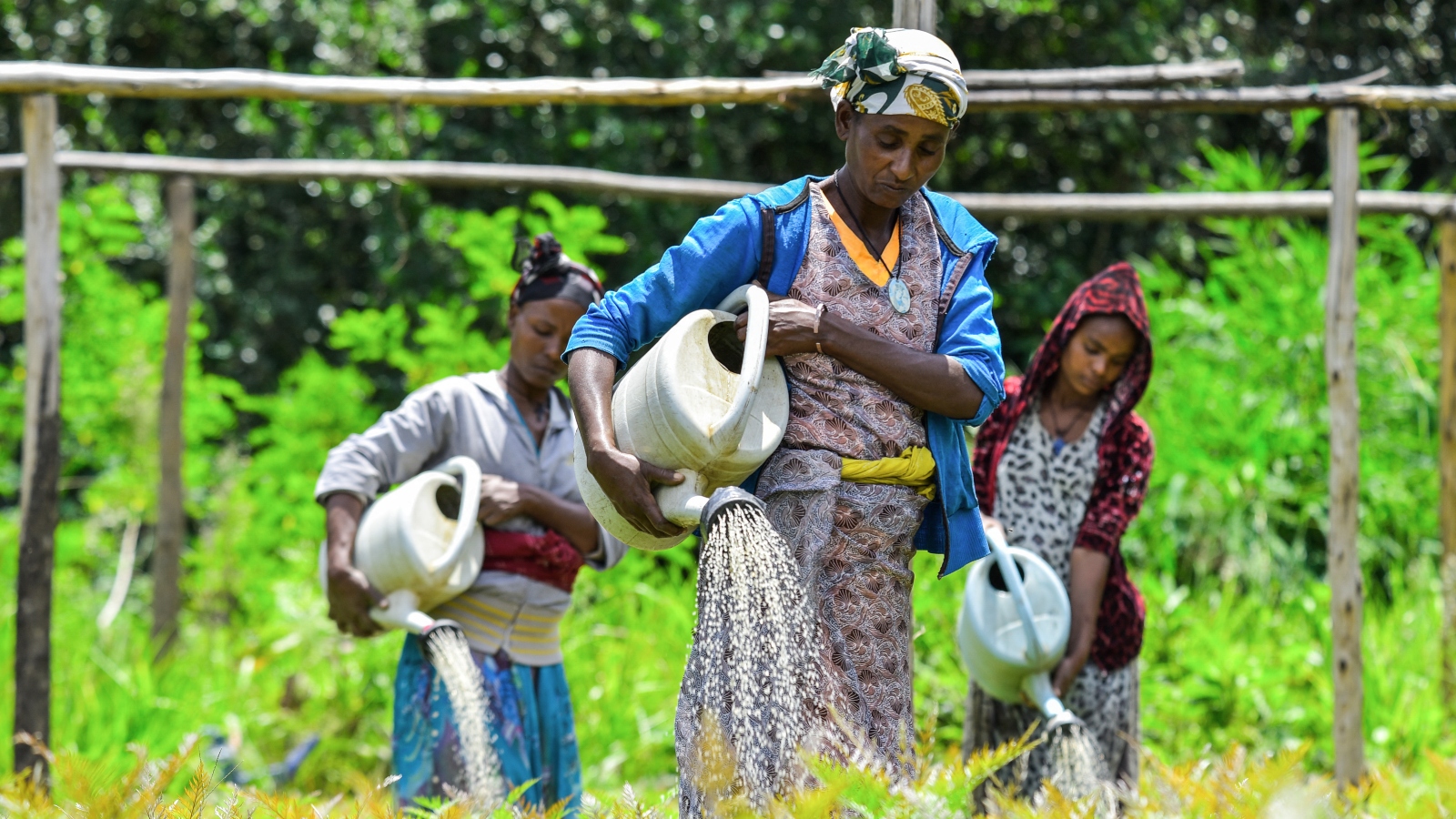
In just the last seven years, tens of millions of Ethiopian citizens have planted more than 47 billion seedlings across the country in what has become one of the largest environmental restoration campaigns in human history. Operating under the banner of the Green Legacy Initiative, the program aims to plant a staggering 50 billion seedlings by 2030. Volunteers are working diligently to rebuild native forests and thoughtfully integrate trees into existing farmland, sequestering carbon in the process and striving to protect future generations from ever-more extreme weather events.
While large-scale reforestation programs frequently fall short of their lofty goals, many people in Ethiopia are finding deep hope in the sheer scale of the ambition.
“Reforestation is one of the most difficult things you can imagine,” said Aad Kessler, a researcher at Wageningen University in the Netherlands. “It almost always fails, but this is so big that even if 30 percent of the trees survive, it’s still huge.”
Historical context underscores the magnitude of the challenge. In the early 20th century, dense forests covered an estimated 35 to 40 percent of Ethiopia, with greenery spanning much of the country’s cool, fertile uplands. However, as local populations grew and settlements expanded, trees were cleared for agriculture, pasture, fuel, and construction. As soils steadily lost their natural fertility, cultivation pushed onto increasingly marginal lands, including steep mountain slopes. Without protective vegetation and proper tillage management, fertile topsoil washed away into rushing rivers and vital reservoirs. By 1989, national forest cover had plummeted to an estimated less than 3 percent, while Ethiopia’s highlands were losing around 1 billion metric tons of topsoil every single year.
Following the devastating droughts and famines of the 1970s and 1980s, the Ethiopian government and international donor organizations began investing heavily in foundational soil and water conservation projects. These early measures included excluding livestock from worn-out tracts of land, planting trees, building stone terraces, and constructing check dams—small, low barriers made of rocks and logs placed across gullies to slow the destructive flow of rainwater. By the 2000s, these vital restoration programs were being implemented at an increasingly large scale.
The government supercharged this momentum in 2019 by transforming tree-planting into a sweeping national campaign known as the Green Legacy Initiative. The scheme successfully mobilized millions of individuals and groups, including smallholder farmers, public servants, schools, and religious organizations, while distributing free seedlings across every corner of the country.
In 2024, the government established the Green Legacy and Landscape Restoration Special Fund, committing between 0.5 percent and 1 percent of the annual federal budget—roughly $73 million to $145 million—specifically toward restoring damaged landscapes. Development experts note that this was an unusually large financial commitment for a low-income nation, and the program’s undeniable ambition and scope contributed significantly to Ethiopia being selected as the host of the upcoming United Nations climate conference, offering a prestigious international platform to showcase its greening efforts.
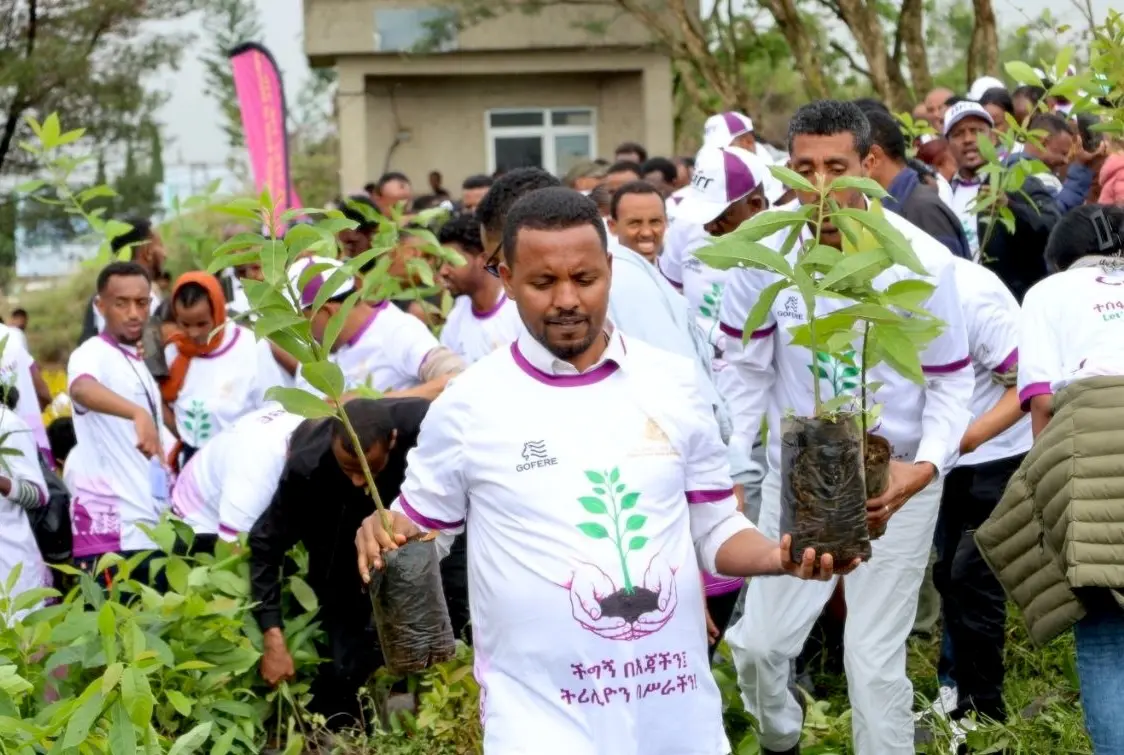
The mobilization capacity of the campaign is immense. In August, 26.6 million Ethiopians planted 800 million tree seedlings in a single day, according to official government figures, surpassing the previous year’s impressive tally of 714.7 million.
Among the dedicated participants was Yeshihareg Teferi, who traveled at sunrise from her home in Addis Ababa to Tulu Dimtu to hunch in the cold rain and dig holes in the mud. It marked Teferi’s fifth consecutive year participating in the annual event. While she had previously planted indigenous species such as the African wild olive and African fern pine, this time she deliberately chose juniper.
“We have a responsibility to ensure future generations inherit a green and fertile environment, rather than barren land,” she said.
Tangible signs that the grueling work is having a positive impact are already emerging across the landscape. The Ethiopian government reports that national forest cover rose from 17.2 percent in 2019 to 23.6 percent in 2023. Furthermore, scientific studies of restored areas have documented substantial reductions in soil erosion. Between 2013 and 2023, the annual deforestation rate fell sharply from more than 350 square miles to approximately 100 square miles.
These concerted efforts are also providing unexpected benefits for local wildlife populations. In Abijata-Shalla National Park, located in the Ethiopian highlands, conservation workers replanted degraded areas, constructed terraces, and built contour bunds—small earthen ridges running across hillsides designed to slow runoff and allow water to thoroughly soak into the soil. As trees and native vegetation returned, groundwater infiltration increased noticeably, and water levels in the park’s lakes began to rise, according to Kumera Wakjira, director-general of the Ethiopian Wildlife Conservation Authority.
The rebounding water levels spurred the return of various fish species and fish-eating birds, including cormorants and African darters. At the same time, Grant’s gazelles and wild dogs are beginning to expand back into territories where they were previously scarce, Wakjira noted.
Despite these encouraging victories, newly planted trees face significant survival hurdles. A 2022 study examining 176 reforestation projects across Asia found that roughly half of all planted trees did not survive past five years. Moreover, experts emphasize that simply planting trees does not automatically create a functioning forest.
Endalkachew Wolde-Meskel, a soil scientist and senior researcher at the Center for International Forestry Research, explained that true ecological restoration usually requires the natural regeneration of grasses and understory vegetation, paired with dedicated soil- and water-conservation measures and long-term management by local communities.
“The objective is not really ‘plant trees,’” he noted. “It is to restore the functioning of the entire landscape.”
Emiru Birhane Hizikias, an Ethiopian restoration ecologist at Norway’s Nord University, described having the prime minister personally lead the tree-planting charge as a “blessing, politically speaking.” However, he cautioned that the breathtaking speed and scale of the Green Legacy Initiative have sometimes outpaced the necessary administrative and technical systems required to ensure long-term survival on the ground. Too often, he argued, the primary focus remains on getting massive numbers of seedlings into the earth rather than ensuring they are properly nurtured.
“You can’t expect a baby to grow if you don’t care for it,” Hizikias said, adding that “that’s how plantation in Ethiopia is being done.”
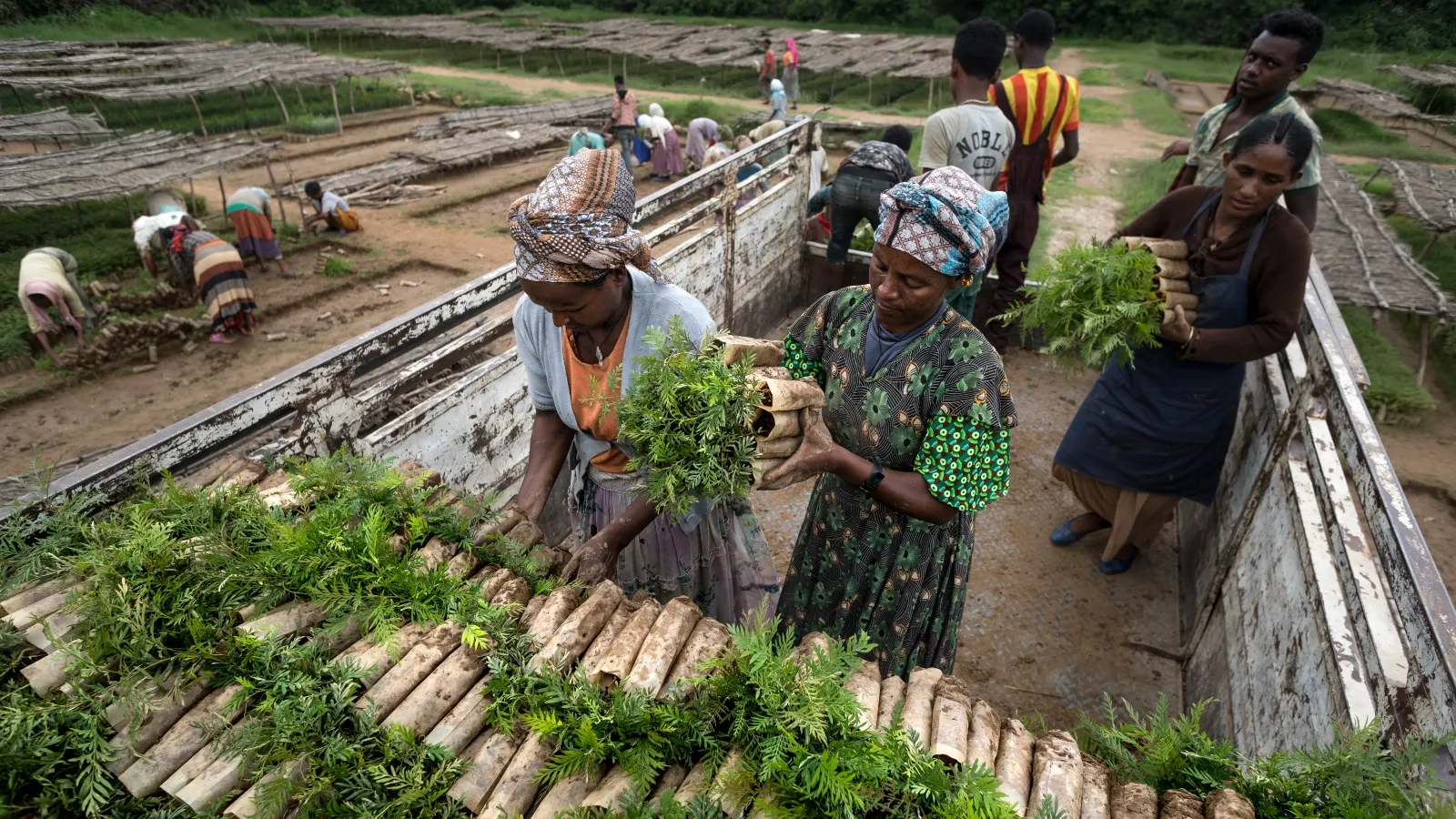
Other experts strongly dispute that characterization. Abreham Berta Aneseyee, an environmental scientist at Wolkite University in Ethiopia and an adviser to the Ministry of Agriculture, maintains that the massive planting campaign is closely accompanied by practical, hands-on guidance from government forestry and farming experts. These specialists travel from farm to farm, advising smallholders on how to properly plant and care for different types of seedlings—including how deeply to place them in the soil and how to construct stabilizing structures like bunds. They also educate farmers on sustainable forest management and the importance of protecting mature trees rather than cutting them down.
A 2026 study analyzing more than 44,500 seedlings planted in southern Ethiopia under the Green Legacy Initiative in 2023 found that about 80 percent had successfully survived. Survival rates were significantly higher among older seedlings, those planted during the wet season, and those whose planters had received specialized training in best plantation practices. In the Humbo and Boloso Sore districts of Ethiopia’s southwestern Wolaita Zone, the Green Legacy Initiative has been successfully layered onto longer-running community land management efforts, with residents building check dams to stabilize gullies, digging half-moon ditches to trap scarce water, and planting trees alongside native grasses and shrubs.
Kessler noted that Ethiopia’s approach has few direct parallels in Africa due to its unique combination of top-level political leadership, dedicated domestic funding, massive public mobilization, and sheer geographic scale. He compared the undertaking to China’s historic restoration of the Loess Plateau, one of the most severely eroded regions on Earth. In the 1990s, China launched major restoration initiatives on the plateau—including a World Bank-backed watershed rehabilitation project and the 1999 Grain for Green program, which financially compensated farmers to restrict cultivation on vulnerable slopes and plant trees, shrubs, and grasses. By 2016, more than 11,500 square miles of rain-fed cropland had been successfully converted to dense forest or grassland, driving a 25 percent increase in regional vegetative cover over a single decade.
Important limits to the comparison remain, however. While China paid farmers to completely take degraded slopes out of agricultural production, millions of Ethiopian smallholders still rely heavily on their small plots for daily food and survival. Still, Kessler observed that both monumental efforts share a fundamental philosophy: “Do it massively, and then see where you end up.”
Kessler’s own work, which includes a government-backed field project in Ethiopia, adopts a more participatory methodology by directly involving farmers and local communities in decentralized decisions regarding what areas to restore and how to manage them.
“Of course it is better [than top-down action],” he acknowledged, “but it takes more time.”
Even as Ethiopia pours resources into rebuilding its forests and soils, accelerating climate change continues to alter the environmental baseline that these fragile landscapes must withstand. In the arid pastoral regions of Afar and Somali, the Green Legacy Initiative specifically focuses on planting drought-tolerant species, yet it remains uncertain whether the trees taking root today will survive the harsher climate conditions projected for coming decades.
The Intergovernmental Panel on Climate Change projects increasingly frequent and intense rainfall events across East Africa as global temperatures continue to rise. In July 2024, exceptionally heavy rainfall in Ethiopia’s southern highland district of Geze Gofa triggered two devastating landslides that killed at least 257 people. Recent scientific studies also suggest that climate change is driving more frequent and severe El Niño cycles, with profound consequences for the region. Over the summer, the Famine Early Warning Systems Network linked El Niño to historically poor summer rains in parts of Ethiopia, leaving certain areas facing their driest June and July on record.
For many farmers, these shifting climatic patterns have already complicated the foundational requirement of agricultural restoration: helping young seedlings survive their critical first season.
Belayneh Mamo, a 65-year-old farmer from Ethiopia’s northern and drought-prone Amhara region, traditionally relies on July rainfall to water his teff, sorghum, maize, and wheat crops. Although he receives government-provided coffee, neem, and gesho seeds, he was unable to plant anything this year until August, when the season’s delayed rains finally arrived.
“In previous years, September was a period when crops were already developing and food such as bulgur and maize were becoming available for consumption,” Mamo said. “The delays affected the seedlings we plant, our crops, and the availability of animal feed.”
Back on Argane’s hillside farm in the Gurage Zone, however, tangible signs of environmental recovery are already evident. Since 2019, he has planted grasses, fodder plants, fenugreek, and fruit trees along the edges of his fields. These additions help anchor the fragile soil in place while providing essential feed for the four cows, six goats, and three sheep he keeps for milk and meat. As a result of these restorative practices, his barley harvest has risen from about 1,800 pounds per acre to roughly 3,200 pounds, while the new trees and grasses have successfully reduced erosion and slowed the destructive velocity of water rushing across his land during heavy seasonal downpours.
“Restoring degraded land isn’t just about protecting the environment,” Argane reflected. “It’s also about making life better for my family and community.”