
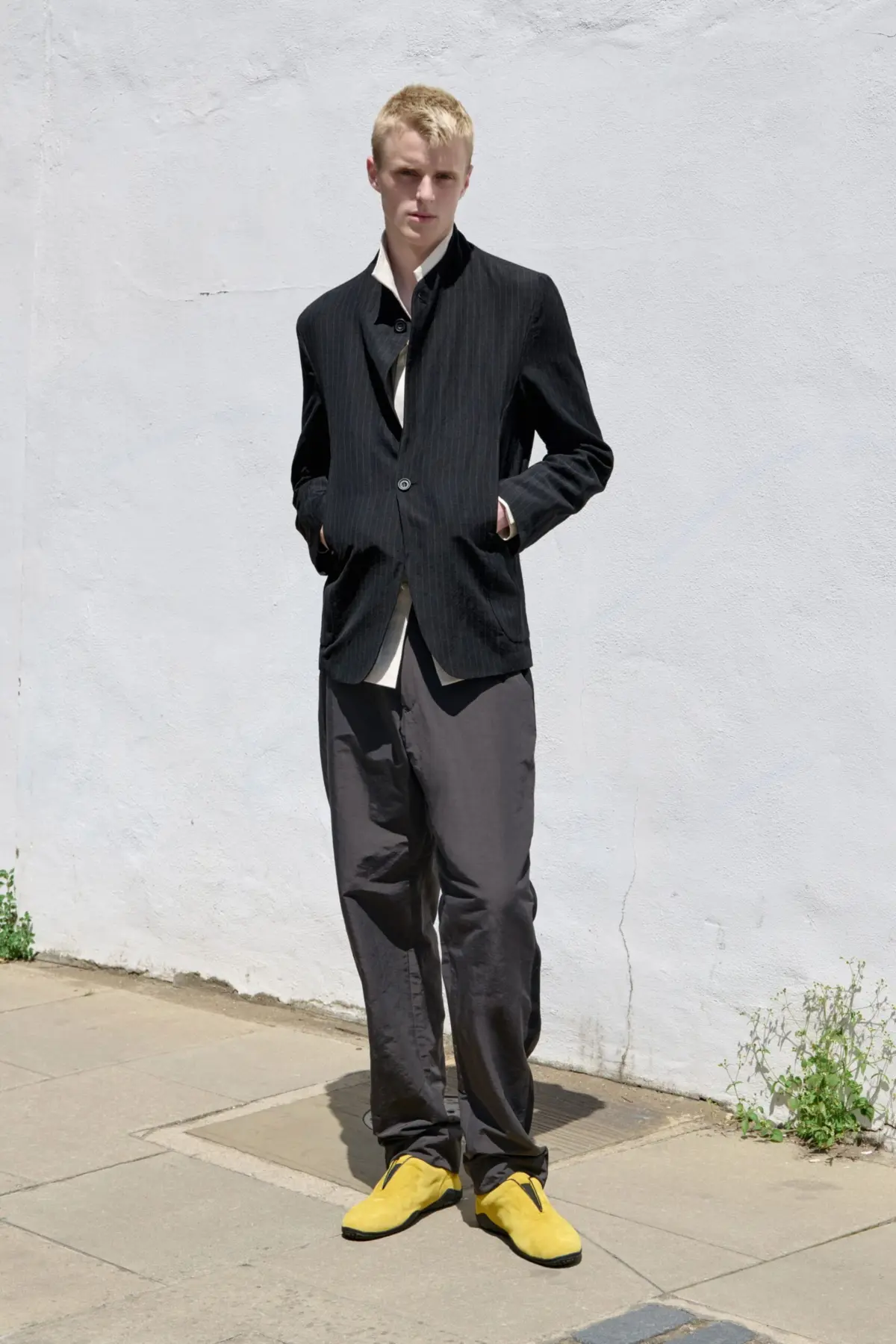
In the quiet, focused atmosphere of his East London studio, designer Luke Derrick is rethinking what it means to be “British” in the modern era of fashion. His latest collection for Spring is a testament to this ongoing investigation—a masterful, if slightly irreverent, collision between the rigid, time-honored traditions of Savile Row tailoring and the chaotic, functional energy of British sportswear. For those familiar with Derrick’s trajectory, this latest work represents his most playful, observational, and self-assured outing to date.
Derrick’s approach is rooted in a shrewd observation of the national psyche. He posits that the British identity, particularly when viewed through the lens of style, is often trapped in a binary struggle. "A lot of these very traditionalist ideas of men’s fashion are locked in a certain idea of Britain," Derrick explains. "Britain is either capital-H heritage, or we’re hyper-experimental and subversive. It’s a reflection of how we interact with our own history. We’re either time-machine worshiping it, or we’re trying to shred it to bits."
Having cut his teeth at storied fashion houses like Brioni and Dunhill, Derrick possesses an intimate, working knowledge of "capital-H heritage." He understands the architecture of a suit, the drape of fine wool, and the expectations of luxury. However, it is his ability to graft subversive, everyday elements onto these structures that gives his work its distinctive lift-off. By rejecting the choice between reverence and destruction, he asks a poignant question: "Why can’t we be reactive to the country that we’re actually in?"
The Anatomy of the Everyday
For his latest Spring collection, Derrick drew heavily from the visual language of his upbringing in Oxford. The influence is unmistakable, manifesting in a parade of rowing suits, varsity hoodies, classic boating jackets, and the kind of half-changed sports kits one might spot on a student wandering through the university’s manicured, historic parks.
Derrick has taken these disparate, familiar items and recontextualized them into a uniform for the modern, on-the-go city dweller. The resulting silhouettes capture the specific, slightly disheveled charm of someone who is perpetually in transit. The styling choices are deliberately oddball, yet they resonate with a palpable sense of reality—the kind of spontaneous, unplanned combinations that occur on the street rather than in the sterile, air-conditioned confines of a design atelier.
One standout ensemble featured a buttercup-yellow mandarin collar jacket paired with a matching pale yellow neckerchief, worn over jersey shorts, which were layered atop bright yellow cycling shorts. Another look presented a structured, double-breasted jacket in a deep, regal purple, paired with slate-gray, wide-leg trousers. The trousers themselves were a masterclass in subtle subversion; they featured a liquid-like drape, with the seams cleverly spun around to the front of the leg, altering the silhouette just enough to catch the eye.
The collection’s lookbook, shot during the sweltering intensity of a June heatwave, reinforces this grounded, observational quality. The models appear as if they have just stepped off a bus or emerged from a library, squinting against the harsh sunlight and peeling off layers to cope with the humidity. It is an aesthetic of survival, not just style. "A lot of the work is pretty observational," Derrick notes, emphasizing that his inspiration is found in the lived experience of the people around him.
Navigating the Thorniest of Social Paradigms
Beyond the clothes themselves, there is a deep, sociological current running through Derrick’s work. While previous seasons saw him mining the rich, multicultural tapestry of his East London neighborhood, this collection turns its gaze toward the most enduring and complex of British social paradigms: class.
Derrick approaches the subject with a mix of humor and analytical rigor. "You’ve got rugby shorts against suit jackets, and a big old tuxedo shirt you might have inherited from your dad—things borrowed, things shared, things appropriated," he observes. This act of appropriation is not meant to be cynical, but rather a reflection of the "high-low" energy that defines British life.
One of the most clever pieces in the collection is a pair of powder-pink sweatpants. At first glance, they appear to be standard leisurewear, but they feature a distinct hoodie-style pocket placed above the waistband, a design element partially inspired by the formal structure of a cummerbund. It is a brilliant collision of references that highlights the collection’s core ethos: a "kind of arrogant, ‘I didn’t even try’ culture" that Derrick identifies as being innately British.
The designer also takes on the complexities of modern masculinity, utilizing a series of layered, hyper-short shorts to explore the shifting boundaries of gender expression in clothing. Derrick is fascinated by the duality of the garment, noting that it has become "both the straightest and queerest thing ever." He points out that the style is as likely to be seen on rugby lads at a party in the shires as it is to appear on a high-fashion runway, such as those overseen by Tom Ford.
Growth, Improvisation, and the Future
Interestingly, the inclusion of shorts in this collection represents a personal milestone for Derrick. By his own admission, the designer—who stands at 6’6"—has long held a personal grudge against the style, citing his own "bean pole" legs as a source of self-consciousness. "I think I said once that I would never, ever design shorts," he admits with a laugh. "I’m very self-conscious about that, but I’ve finally been able to get over myself. There was some self-growth in that."
This journey of acceptance mirrors his broader philosophy toward the design process. The pattern for these shorts was sourced from a pair he borrowed from a friend, while a T-shirt in the collection was derived from an old training top he once wore but had long outgrown, resulting in a unique, half-length sleeve profile. For Derrick, these choices are not mere design decisions; they are reflections of a national identity rooted in resourcefulness.
"I don’t think we’re a country of luxury; I think we’re a country of improvisation," he says. "You forgot your PE kit, or it’s too hot, and you’ve removed one thing too many—it’s this adaptive mindset."
This authentic, lived-in flavor has become the hallmark of Derrick’s vision, and it is a vision that is resonating far beyond East London. His skewed, highly specific Britishisms have found an especially receptive audience in Japan, a market that has become a core engine for his rapidly expanding business.
As he continues to build his brand, Luke Derrick has successfully proven his pragmatism, demonstrating that he can navigate the commercial demands of the fashion industry without losing the intellectual curiosity that defines his work. With this latest collection, he has shown that he possesses an alchemical ability to blend that pragmatism with a puckish, creative spirit, ensuring that his exploration of British identity remains as vital and evolving as the country itself. Whether he is dissecting the remnants of the past or responding to the heat of the present, Derrick’s work remains a compelling reflection of the world as it is actually lived.