
While Julie de Libran has long established her reputation within the rarified, high-stakes atmosphere of the couture circuit, a quieter, more personal evolution has been unfolding behind the scenes. Within the intimate, jewel-box confines of her boutique on Paris’s Left Bank, the designer has been steadily cultivating a robust ready-to-wear business. This expansion, built on the principles of exclusivity and appointment-only service, serves as a testament to her vision for modern dressing—one that moves beyond the spectacle of the runway and into the practical, refined reality of a woman’s daily life.
Her latest collection is a masterclass in what she defines as "travel-ready" options. In an era where the pace of professional and personal life demands versatility, De Libran has curated a concise edit of garments designed to withstand the rigors of transit without sacrificing elegance. Among the standout pieces are separates crafted from hammered silk in vibrant marigold and deep blues, sourced from a storied fabric maker in Lyon. These pieces are not merely aesthetically pleasing; they are technically superior, engineered to be virtually wrinkle-proof, making them the ultimate companions for the frequent traveler. The collection also leans into textural depth, featuring a fitted pantsuit in luxurious chocolate corduroy and a summer wool check, meticulously finished with silk lining to ensure both comfort and a structured silhouette.
To understand the DNA of this collection, one must look at the formative years of De Libran’s career. During her tenure working alongside Marc Jacobs at Louis Vuitton, she gained a profound understanding of the "utilitarian" garment—a philosophy that continues to anchor her design process today. Reflecting on those years, she notes that Jacobs instilled in her the vital importance of the uniform.
"He taught me why a uniform is so important—something you reach for because it makes you feel good, you know it fits properly, and you never have to overthink it," she explains. For De Libran, this ethos represents her "American side," a pragmatic approach to fashion that prioritizes the wearer’s confidence and ease. It is a philosophy that strips away the unnecessary, focusing instead on the reliability of a garment that serves as a dependable foundation for the day.
However, this American-inspired pragmatism is only one half of the equation. Her "French side," as she describes it, is defined by the art of balance. This duality allows her to pair a functional white denim gilet or a sharp safari jacket with the delicate sensibility of a halter blouse or a lace-trimmed black skirt. This contrast—between the rugged and the refined, the masculine and the feminine—is the signature of her work. Whether it is a Supima denim vest or a pair of dark-wash trousers, the goal is always to create a wardrobe that feels cohesive yet eclectic, capable of transitioning seamlessly from a business meeting in New York to a quiet dinner in Paris.
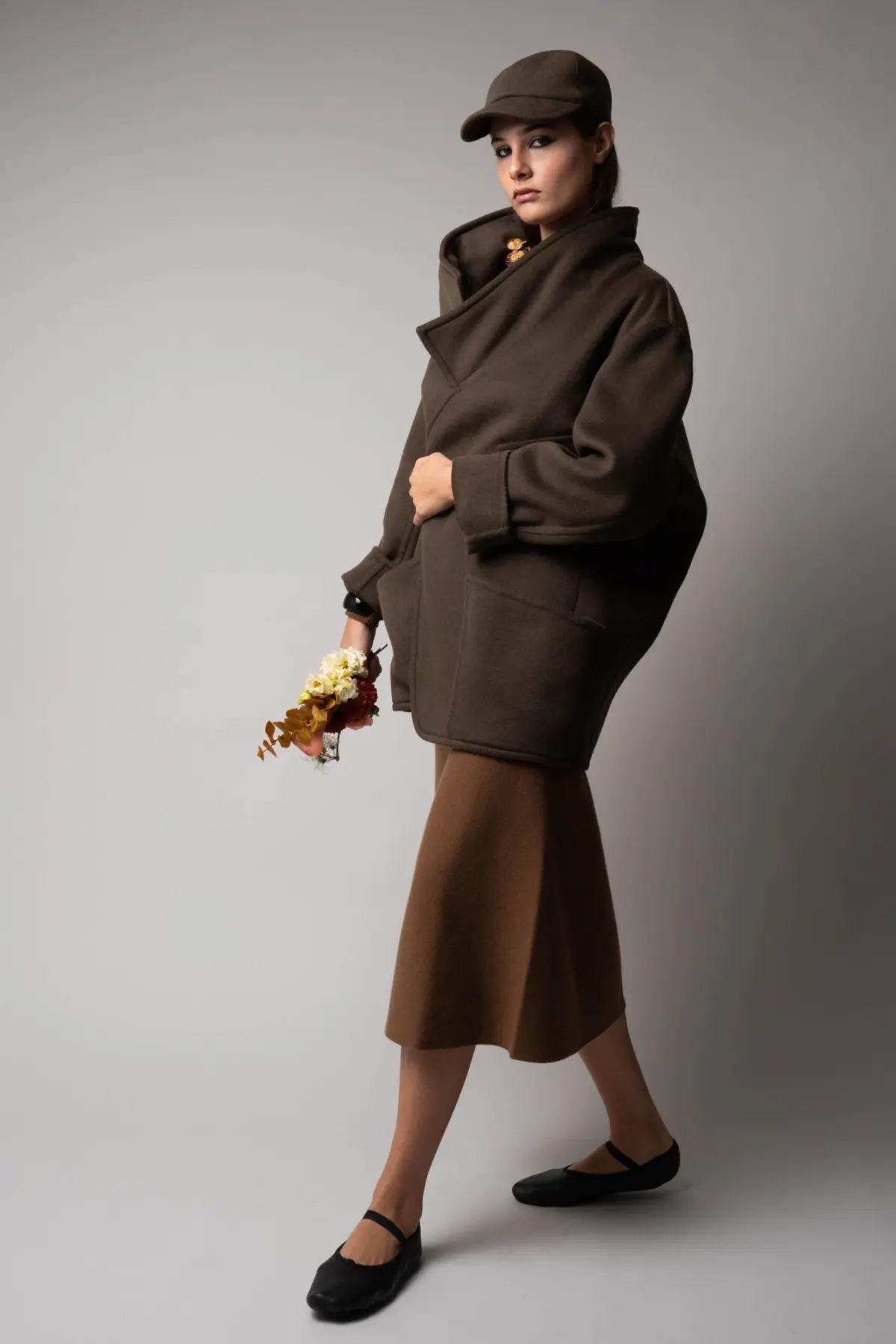
Perhaps the most significant footprint De Libran has established in the luxury market is her mastery of outerwear. This season, she has leaned into the coat as the centerpiece of the modern wardrobe. Her offerings range from the austere, single-breasted car coat in anthracite double-faced cashmere—cleverly scored from Nona Source Paris, reflecting her commitment to sustainable sourcing—to a deeply personal take on the classic pea coat. This particular piece is a hybrid construction, fashioned from dark denim and elevated with a leftover swath of couture jacquard featuring a stylized floral motif in rich, satiny shades of burgundy and forest green. It is this type of meticulous material selection that defines her work, turning leftovers and scraps into high-fashion statements.
Hybridity is a recurring motif in her spring designs, a trend she approaches with both ingenuity and a nod to traditional craftsmanship. One of the most striking pieces in the collection is a beige bonded cotton coat that serves as a prime example of her technical prowess. It features couture-inspired sleeves in a camo print shot through with bronze lamé, and it is fully reversible, revealing a khaki lining on the flip side. It is a garment designed for a woman who needs her clothing to perform multiple roles, offering two distinct aesthetic directions within a single, high-quality object.
Her carry-over pieces, which have become staples of her boutique, demonstrate a commitment to longevity over fleeting trends. Her signature cashmere coat, which features a distinct drop collar, remains a focal point. Available in versatile tones of black, coffee, and moss green, the coat is designed to be worn in multiple ways: belted tightly over an evening dress for a structured, formal look, or worn loose and relaxed over a pair of jeans for a casual, effortless feel.
For De Libran, the design process has become increasingly informed by her own nomadic lifestyle. With the opening of a new office in New York, her travel schedule has intensified, and her clothes have become her primary companions. She recounts using her own cashmere coats as blankets during flights, underscoring the tactile comfort of her designs.
"I love the styling part," she says, reflecting on how her pieces integrate into her life. "Everything I have folds and travels so well my sister calls me Mary Poppins. I love that it’s not about a destination, it’s about how you feel."
This sentiment captures the essence of the Julie de Libran brand. By focusing on the emotional resonance of the clothing—how it feels against the skin, how it fits the body, and how it empowers the wearer to navigate their environment—she is carving out a niche that is both deeply personal and globally relevant. Her work is a reminder that in the rush of contemporary life, the most sophisticated choice is often the one that provides the most comfort.
As she continues to refine her vision from her Left Bank boutique, De Libran remains committed to the idea that clothing should not be a destination in itself, but a facilitator of experience. Whether it is through her selection of sustainable materials, her reverence for the "uniform," or her focus on the versatility of the coat, she is building a legacy defined by thoughtful, enduring design. It is a slow, steady expansion, one that honors the traditions of couture while embracing the realities of a modern, mobile world. Through this lens, the designer has created more than just a collection; she has provided a blueprint for a wardrobe that is as resilient as it is elegant, ensuring that for the woman who wears her clothes, the journey is always as stylish as the arrival.