
In an industry often caught in the churn of rapid-fire trends and seasonal homogeneity, Melitta Baumeister has carved out a singular space defined by architectural rigor and material experimentation. Her latest collection for Spring 2027 serves as a testament to this ongoing evolution, arriving at a moment when her profile is arguably higher than ever, bolstered by a highly successful and widely visible collaboration with Nike. While the sportswear giant has brought her aesthetic to a broader global audience, her eponymous label remains a sanctuary for those who view fashion as a sculptural discipline. For this season, Baumeister turned her focus to a provocative intersection: the shared language of the atelier and the training ground.
During a recent discussion, Baumeister articulated the conceptual bedrock of her Spring 2027 collection, describing her designs as clothing for “artletes.” It is a term that bridges the gap between the precision of high fashion and the endurance required of physical training. “I just felt so much how craftsmanship is also some sort of athleticism,” she explained via a Zoom call. “Because to be good at anything, you have to do it a lot and you have to repeat yourself a lot.” This dedication to repetition and technical mastery is immediately evident in the collection’s silhouette, which cuts through the aesthetic clutter of the current fashion landscape with a sharpness that has become a hallmark of her work.
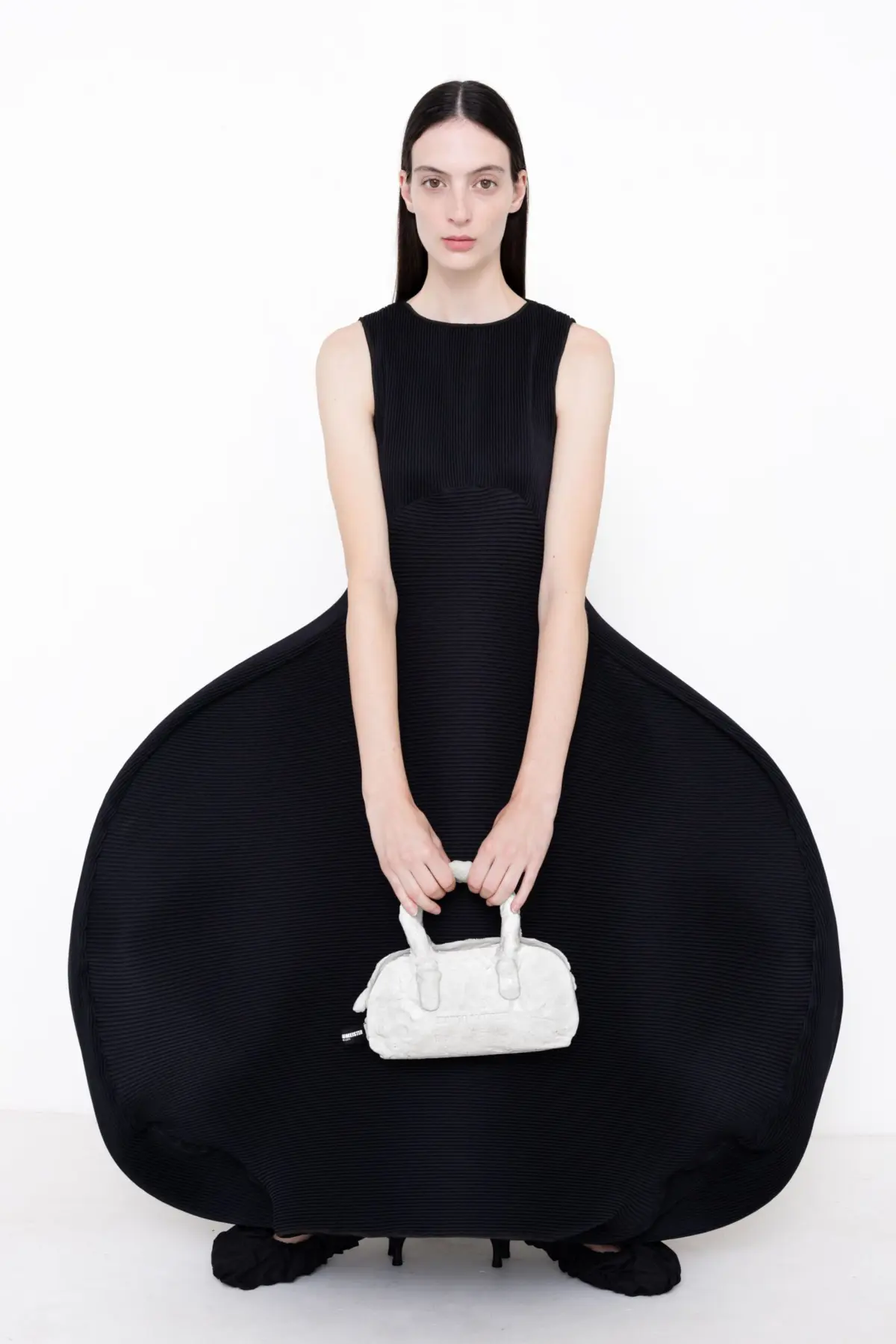
The collection is defined by a series of deliberate, gravity-defying shapes that challenge the traditional drape of textiles. Nowhere is this more apparent than in a standout dress rendered in a vibrant, sour apple green. Rather than relying on soft folds, the garment achieves its iconic ball-shape silhouette through the meticulous placement of pleats at precise, calculated angles. This is not merely a design choice; it is an engineering feat. By utilizing wired hems and necklines, Baumeister creates graphic, asymmetric structures that seem to hover away from the body, imbuing the garments with a sense of kinetic energy. The use of foam—a material often relegated to the background of construction—is here brought to the fore, providing the necessary architecture for small cap-sleeved jackets finished with nostalgic Peter Pan collars.
While the structural integrity of the pieces is undeniable, the collection also incorporates a series of body-focused prints. These motifs, which appear intermittently throughout the lineup, were designed as a direct nod to the centrality of the human form in both sports and sartorial practice. Conceptually, the prints aim to emphasize the physicality of the wearer, reflecting the way fabric interacts with the body in motion. However, their inclusion sparked a nuanced debate regarding their effectiveness. While the logic behind the prints is sound, their presence occasionally proved distracting, pulling the eye away from the more compelling boldness of the garment’s structural cuts. In a collection where the silhouette is so masterfully articulated, the prints at times felt like an unnecessary narrative layer, slightly obscuring the raw power of the forms themselves.
One of the most refreshing aspects of the collection is Baumeister’s shift toward more wearable hemlines, a decision born from her own personal experiences. Reflecting on her summer exercise regimen, the designer noted that she found herself frequently cycling, an activity that highlighted the impracticality of her signature voluminous, floor-sweeping skirts. “I was cycling so much in the summer and my big skirts are always too long and I kept tacking them up,” she said. This frustration led to the introduction of shorter, above-the-knee hemlines, which maintain the architectural spirit of her longer pieces while offering a newfound ease of movement. Beyond the practical benefits, there is an underlying philosophy to this change that challenges ageist conventions in fashion. “I felt like you don’t have to be so young to wear short skirts,” she noted, signaling a desire to make her complex, sculptural silhouettes accessible to a broader demographic of women.
This focus on wearability is part of a broader, long-term shift in Baumeister’s design process. She has been actively working to lighten the weight of her sculptural designs, ensuring that the visual impact of her clothes does not come at the cost of physical comfort. This effort to marry reality with materiality is a recurring theme in her work, but it has gained new urgency in the current climate. Baumeister expressed a profound belief that, in an era dominated by digital production and fast-fashion manufacturing, the value of the handmade has never been more critical.
“In the times that we live in now, it becomes more and more important that you notice that things are made by hand,” she said. “I feel very connected to that and I think craft is getting more important.” This philosophy manifests in the collection through a tactile exploration of texture. She introduced intricate fringe made from hand-shaped appliqués, which add a rhythmic, organic quality to the otherwise rigid foam and wired structures. This juxtaposition between the industrial feel of her silhouettes and the artisanal nature of her detailing creates a compelling tension that defines the collection’s soul.
The finale of the show served as a summation of this philosophy. Baumeister debuted a wearable jacket constructed entirely from a lighter variety of air clay. It was, by all accounts, the collection’s hero piece—a daring, sculptural object that felt less like a garment and more like a work of art intended to serve as a foundation for a larger look. As the piece moved down the runway, it underscored the designer’s commitment to pushing the boundaries of what materials can do. It was a bold statement, one that invited the audience to consider the garment as a piece of molded architecture, destined to have an entire outfit built around its unique, earth-bound aesthetic.
Ultimately, Melitta Baumeister’s Spring 2027 collection represents a confident stride forward. She has successfully managed to reconcile the demands of high-concept design with the practical realities of everyday life, all while maintaining the integrity of her creative vision. By reframing the atelier as a place of athletic discipline, she has not only justified her own rigorous design process but has also provided a framework for understanding why, in a world of infinite digital noise, the presence of the human hand remains the most powerful tool in fashion. As she continues to evolve, the challenge for Baumeister will be to maintain this delicate equilibrium between the abstract and the functional, ensuring that her architectural experiments remain as inviting to the wearer as they are impressive to the observer.