
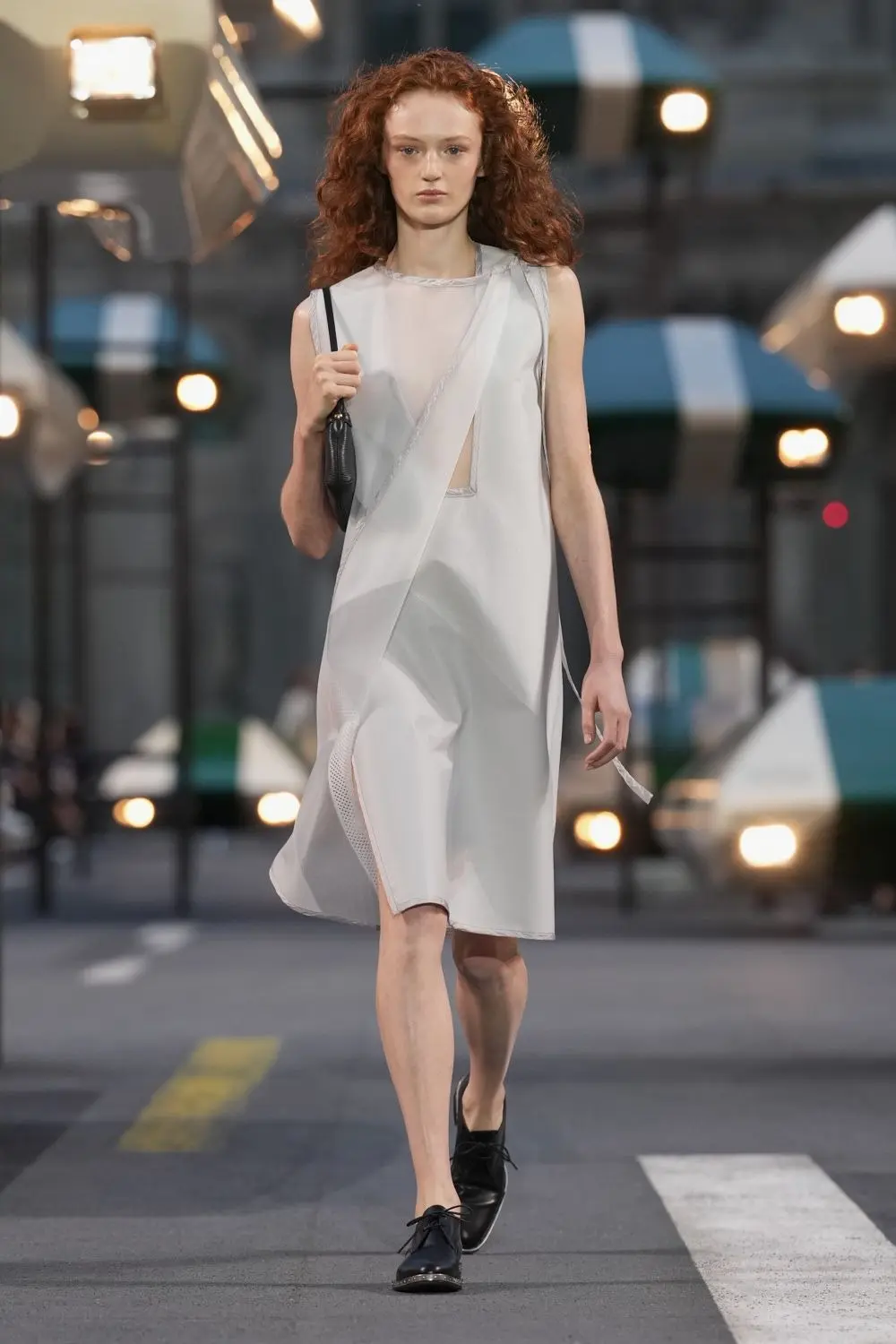
The Louvre’s historic Cour Carrée was transformed into a cinematic, futuristic airfield for the Louis Vuitton Spring 2027 show, an environment that felt as if it had been plucked directly from the set of The Jetsons. Hovering above the assembled audience were flying cars, their surfaces adorned with the iconic Damier check print and glowing red tail lights, casting an eerie, high-tech luminescence over the ersatz macadam landing strip. Yet, despite the theatrical, science-fiction spectacle, Nicolas Ghesquière’s latest collection signaled a deliberate pivot away from the hyper-conceptual, otherworldly narratives that have often defined his recent work. While the set design leaned into the aesthetics of tomorrow, Ghesquière’s design philosophy for the season was firmly rooted in the present, championing an “ergonomic,” body-first approach that prioritized the wearer over the character.
This shift marks a significant departure for the veteran designer. It has been two decades since Ghesquière famously debuted his C3PO-inspired metallic leggings during his tenure at Balenciaga—a collection that cemented his reputation as a visionary of the future. While he has never shied away from the avant-garde, the Spring 2027 collection serves as a reminder that even the most imaginative architects of fashion must eventually address the fundamental relationship between cloth and skin.
The timing of this aesthetic recalibration is particularly notable. Only last week, President Emmanuel Macron bestowed the Legion d’Honneur upon Ghesquière at the Élysée Palace, recognizing his profound contributions to French fashion. The ceremony was marked by a lighthearted moment between the designer and the President, who noted that Ghesquière has dressed First Lady Brigitte Macron since the start of her husband’s political tenure. “It just occurred to me that you were the second man in her life,” the President quipped to the delight of the audience, highlighting the designer’s deep integration into the cultural and political fabric of France.
Despite his proximity to the corridors of power and the grand, theatrical silhouettes he has explored in recent years—ranging from the rustic, traditional shepherd’s cloaks of his previous collection to the Dune-inspired, sand-swept robes of Resort 2023—Ghesquière has reached a point of introspection. His work has historically been defined by an “out-of-time” quality, seamlessly blending disparate eras such as 1980s party aesthetics with the rigid, structured panniered frocks of the 18th century. In contrast, the opening look of this spring show—a simple, sleeveless white shift paired with understated black men’s oxfords—offered a stark, quiet clarity that caught many observers off guard.
When asked about this abrupt turn toward the understated, Ghesquière explained that the collection was an attempt to strip away the noise. “I wanted to express a sensation of simplicity, a feeling of purity,” he remarked. “It’s an impression of minimalism, but the work behind this construction, the simplification, making things extremely light, is really complex.”
This pursuit of “extreme lightness” was evident in the garments that followed. The collection featured collarless jackets and straight-leg trousers that possessed the unadorned, functional efficiency of a uniform. There was a deliberate avoidance of decorative excess; instead, the focus shifted to the drape of the fabric and the precision of the cut. Floaty summer dresses were rendered in layers of chiffon with delicate, lettuce-edged hemlines, while checked pantsuits were engineered to be light enough to move with the fluidity of flou tailoring. It was a masterclass in controlled restraint, where the sophistication lay not in embellishment, but in the structural integrity of the clothes themselves.
Ghesquière attributed these new instincts to the overwhelming nature of the current global climate. “These instincts came from the chaos of the world around us,” he noted, suggesting that when the environment feels increasingly fragmented and loud, the most radical response is a return to the grounded and the essential.
The designer’s pivot toward the relatable is not occurring in a vacuum. The broader fashion industry is currently navigating what many have termed a “great reset.” A new generation of creative directors has ascended to the helm of major houses, and, whether driven by the intense pressures of the global marketplace or a genuine desire to realign with the changing needs of the modern consumer, many are leaning into collections that prioritize wearability. In an era where “quiet luxury” and grounded, unstudied aesthetics have regained dominance, Ghesquière’s move feels both timely and strategically sound.
For those who have followed Ghesquière since his early days at Balenciaga, there is a sense of nostalgia in this development. During that era, his acolytes famously rhapsodized about his “perfect pants”—trousers that managed to be both architecturally interesting and impeccably wearable. The Spring 2027 collection echoes that spirit of functional brilliance. In a modern context, “wearable Ghesquière” has a renewed, aspirational ring to it, suggesting that he is once again focusing on the art of the everyday.
Among the standout pieces were several evening looks that successfully bridged the gap between his flair for the dramatic and his new, simplified methodology. Specifically, a series of embellished hammered satin elongated tanks, finished with dramatic, flowing trains and paired with fluid, high-waisted trousers, captured the best of both worlds. These pieces offered the gravity and elegance required for high-fashion red carpets while maintaining a sense of ease and movement that felt entirely contemporary.
As the show concluded under the watchful gaze of the flying cars, the message was clear: Ghesquière is not abandoning his vision, but he is refining it. By simplifying the silhouette and prioritizing the ergonomic needs of the wearer, he is stripping away the artifice to reveal a more honest expression of his craft. Whether this is a permanent evolution or a brief interlude remains to be seen, but for now, the prospect of a more grounded, essential Ghesquière is a welcome development. His ability to synthesize the complex, the chaotic, and the futuristic into something as pure as a white shift dress suggests that he is not just keeping pace with the industry’s reset, but potentially leading it. If the path forward involves pursuing this line of thinking—where construction is invisible and elegance is effortless—it is a trajectory that will likely define the season and resonate with a generation of customers who are increasingly looking for clothes that reflect the reality of their own lives.