
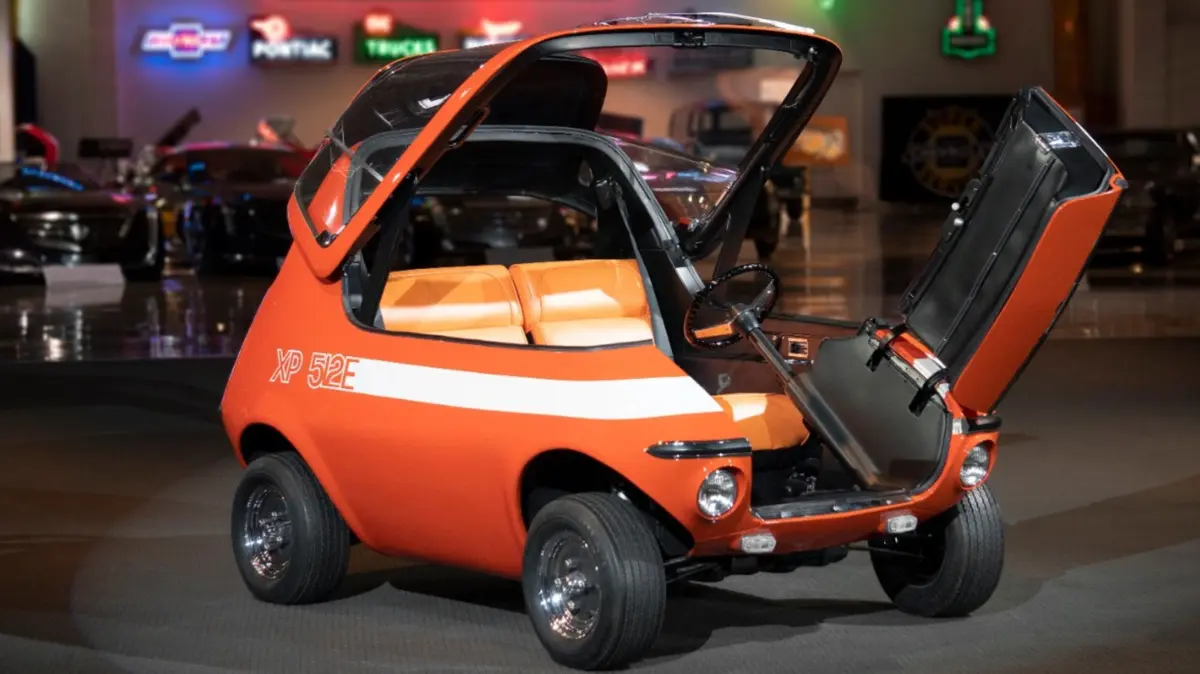
When automotive historians and enthusiasts discuss General Motors’ early entries into the modern electric vehicle landscape, conversation almost invariably turns to the iconic EV1. Produced in two distinct batches across 1997 and 1999, the sleek, slippery two-seater quickly achieved legendary status. Just over a thousand examples of the purpose-built electric cars rolled off the line, becoming nearly as famous for their dramatic ultimate fate—being unceremoniously collected and crushed into tiny cubes—as they were for their genuine engineering innovations.
Yet, contrary to popular automotive lore, the EV1 was far from General Motors’ maiden voyage into the realm of all-electric passenger transportation. That foundational title belongs to a far more obscure vehicle: the 1969 XP 512E concept car. Looking even further back into the corporate archives reveals that GM’s electrification roots run deeper still, encompassing a fleet of commercial electric trucks sold to businesses between 1912 and 1916. However, when it comes to passenger cars designed to run purely on battery power, the XP 512E remains the true pioneer.
The XP 512E did not emerge in a vacuum; it was born as a member of a tripartite family of diminutive, city-focused experimental vehicles developed by GM for its grand "Progress of Power" exhibition in 1969. This major corporate press event drew automotive journalists and media representatives from across the United States to the sprawling confines of the GM Technical Center in Warren, Michigan. The goal was to provide the fourth estate with an exclusive look at the automaker’s cutting-edge powertrain research and development initiatives.
The exhibition floor was crowded with forward-looking technology demonstrations. Alongside the small city cars, visitors could inspect advanced silver-zinc batteries, experimental hydrogen fuel cells, gas turbine engines, innovative wheel-hub motors, modernized steam engines, and early prototypes of catalytic converters. It was a remarkably prescient showcase, foreshadowing developments that would occupy the automotive industry for decades to come. Notably, GM would eventually cement its place in regulatory history by becoming the very first volume automaker to develop a production-ready catalytic converter for the 1969-conceived technologies that reached the market by 1975.
For the journalists in attendance at the Progress of Power event, the experience was not merely visual. Several of the concept vehicles on display, including the XP 512E, were made available for actual test drives around the facility. Automotive journalists eagerly took turns experiencing the future of propulsion firsthand. Among them was renowned Mechanix Illustrated writer Tom McCahill, who slid behind the wheel of the electric microcar and famously reported that the driving experience was "quite smooth," according to historical accounts preserved by Hemmings.
Despite the surprising refinement of its ride quality, the vehicle’s physical dimensions and operational capabilities were remarkably modest by modern standards. The XP 512E was exceptionally tiny, possessing a total length shorter than the height of contemporary NBA basketball star Victor Wembanyama. Its driving range was similarly restricted. When operated at a steady 25 miles per hour, the car could travel a maximum of 58 miles on a single charge. If the driver dared to push the vehicle to its absolute limit—a modest top speed of 30 miles per hour—the usable range shrank dramatically to just 47 miles.
Delving into the XP 512E Details
Formally designated as the 512 Electric Experimental, the vehicle was engineered from the ground up to minimize space and maximize efficiency in congested urban environments. It measured a tidy 86.3 inches in length and 56 inches in width, supported by a wheelbase of a mere 52 inches. To put those dimensions into perspective, the XP 512E was roughly a foot shorter and three inches narrower than a first-generation Smart Fortwo.
Weight management was a critical engineering priority for the development team, and the XP 512E achieved an exceptionally low curb weight of 1,250 pounds—about 250 pounds lighter than a typical Smart Fortwo, which generally tips the scales around 1,500 pounds. General Motors achieved this remarkable weight savings primarily through two major design choices: constructing the car’s body out of lightweight fiberglass and outfitting it with a specialized 84-volt lead-acid battery pack engineered explicitly to shed unnecessary pounds.
Performance expectations, however, required a fundamental adjustment for anyone accustomed to modern internal combustion cars, let alone today’s high-torque electric vehicles. Propelled by a rear-mounted direct-current (DC) electric motor, the XP 512E required approximately 12 sluggish seconds to drag itself up to its maximum velocity of 30 miles per hour. In the modern era, high-performance battery-electric vehicles can effortlessly launch from zero to 60 miles per hour in 3.5 seconds or less, rendering the 512E’s acceleration look almost glacial by comparison.
Conversely, the car proved surprisingly competitive when it came to replenishing its energy reserves. Recharging the depleted lead-acid battery pack took approximately seven hours when plugged into a standard 115-volt household electrical outlet. While direct comparisons to modern infrastructure are complex, plugging a contemporary vehicle like a 2027 Toyota bZ into a standard Level 1 household charger can require upward of 60 hours for a full recharge, highlighting just how small the XP 512E’s battery capacity truly was.
Inside the cabin, the XP 512E offered virtually no superfluous amenities or luxury equipment. The interior was anchored by a single, straightforward bench seat accompanied by a basic heater and defroster system, an ashtray, and little else to distract the occupant. The vehicle’s most distinguishing aesthetic and functional feature was its unique canopy. The entire upper glass and roof assembly tilted backward to grant entry, operating in tandem with a lower front door that swung open in a manner reminiscent of the famous BMW Isetta. Furthermore, this canopy design allowed motorists to drive with the top partially or fully opened, delivering an unexpected drop-top motoring experience.
What Were the Other 1969 XP 512 Cars?
The all-electric XP 512E was only one piece of a broader technological puzzle presented at GM’s Progress of Power exhibition. The overarching XP 512 platform actually encompassed three distinct variants, most notably including the corporation’s very first exploration of a plug-in hybrid electric vehicle.
Debuting at the 1969 event, the XP 512H arrived more than four decades before the introduction of the Chevrolet Volt, which is widely recognized as the world’s first commercially available plug-in hybrid electric vehicle (PHEV). This historical milestone remains significant within automotive engineering circles, even as the broader industry continues to debate the evolving role of plug-in hybrids as stepping stones or permanent fixtures in the transition toward full electrification.
While detailed archival documentation for the XP 512H is scarcer than its all-electric sibling, the fundamental architecture of the vehicle is well understood. The plug-in hybrid concept paired a tiny 200-cubic-centimeter gasoline engine with a DC electric motor that drew electrical current from a 72-volt lead-acid battery array. The powertrain featured a clever functional integration: the internal combustion engine was capable of simultaneously driving the rear wheels while also generating supplementary electrical energy to replenish the onboard battery pack.
The operational profile of the hybrid was designed for maximum urban efficiency. The car operated purely on electricity when traveling at speeds up to 10 miles per hour, after which the gasoline engine seamlessly engaged to provide additional momentum for higher speeds. Much like the 512E, the hybrid variant could be conveniently recharged by plugging it into a standard household electrical outlet. Utilizing this dual-power system, the vehicle achieved an all-electric range exceeding five miles at a cruising speed of 30 miles per hour, and could travel an impressive 150 miles while consuming a mere three gallons of gasoline, maintaining a top speed of 35 miles per hour.
Rounding out the trio of experimental city cars was the XP 512G, a purely gasoline-powered iteration. This model relied on a minuscule two-cylinder engine displacing just 19 cubic inches and generating a modest 12 horsepower. Performance figures were predictably pedestrian: the 512G required roughly 18 seconds to crawl up to its 30-mile-per-hour mark and topped out at an ultimate velocity of 45 miles per hour. However, what the vehicle lacked in speed, it more than made up for in sheer fuel efficiency. By squeezing an incredible 280 miles of driving range out of a tiny four-gallon fuel tank, the XP 512G achieved a staggering fuel economy rating of approximately 70 miles per gallon.