
In the realm of high fashion, where seasonal trends often flicker and fade with the changing winds, Gabriela Hearst has carved out a niche defined by profound intention. For her latest spring collection, the designer shifted her focus from the global stage to a deeply personal and political exploration of history, specifically the last century of Afghan women. Moving beyond the typical scope of runway inspiration, Hearst transformed her design studio into a laboratory of anthropology, charting a timeline that stretches from the late Emirate period through decades of social reform, the turbulence of war, the complexities of the U.S. intervention, and the somber reality of the current Taliban regime.
The collection serves as more than just an aesthetic exercise; it is a deliberate act of advocacy. Hearst, ever conscious of the social impact of her work, anchored the collection in a sobering statistic: the female literacy rate in Afghanistan has plummeted to a mere 37% under the current administration. By highlighting this figure, Hearst aimed to focus international attention on the systematic erosion of women’s rights in the country. Yet, the collection avoids the pitfalls of pity, instead choosing to celebrate the indomitable spirit of Afghan women and the rich, enduring traditions of their craftsmanship—specifically in the realms of textile weaving and jewelry making—that have persisted despite the shifting political landscape.
To navigate this delicate narrative with the necessary nuance, Hearst enlisted a cadre of experts who understand the region’s cultural fabric intimately. Among her primary collaborators is Shoshana Stewart, the head of Turquoise Mountain, a nonprofit organization dedicated to preserving historic artisan traditions and connecting the country’s master craftspeople to the global design market. Furthermore, Hearst partnered with Fara Homidi, the Afghanistan-born, California-raised makeup artist and beauty brand entrepreneur, whose personal heritage provided a bridge between the collection’s conceptual roots and its visual execution. This collaborative approach ensured that the project was not merely an aesthetic appropriation, but a meaningful dialogue between the designer’s signature tailoring and the ancestral skills of Afghan artisans.
The centerpiece of the collection, which Hearst poignantly described as “the heart of the show,” consists of hand-painted miniatures encased in crystal and silver, repurposed as intricate buttons for her signature blazers and tailored coats. While the ephemeral nature of a runway show often obscures the finer details of a garment, these miniatures reward a closer inspection. Each piece acts as a miniature work of art, elevating the standard silhouette of high-end tailoring into something historic and tactile. These buttons are not merely decorative; they serve as a testament to the preservation of traditional Afghan art forms, which are often overlooked in favor of more mass-produced global aesthetics.
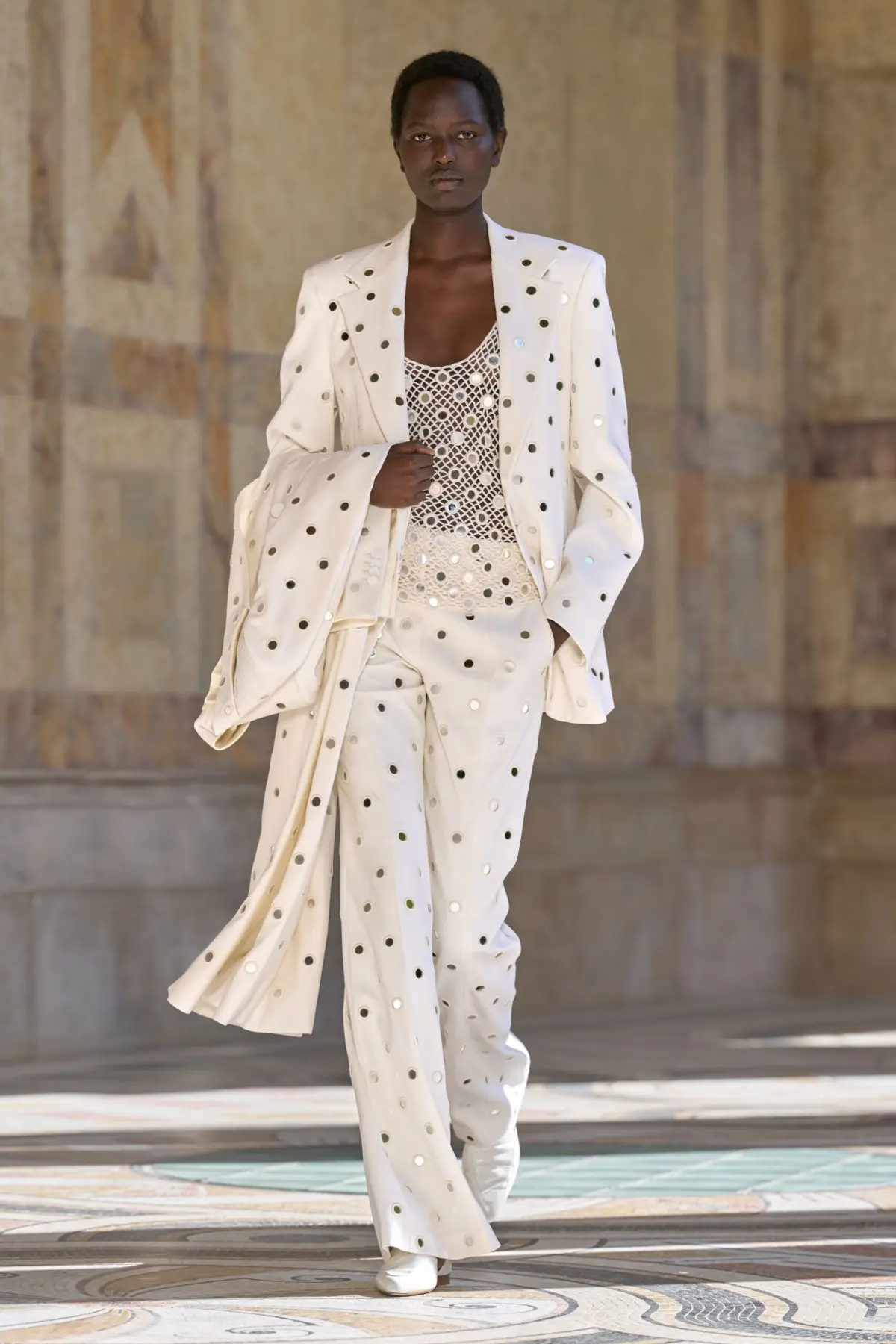
The show’s opening look—a crisp, structured white pantsuit—immediately signaled the collection’s thematic intent. The jacket and trousers were meticulously adorned with shisha mirrors, the small, reflective discs traditionally used in various Central Asian cultures to ward off the “evil eye.” The choice was deliberate and symbolic, suggesting a protective layer over the wearer. The impact of the design was magnified when the musician St. Vincent took to the stage to perform, appearing in a black counterpart to the opening look, which highlighted the versatility and inherent strength of the tailoring.
As the collection progressed, the aesthetic language shifted to include delicate crochet and knit dresses, which maintained the dialogue between modern silhouettes and ancient motifs. The final act of the runway show featured a series of vibrant, colorful dresses that served as a canvas for the works of Sughra Hussainy, a U.S.-based Afghan artist. These garments reproduced the intricate patterns found in traditional Suzani and Hazara textiles, bringing the visual history of the region to the forefront of the contemporary fashion narrative. By integrating these specific regional textile traditions, Hearst succeeded in grounding the collection in a geography that is often discussed only in terms of geopolitical conflict, rather than its immense cultural contributions.
The inherent risk of a Western designer incorporating the traditions of a marginalized or conflict-stricken culture into a luxury fashion collection is a subject of ongoing, necessary debate within the industry. The optics of such a collaboration can easily veer into exploitation if not handled with absolute transparency and respect. However, Hearst has built a career on a foundation of ethical production and long-term partnerships. Her commitment to artisanal collaboration is not a recent development; it is a core pillar of her brand’s identity, perhaps best exemplified by her long-standing relationship with the artisans of Manos del Uruguay, in her home country.
Regarding the Afghan collaboration, Hearst has emphasized that this is not a one-off project for the season. Her involvement with Turquoise Mountain is designed to be ongoing, ensuring that the partnership provides consistent economic support and visibility for the artisans involved. This long-term commitment serves as a critical buffer against the criticisms often leveled at luxury houses that engage in cultural "borrowing." By sustaining the relationship, Hearst positions her brand not as a temporary benefactor, but as a consistent platform for the artisans to share their work with the world.
Beyond the weight of the Afghan influence, the collection also marked a significant evolution in Hearst’s own design vocabulary. The technical prowess on display was evident in the knitwear, where hems were expertly manipulated to extend and encircle the shoulders like a shawl. This complex patternmaking, while technically challenging, resulted in garments that felt effortless and elegant, avoiding the stiffness that often accompanies high-concept construction.
The collection also showcased a mastery of materiality, with long suede slips in shades of chartreuse and jade providing a bold, tactile contrast to the more ethereal knits. There was an “unstudied” appeal to the styling that felt refreshing; the models moved with a sense of ease that belied the meticulous effort behind the clothes. Small, thoughtful accessories rounded out the look, including petite leather pouches worn as necklaces and safety pin brooches secured at the collars. These brooches, embellished with semiprecious stones such as quartz, lapis lazuli, and malachite, were produced by the artisans at Turquoise Mountain, further cementing the bond between the designer’s vision and the craftspeople’s hands.
In viewing the collection as a whole, it is clear that Hearst has attempted to strike a balance between the personal and the political, the global and the local. The show did not offer a solution to the complex humanitarian issues currently facing Afghanistan, nor did it claim to. Instead, it functioned as a conduit—a way to channel the attention of a global audience toward a region in crisis, while simultaneously honoring the beauty and skill of its people.
By centering the work of artisans and artists like Sughra Hussainy, Hearst elevated the collection beyond the realm of traditional fashion reporting. The narrative was one of resilience, emphasizing that while political regimes may change and borders may fluctuate, the cultural heritage and the artistry of a people remain, provided they are given the platform to survive. As the industry continues to grapple with its responsibility toward the cultures it draws inspiration from, the collaboration between Gabriela Hearst and the craftspeople of Afghanistan offers a compelling blueprint for how high-end design can intersect with advocacy, history, and profound respect. The success of the collection lies in its restraint; it allows the story of the artisans and the history of the region to speak through the clothes, rather than allowing the clothes to be overshadowed by the designer’s own voice. In doing so, Hearst has created a collection that is as intellectually stimulating as it is sartorially impressive, leaving an impression that lingers long after the final model has exited the runway.