
A new residential development rising south of Denver, Colorado, has become the testing ground for an unusual and potentially transformative industry partnership that could reshape how homes are heated and cooled across the United States.
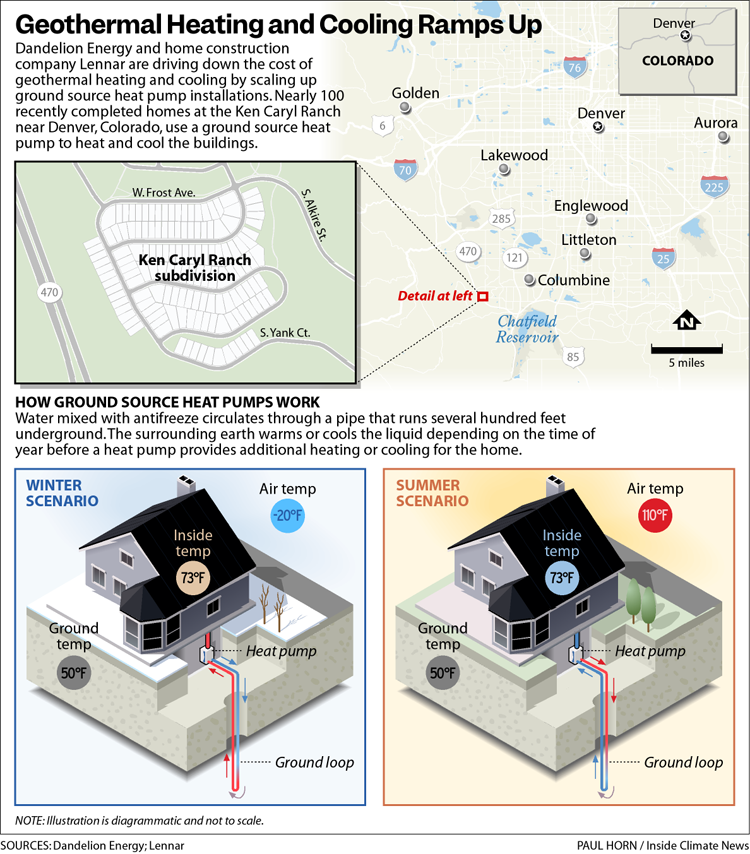
Dandelion Energy, a geothermal energy startup, and Lennar, one of the nation’s largest homebuilders, have recently completed construction on nearly 100 homes at the base of Colorado’s scenic Front Range. Every single property in this new subdivision is equipped with an advanced ground-source heat pump system designed to tap into steady, subterranean temperatures. These installations consume significantly less electricity than even the most efficient air-source heat pumps on the market today. By scaling this technology, the project aims to help Colorado meet its ambitious climate goals while simultaneously reducing peak energy demand on the local electrical grid and entirely eliminating the need for expensive new gas pipeline infrastructure.
Ground-source heat pumps function by drawing on the remarkably steady temperatures found below the earth’s surface to help heat and cool buildings throughout the year. However, historical roadblocks have kept these systems from entering the mainstream. Traditional geothermal projects require custom engineering designs and intensive drilling requirements. Typically, an individual home requires one or more boreholes to be drilled hundreds of feet deep into the earth. The drilling process alone frequently carries a price tag exceeding $10,000, creating an initial financial barrier that has relegated the technology primarily to custom, high-end builds.
Dandelion Energy, a company that originally got its start at X—the famed “moonshot” research and development subsidiary of Alphabet, Google’s parent company—asserts that it has found a way to upend this economic model. The startup claims it can complete geothermal heating and cooling projects twice as fast and at roughly half the cost of conventional, one-off installations by applying industrial efficiency to the process.
“We are taking a kind of mass market and maximally efficient lens to what has historically been a bespoke kind of custom, high-end product,” said Dan Yates, Dandelion Energy’s chief executive officer and chairman.
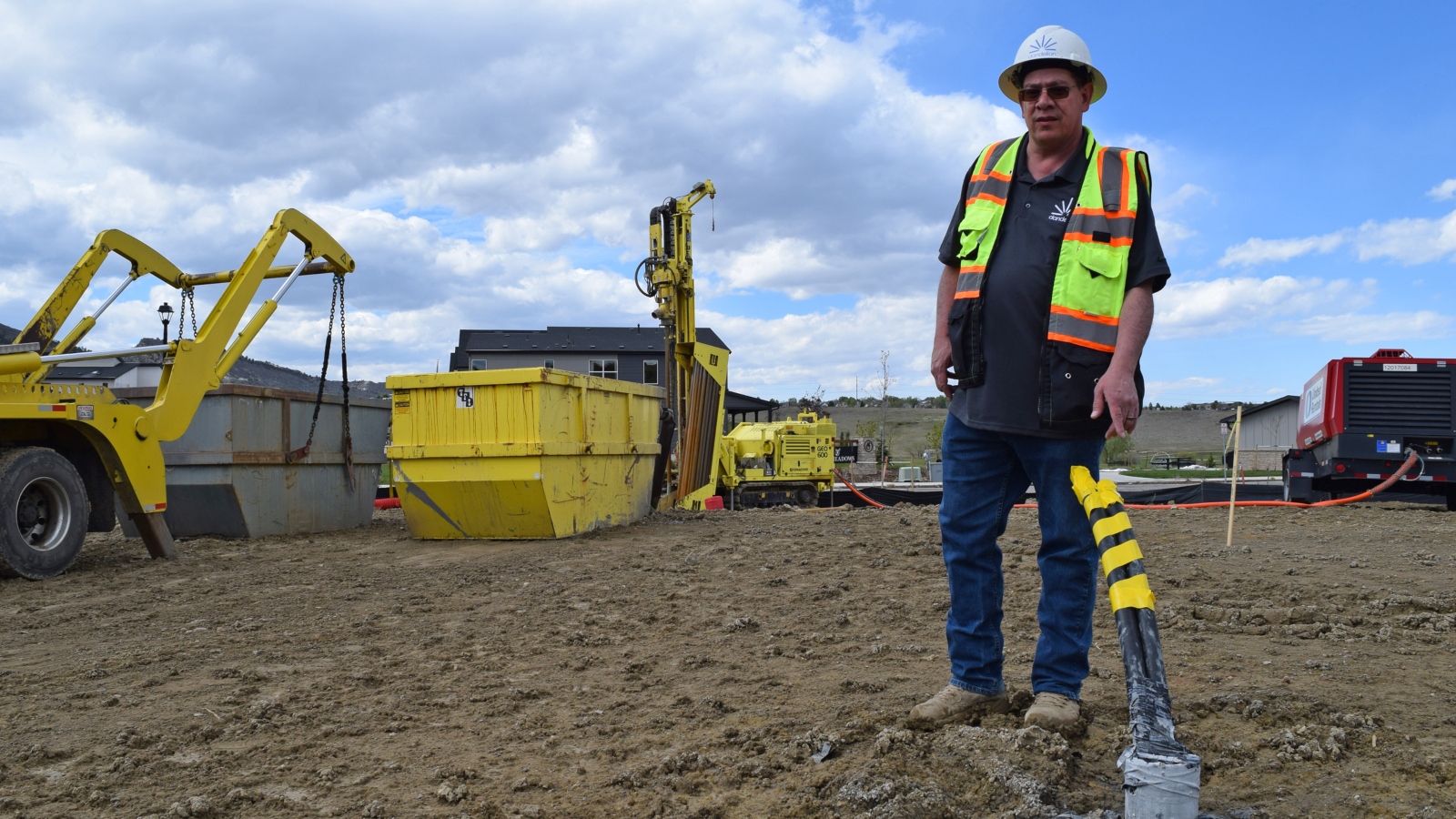
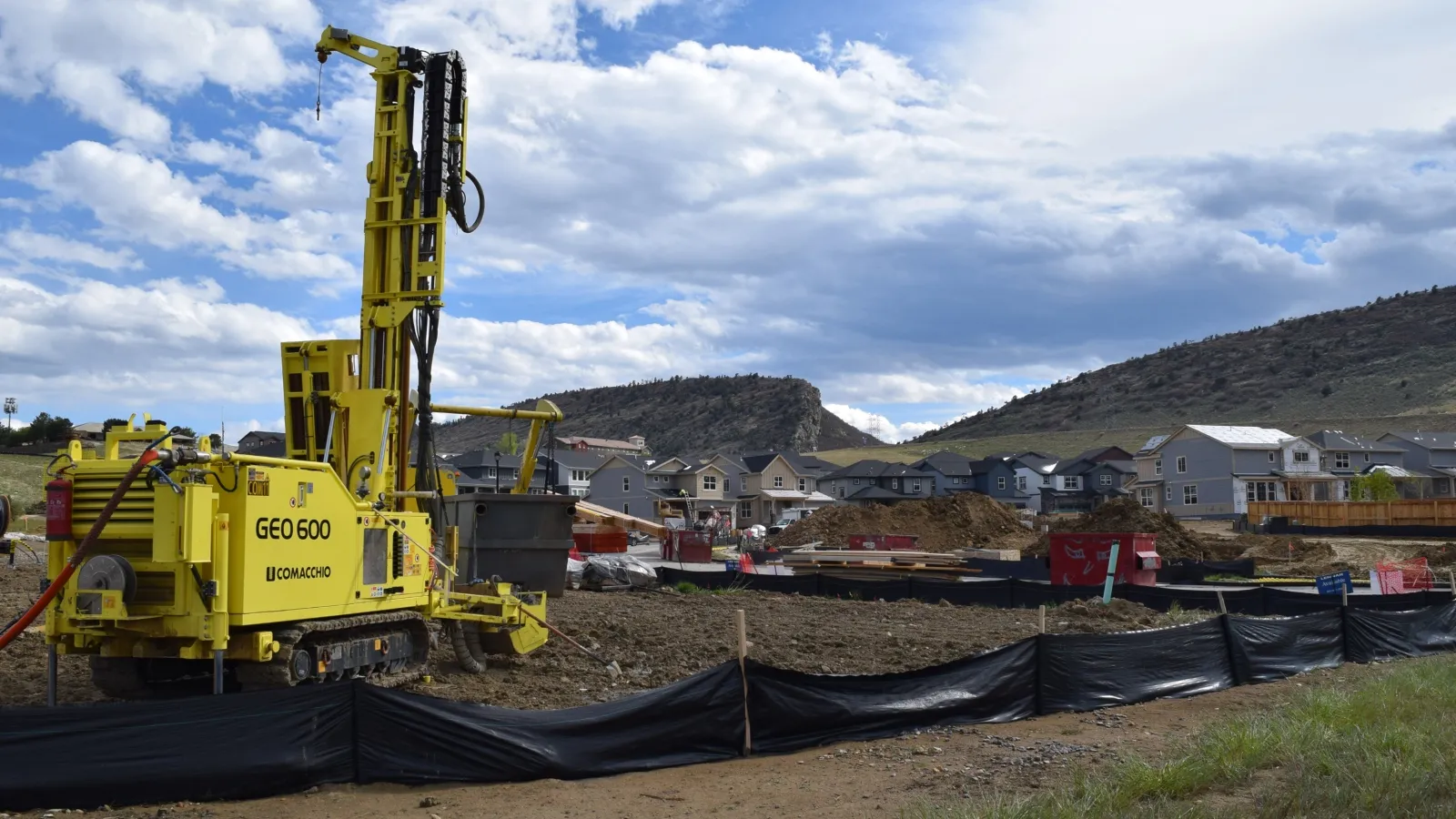
Earlier this year at Lennar’s Ken Caryl Ranch development located in Littleton, Colorado, Dandelion’s specialized drilling team demonstrated a lightweight, highly mobile rig. The equipment is specifically designed to zip quickly from one residential lot to the next, drilling boreholes and installing polyethylene pipes across the sprawling housing development long before the actual home foundations are poured.
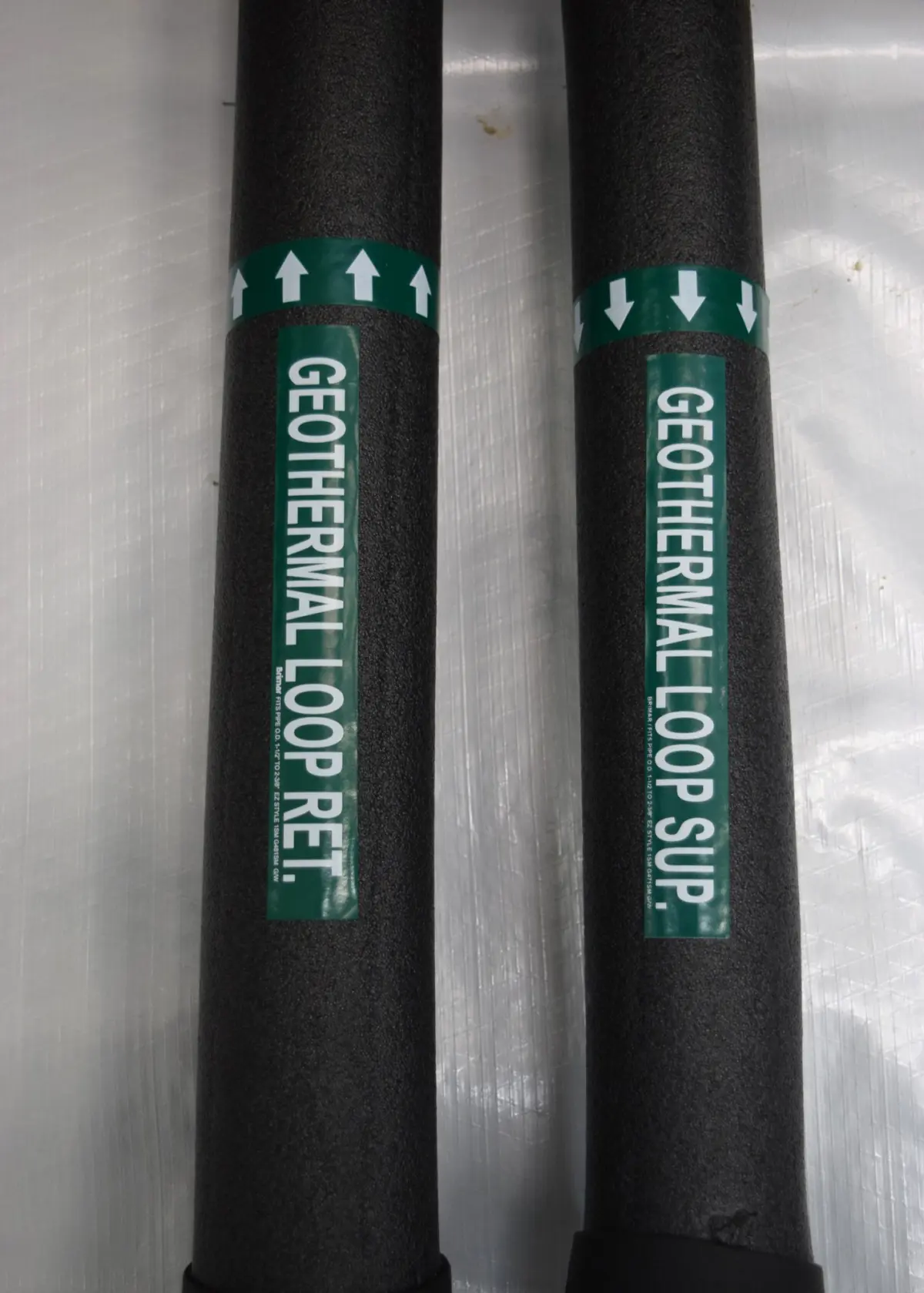
Under this setup, each home receives a single bore hole ranging between 200 and 500 feet deep. At this depth, subsurface temperatures remain at a remarkably consistent 50 degrees Fahrenheit year-round. Water circulating through the buried polyethylene pipe is naturally warmed or cooled by the surrounding earth. Once that water returns to the surface, a heat pump installed in the basement of each new home provides the final layer of heating or cooling, depending on the demands of the season.
Dandelion’s specialized drilling crew can complete necessary boreholes for one or more homes per day. By contrast, if a drilling team had to deploy a heavy rig to a single, isolated building site elsewhere, they could easily lose an entire day simply transporting, setting up, and dismantling the heavy machinery.
Furthermore, installing these devices across dozens of identical new homes simultaneously eliminates the need to draft custom architectural and mechanical plans for each building. It also avoids the potentially disruptive and costly retrofits that plague homeowners trying to update older heating, ventilation, and air conditioning systems.
The end result is an exceptionally efficient heating and cooling mechanism that Dandelion says easily outperforms standard air-source heat pumps and conventional natural gas heating systems. This efficiency advantage becomes especially apparent during severe winter cold snaps. During these periods of extreme weather, energy demand across the utility grid skyrockets, yet ground-source heat pumps continue to use roughly a quarter of the electricity demanded by air-source heat pumps, according to Yates.

It is, in his words, “the only system that actually reduces peak demand and electrifies homes at the same time.”
The Ken Caryl Ranch housing development forms a key component of a much larger initiative that Dandelion launched in partnership with Lennar back in 2025. The ambitious multi-year collaboration aims to install geothermal heating and cooling infrastructure at more than 1,500 new homes across Colorado over a two-year span. Looking further ahead, Dandelion harbors national ambitions, hoping to scale up its operations to equip 10,000 homes per year nationwide in the coming years.
“Our mission at Dandelion is to mainstream geothermal, and we think that the time has finally arrived for that to happen,” Yates said.
The broader energy landscape indicates that a shift may indeed be underway. Just over a million homes across the United States currently feature ground-source heat pumps, with approximately 100,000 new installations added annually, according to a comprehensive U.S. Department of Energy report published in 2025. The federal agency’s findings suggest that geothermal heating and cooling could expand to reach 7 million homes nationwide by 2035. Achieving that milestone would slash winter peak energy demand by more than 40 gigawatts across the country, resulting in roughly $4 billion in annual savings for the U.S. electric grid.
Despite these promising projections, ground-source heat pumps currently account for only a tiny fraction of new home heating and cooling systems installed in the United States. By stark contrast, approximately 3.6 million air-source heat pumps were sold nationwide last year, outpacing traditional gas furnace sales for the fourth consecutive year, noted Yara van Ingen, an associate with BloombergNEF’s building decarbonization team.
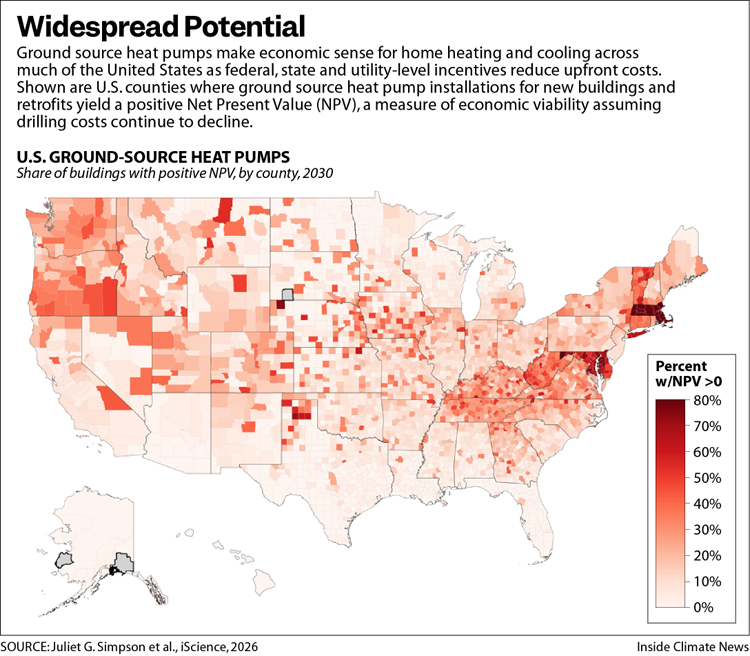
Nevertheless, research indicates that the geographical limits of geothermal energy are far wider than commonly assumed. Ground-source heat pumps are technically and economically viable across the vast expanse of the continental United States, according to a scientific study published recently in the journal iScience, which factored in local climate variations, regional energy costs, available policy incentives, and subsurface geological conditions.
“It is technically possible everywhere, and there is economic potential across all states,” said Juliet Simpson, a former research engineer at the National Laboratory of the Rockies and the lead author of the study.
A primary historical challenge facing ground-source heat pumps remains their steep upfront capital cost, which averages around $25,000 for a typical new home installation, according to the Department of Energy report. Van Ingen pointed out that additional hurdles—such as strict space constraints in dense urban environments and complex, fragmented local permitting requirements across different American municipalities—can further complicate the borehole drilling process.
To overcome these cost barriers, innovative startups like Dandelion and major homebuilders like Lennar, which has financial investments in the geothermal company, are working diligently to streamline operations. However, targeted government incentives and utility policy changes are playing an equally vital role in shifting the market dynamics.
In Colorado, an aggressive energy efficiency program administered by Xcel Energy, the state’s largest gas and electric utility company, provides approximately $25,000 per home for new, high-efficiency residential buildings that incorporate a ground-source heat pump. These funds are designed to offset the added building and heat pump capital costs.
“For large neighborhoods with hundreds of homes, builders may receive seven-figure rebate amounts,” an Xcel spokesperson noted in a written statement.
These substantial utility rebates help Xcel make meaningful progress toward its corporate sustainability targets while helping Colorado comply with its Clean Heat Standard. That state regulation legally mandates a 22 percent reduction in greenhouse gas emissions below 2015 levels by the year 2030.
Additionally, the state of Colorado offers a $2,000 state tax credit specifically for ground-source heat pumps. The state also requires homebuilders to pay out-of-pocket for new gas service expansion pipes—expensive fees that developers can completely bypass if they choose to construct all-electric neighborhoods.
State policies designed to incentivize high-efficiency electric heating and cooling while actively discouraging the expansion of fossil fuel networks in residential areas are explicitly intended to drive down greenhouse gas emissions stemming from the building sector, explained Will Toor, executive director at the Colorado Energy Office.
Similar supportive frameworks are beginning to appear in other jurisdictions. Other states and utility companies are introducing financial incentives for ground-source heat pumps, including Maryland, where Dandelion recently announced plans to deploy the technology across 129 new homes. Furthermore, commercial-scale ground-source heat pump projects across the country are now eligible for lucrative federal tax credits that can cover 30 percent or more of total installation costs.
“The economics just look better and better,” said Jessica Silber-Byrne, senior manager of thermal energy networks for the Building Decarbonization Coalition, a nonprofit organization dedicated to eliminating fossil fuel use in buildings. “There is a combination of both incentives and market signals that suggest that this is about to really take off.”