
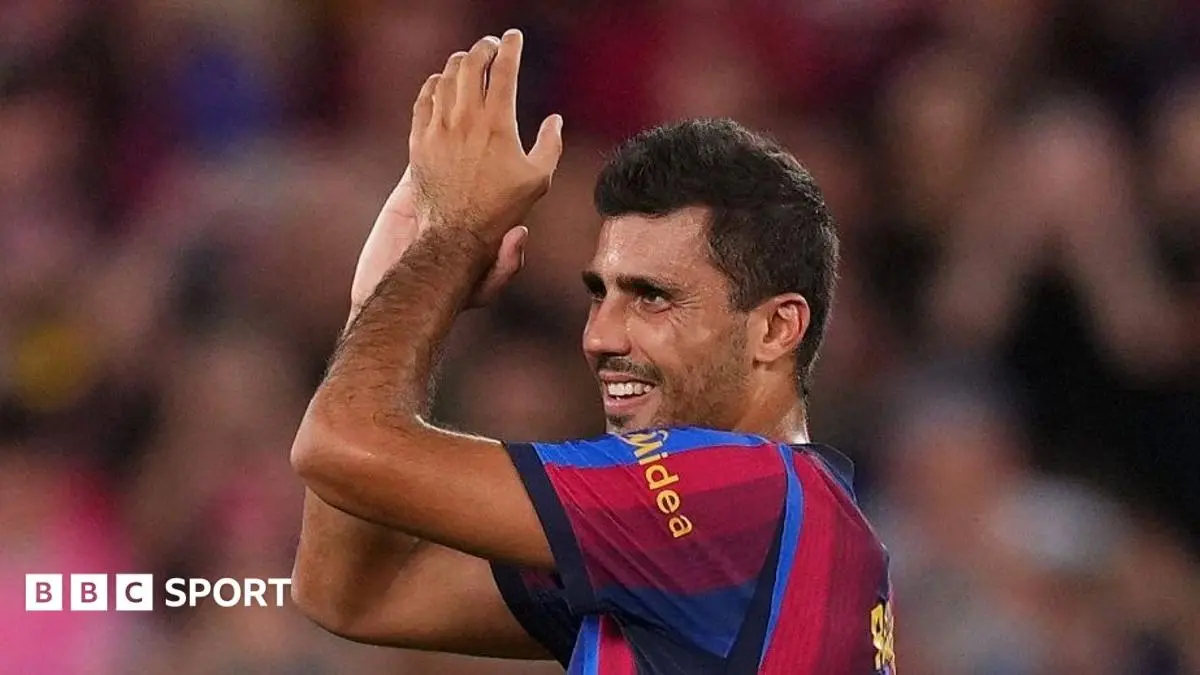
Rodri never wanted to be interesting.
While a generation of professional football players spend their careers building personal brands, chasing viral clicks, and curating their images, the Barcelona and Spain midfielder prefers to stay far away from social media and out of the spotlight. When he does speak publicly, he talks about tactics the way other players talk about luxury cars. He is, by his own honest admission, an introvert who happens to control football matches for a living.
And it has been quite a career so far. The 30-year-old midfielder has won an astonishing 12 major trophies with Manchester City while simultaneously helping the Spanish national team to historic European Championship and World Cup successes.
On Saturday, he insisted his collective successes with Manchester City could not be taken away from them, coming after the club was found guilty of breaking the vast majority of the 115 financial rules they were accused of breaching by the Premier League. City are expected to appeal against the ruling.
Adding to his glittering resume, Rodri also won the prestigious Ballon d’Or in 2024 and remains firmly in contention to win the award for a second consecutive time in October—a remarkably rare achievement for a holding midfielder.
From an immersive summer camp in Connecticut and a university lecture hall in Castellon all the way to a Champions League final, Rodri has consistently shown an extraordinary willingness to absorb whatever environment he finds himself in, understand precisely why it is being asked of him, and simply get on with the work. Understanding his unique temperament and academic character is also the essential starting point for understanding why Barcelona, rather than Real Madrid, is where his career has turned next following his departure from Manchester City in the summer.
An Unconventional Education and Formative Years
Rodri’s game was shaped by an education system that treats football intelligence as something to be actively taught and moulded. Spanish academies function fundamentally on the idea that a coach is an educator first, and Rodri absorbed that philosophy from a very young age. But he also deliberately stepped far out of his comfort zone very early in life.
At the age of 14, his father wanted him to spend an entire year at an American high school. Because a season in Villarreal’s youth ranks made that plan impossible, the family found a middle ground: a summer camp deep in the woods of Connecticut. That stay left him with the fluent, American-accented English that his Manchester City team-mates would later tease him about, and it was precisely where he watched Spain win the 2010 World Cup, sitting entirely alone by a lake, thousands of miles away from home.
His football education accelerated rapidly after he was released by Atletico Madrid as a teenager, largely because his physical body had not yet caught up with his remarkably advanced footballing brain. Villarreal quickly picked him up, and there the two primary strands of his life—elite football and rigorous academic study—ran in parallel. He moved to Castellon, the largest city near Villarreal, at the age of 17 and enrolled at university to study business administration.
He remarkably combined morning training sessions with afternoon university lectures. He cycled to training every day and lived among ordinary university students who had no idea that their quiet classmate would soon be starting matches in La Liga. When he eventually appeared on television one evening during a broadcast match, his flatmates finally realized that the ordinary boy from their accounting class wore the number six shirt for Villarreal. He has since called that period the best time of his life.
The rest of his ascent to the summit of world football is well known. Atletico Madrid brought him back in 2018 under the intense management of Diego Simeone, who sharpened his competitive edge and defensive grit. Just a year later, Manchester City paid his 70 million euro release clause, and Pep Guardiola transformed him into arguably the finest holding midfielder of his generation.
There were inevitable setbacks along the way, including a painful Champions League final defeat by Chelsea in 2021 that left him emotionally unable to speak to his own family afterwards. Two years later came the ultimate redemption, scoring the winning goal that secured Manchester City’s historic Champions League triumph in 2023. That single goal fundamentally changed the narrative of his career. Success at the European Championship with Spain soon followed, accompanied by the Ballon d’Or, a World Cup title, and an MVP award that directly preceded his high-profile move to Barcelona this summer. And observing his trajectory, one gets the distinct feeling his story is far from finished.
Why Barcelona Won the Race Over Real Madrid
Rodri has been remarkably open about how seriously he took Real Madrid’s strong interest in him during the summer transfer window. Speaking to the Spanish sports radio station COPE, he revealed that the club behaved impeccably and pursued him properly from the very first approach. He spoke at length with many key figures in and around the club, admitting that the genuine warmth of those conversations made his eventual decision considerably more difficult.
New manager Jose Mourinho communicated his overarching footballing ideas with absolute clarity, detailing precisely what he wanted from Rodri on a personal level, and that direct, assertive approach deeply appealed to him. Inside Real Madrid, the internal consensus that Rodri was the exact player they required went well beyond the coaching staff. Several influential figures at the club still regard him as the specific profile the squad is currently missing—a controlling midfielder capable of dictating tempo in a way that nobody else on their current books quite replicates.
The sheer scale of Mourinho’s pursuit reflected a genuine, unwavering conviction that Rodri was desperately required. Madrid have not gone out into the market to find an alternative version of what he would have given them, meaning the strategic gap the midfielder would have filled remains a glaring vacancy.
Ultimately, Rodri’s reasons for turning down that significant interest were strictly footballing rather than personal. His final decision came down entirely to where he felt he could grow and contribute the most—a sporting project built meticulously around a squad full of young players, many of whom he already knew, and who naturally fitted the way he understands the game. It was a calculated decision about which team truly needed what he uniquely offers, and where he could make the most profound difference.
Settling Into Hansi Flick’s Barcelona
Rodri is a veritable footballing encyclopaedia and, by the consensus of many experts, the single best defensive midfielder in the world today. There are very few players better when it comes to positional discipline, and he ranks among the elite because of both what he does himself and how he elevates the performance of his team-mates. Without the ball, both in the defensive press and when dropping back into deep blocks, he provides an immediate sense of security right in front of the backline, particularly in those chaotic moments when Barcelona transition and lose possession.
Yet he is equally outstanding with the ball at his feet because he distributes it quickly and invariably chooses the correct passing route. All of those qualities are visible in every single Barcelona match. His arrival has been described internally at the club as one of the most significant developments of recent years, both on and off the pitch. He has played in all but one match of Barcelona’s flawless start to the campaign.
For a squad that lost several senior voices in recent seasons, Rodri’s vast experience in high-pressure moments has added a vital stability that had been noticeably missing. He has taken on an informal mentoring role with the club’s academy graduates, several of whom already regard him as a primary reference point. He prefers to explain tactical concepts rather than simply demonstrate them, an innate instructional instinct that has surprised the coaching staff just as much as his supreme footballing ability has. He does not wear the captain’s armband, and probably will not for some time, but inside the dressing room many already speak of him as a captain in everything but title.
Manager Hansi Flick made it clear from day one that Barcelona had signed a distinct type of midfielder they simply did not possess, as well as a foundational reference point for a squad right in the middle of a major rebuilding phase. His on-field partnership with Pedri has rapidly emerged as one of the most encouraging signs of the season, especially given that there were initial doubts raised about whether the two technicians could coexist.
The pair combine naturally, expertly managing match tempos and sharing the collective responsibility for circulating possession. Flick views them as entirely capable of controlling matches through spatial positioning, intelligent possession, and an advanced reading of the game rather than raw athleticism.
Asked directly to compare Hansi Flick with Pep Guardiola, Rodri was unambiguous in his assessment: they are nothing alike. He has spoken candidly about arriving at Barcelona expecting the familiar routine of rondos and possession drills, only to be met instead with grueling days of intense physical work in the gymnasium.
While Guardiola traditionally trusted the natural competition of matches to build peak match sharpness, Flick has chosen a markedly different route with the players who arrived later in pre-season, working them exceptionally hard right from the outset. As one would naturally expect from his extensive CV and his resilient, analytical personality, Rodri has smoothly adapted to the demands rather than resisted them.