
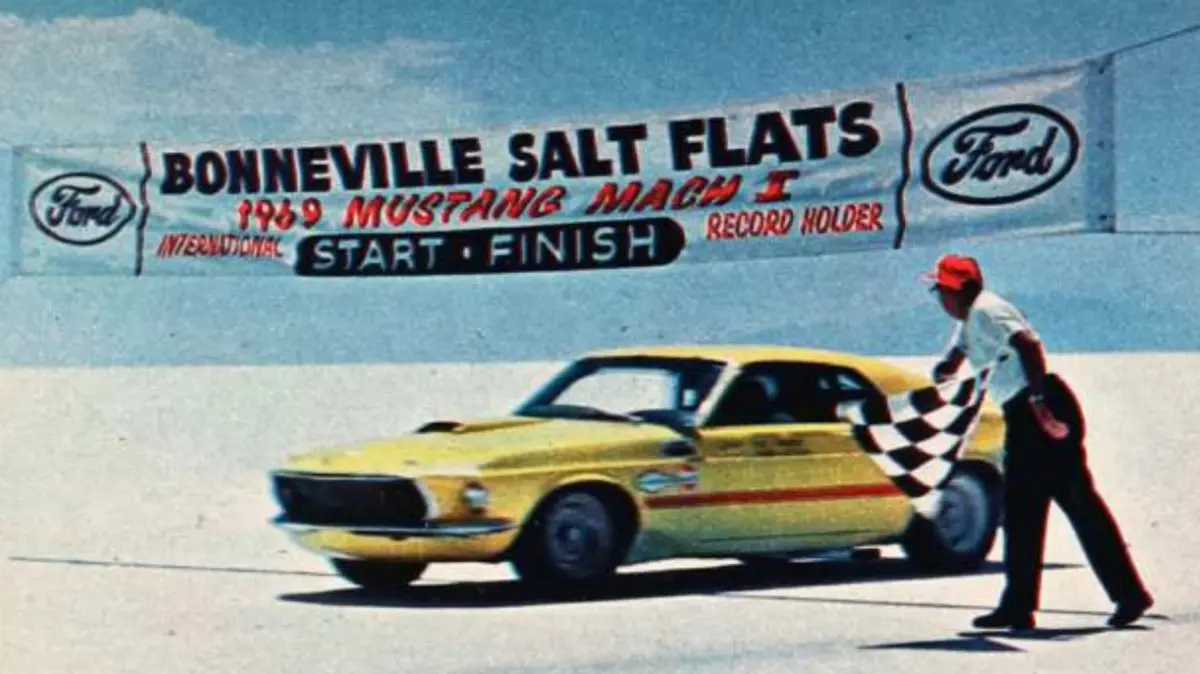
Few figures in the history of American motorsport embodied the relentless pursuit of speed quite like Mickey Thompson. A true hybrid of hot rodder, professional racer, visionary salesman, promoter, and serial entrepreneur, Thompson approached the automotive world with an unmatched, jovial enthusiasm. His unique career and larger-than-life reputation earned him deep industry connections, most notably a close professional relationship with Detroit legend Bunkie Knudsen. When Knudsen assumed the presidency of the Ford Motor Company in 1968, he brought Thompson into the corporate fold with substantial manufacturer backing.
Ford was preparing to launch its aggressively redesigned Mustang for the 1969 model year and needed a high-visibility marketing coup to establish the car’s performance credentials on a global stage. The corporate strategy was simple yet formidable: task Mickey Thompson with capturing a massive sweep of international speed records at the legendary Bonneville Salt Flats using a specially prepared trio of Mustang Mach 1s. For a veteran speed record holder who treated the Utah salt as a second home, the invitation was impossible to refuse. By the time the dust, salt, and rain settled on the multi-month campaign, Thompson and the Blue Oval had successfully secured an astonishing 295 new speed records.
To tackle the grueling endurance trials, Thompson assembled a talented and eclectic crew. He brought along his longtime friend, teammate, and renowned racing talent Danny "On The Gas" Ongais, with whom he would share the vast majority of the grueling driving duties. True to his lifelong instincts as a master promoter, Thompson also invited prominent media figures into the inner circle, including Hot Rod Magazine publisher Ray Brock and Sports Illustrated writer Bob Ottum. The plan was not merely to break a handful of milestones, but to jump behind the wheel and drive for as long and as fast as necessary to obliterate every single Fédération Internationale de l’Automobile (FIA) endurance and speed record within their sights. While reality, weather, and mechanical gremlins ultimately forced adjustments to the original blueprint, the four men still walked away with an unprecedented haul of newly minted FIA records.
The stage for the monumental attempt was set in July 1968, when Thompson and his team meticulously laid out a sprawling 10-mile oval course directly on the expansive salt flats near the Utah-Nevada border. Nature, however, refused to cooperate easily. Heavy rain had swept across the region just a day prior, leaving the fragile salt crust in deeply compromised condition as it struggled to absorb the standing water. Maintaining vehicle control at speeds exceeding 160 miles per hour on a salt course puddled with water is a perilous endeavor. Contemporary reports from the Ford heritage archives vividly describe Ongais and Thompson navigating the treacherous circuit "in a continual four-wheel drift, with the back end of the car ‘hung out’ like a dachshund turning a corner." Despite the harrowing conditions, the drivers pushed forward, demonstrating the raw capability of the machinery and the unwavering bravery of the men behind the wheel.
The Cars
The foundation of this historic record-breaking run rested upon three heavily modified 1969 Mustang Mach 1s. While their exact fabrication dates remain shrouded in some historical ambiguity, automotive historians suggest these vehicles may have been assembled as early as 1967 as part of an elite group of early preproduction prototypes. Recognizing the extreme demands of sustained high-speed oval racing, Ford shipped the three raw chassis directly to the legendary race shop Holman Moody. There, the cars underwent a comprehensive transformation, receiving the exact same rigorous level of chassis preparation applied to the team’s NASCAR Baby Grand touring car series entries.
Among the specialized modifications were aerodynamic covers for the headlights and cleanly shaved roof drip rails to minimize drag at terminal velocities. Beneath the skin, the team implemented robust, NASCAR Torino-style suspension systems. This setup featured a sophisticated quad-shock A-arm front suspension, heavy-duty rear leaf springs, and specialized weight jacks designed specifically to dial in the handling characteristics for relentless circle driving on the abrasive salt surface.
Each of the three Mustangs was tailored for a distinct competitive class and aerodynamic profile. The yellow car, for instance, was constructed specifically to contest FIA Class C competition. The strict rulebook governing Class C mandated an engine displacement falling strictly between 183 and 305 cubic inches. To comply while maximizing output, Ford equipped the vehicle with a high-revving 302 Tunnel Port V8 engine originally developed for the Sports Car Club of America (SCCA) Trans Am racing series. These high-flow induction engines were rumored to produce roughly 420 horsepower in full race trim. While they lacked the low-end grunt required to slug it out head-to-head against the Penske Camaros on tight road courses, they did not need low-end torque to sustain momentum on a sweeping 10-mile oval. This made the tunnel port an ideal, high-RPM powerhouse for a sustained distance run.
The red car, meanwhile, was configured to push significantly higher performance figures. During the official photo shoot for the initial Bonneville run, both the red and blue cars sported formidable NASCAR 427 Tunnel Port engines. However, their intended purposes diverged sharply: the red car was geared for oval-track endurance, while the blue car was engineered strictly for straight-line performance. Interestingly, official record books do not indicate that the blue car ever successfully logged official competitive times during the trials.
The red car’s initial journey was similarly stymied by the unforgiving weather, resulting in its early runs being completely scrapped. When the vehicle returned to the salt months later, it had undergone a dramatic mechanical evolution. The traditional carburation setup had been completely discarded in favor of a bespoke fuel injection system, topped by a massive, intimidating supercharger protruding prominently through a custom-cut hole in the hood.
The Attempt
The initial strategy focused on utilizing the yellow Class C car to capture the elusive 24-hour speed record. However, contemporary accounts reveal that a punishing combination of rain-softened salt, a series of heart-stopping high-speed spinouts, and minor mechanical component failures forced the team to curtail their opening effort at the 500-mile mark. Even with the shortened distance, the run was an unqualified triumph; the team maintained an astonishing average speed of 159 miles per hour for the entire duration, shattering 42 distinct Class C records in a single day.
While popular culture might have featured artists like Wilson Pickett pleading with Sally to slow her Mustang down, Mickey Thompson understood that the salt flats held vast reserves of untapped speed and countless records waiting to be claimed. Unfortunately, the summer of 1968 proved persistently damp, keeping Bonneville soaked for weeks. The crew returned in August as the salt began to dry, only for the heavens to open once more, dumping sheets of heavy rain and forcing the project to be shelved yet again.
By September, however, the weather relented. Bonneville transformed into a much more hospitable landscape—drier, flatter, and significantly safer for sustained high-speed driving. With the public unveiling of the redesigned 1969 Mustang looming just two weeks away, the pressure was on Thompson and Ford to finalize the record books before the car’s official commercial debut.
Thompson eased himself and the engineering crew back into a rhythm by taking the red Class B car out onto the salt. He immediately laid down a blistering pace, capturing an incredible 174 additional records within a 500-mile window while maintaining an average velocity exceeding 175 miles per hour throughout. Following a brief pause for dinner, the team pivoted back to the yellow Class C car to make their definitive assault on the 24-hour endurance record.
The small-block 302 engine performed flawlessly, thoroughly demolishing the existing 24-hour benchmark by covering an astonishing 3,783 miles in a single day. In the process, 101 Class C records fell, with the team even successfully re-breaking several milestones they had set earlier that summer. Decades have passed since those sun-baked days on the Utah salt, but the legacy of that joint effort endures; Mickey Thompson and his dedicated crew still hold 12 of those historic speed records, standing as a testament to American engineering, driving grit, and relentless ambition 57 years later.