
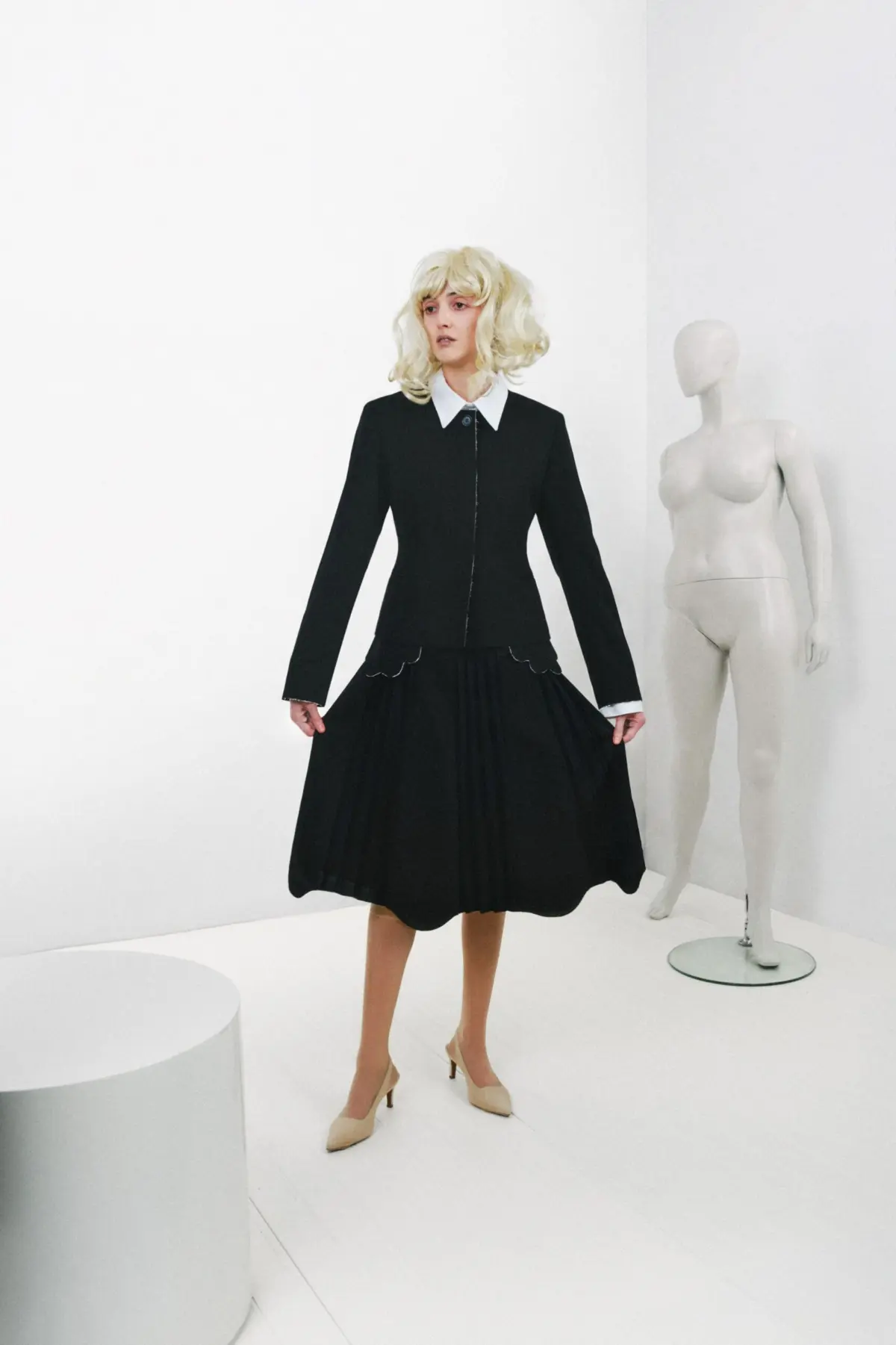
Beate Skonare Karlsson has long been recognized as a master of the digital zeitgeist. As a digital native, the Swedish designer built the reputation of her independent label, Avavav, on a foundation of high-concept, high-impact viral moments. From runways where models intentionally tripped and stumbled to the introduction of uncanny, anthropomorphic "finger shoes"—which famously caught the eye of avant-garde icon Rick Owens—Karlsson understood early on that in a crowded global fashion market, a small, independent brand needs a distinct, disruptive edge to capture the attention of a digital-first audience. By leveraging online spaces, she transformed Milan Fashion Week into a theater of the unexpected.
However, for the Spring 2027 season, Karlsson has opted for a significant shift in strategy. Rather than returning to the high-stakes runway theatrics that defined her earlier seasons in Italy, the designer chose to remain in her home base of Stockholm. While some observers might interpret this move as a retreat, it is better understood as a deliberate rejection of the algorithm-driven cycle of constant novelty. It marks a return to roots, a recalibration of purpose, and, perhaps most importantly, an evolution of her design language from the provocative to the profound.
The Evolution of an Aesthetic
Over the past few years, Karlsson has carefully cultivated a series of unmistakable design signatures. Her work has often been characterized by a "creature-like" quality—pieces that feel biological, organic, and occasionally unsettling. Collectors and followers of the brand are well-versed in her lexicon: the scalloped larva bag, the wide-set curvy panda glasses, and the ubiquitous, flowing fringe centipede scarf. These items were not merely accessories; they were extensions of a world-building exercise that prioritized the strange and the tactile.
Alongside these accessories, Karlsson developed a set of technical hallmarks that gave her streetwear a skeletal, almost alien architecture. Techniques such as "sharpei" ruching—a method of gathering fabric to create deep, textural folds—and her signature sharp slashes and rib-like motifs became the backbone of her silhouette. For the Spring 2027 collection, however, Karlsson signaled a pivot. She decided to set the rigid boundaries of streetwear mostly aside, opting instead for a more mature, sophisticated approach. The result is arguably her most "grown-up" collection to date, though she has been careful to retain the cartoonish sense of fun and irrepressible irreverence that made her brand a cult success in the first place.
Elevating the Everyday through Sculptural Craft
One of the most intriguing developments in this collection is the way Karlsson has begun to translate the shapes that once defined her accessories into the structure of her garments. It is a bold, experimental approach that bridges the gap between wearable art and traditional tailoring. For example, a well-tailored jacket—constructed with a level of polish that would satisfy the most discerning sciura—is updated with curvy, larva-shaped pockets. This infusion of organic, rounder geometry into classic menswear-inspired silhouettes serves as a masterclass in balance.
These softer forms act as a foil to the designer’s primary preoccupation this season: pleating. Karlsson has dived deep into the possibilities of plissée, experimenting with both vertical and horizontal orientations to create garments that feel kinetic and alive. A slinky, accordion-like skirt serves as a standout example, mimicking the movement of a toy spring.
Elsewhere, the collection touches on a sense of historical playfulness. A stretchy minidress, accented with a single, structural hoop, draws clear inspiration from the vintage bathing suits of the early 20th century. While one could read the piece as a nod to the rigid cages that defined women’s silhouettes for centuries, in Karlsson’s hands, the effect is entirely different. It feels light, whimsical, and fundamentally modern.
The influence of domestic craft is also present, albeit elevated through extreme technical precision. A slashed skirt, designed with exposed loops that reveal the construction of its underside, sits alongside a dress crafted with crumpled streamers that evoke the texture of crepe paper. These pieces were inspired by a specific, nostalgic reference: a Christmas episode of Pippi Longstocking, where the home is filled with the messy, joyous detritus of gift-wrapping. Karlsson has managed to take the chaotic, ephemeral spirit of at-home paper crafts and translate it into a luxury garment, executing the folds and layers with the rigor of a couture atelier.
A Response to Digital Fatigue
The collection arrives at a moment of profound industry change. As the fashion world grapples with a collective "digital fatigue," there is a growing movement toward the analog, the tactile, and the authentic. Karlsson’s focus on dimensionality and texture feels perfectly in sync with this cultural shift. Her use of classic gingham on a smart, ribcage-inspired jacket—complete with delicate smocking at the wrists—highlights a designer who is no longer chasing viral trends, but is instead refining her craft to resonate on a more human scale.
This transition toward simplification is intentional. In conversation, Karlsson notes that the industry—and life at large—has reached a point of saturation. We are living through an era of "extra everything," where layering and visual noise are the default settings for communication. Karlsson is actively working against this grain.
"I think it’s nice to just have calm for the eye," she remarked while discussing the collection’s development. "My experience is that it’s a time where it’s just extra everything and layering—not just in fashion, but in life in general. I’m just trying to remove layers and see if the core and the actual essence is still interesting."
This philosophy of reduction proved highly successful. It was perhaps most evident in a simple, pleated tube dress that Karlsson transformed into a quintessential Little Black Dress (LBD). By stripping away the viral gimmicks and the conceptual noise of previous seasons, she allowed the construction, the silhouette, and the fabric itself to speak. The piece felt timeless, elegant, and—crucially—unapologetically Karlsson.
By stepping back from the pressure of the global runway calendar and focusing on the core essence of her label, Beate Skonare Karlsson has successfully matured her aesthetic. She has proven that while the viral stunts were a necessary vehicle to introduce her vision to the world, her long-term viability lies in her ability to marry the whimsical, cartoonish nature of her origins with a serious, thoughtful approach to garment construction. As she continues to navigate the balance between the digital and the analog, her work remains a vital, shifting study in what it means to be a modern designer in a world that is increasingly desperate for something real.
The Spring 2027 collection serves as a testament to the fact that Karlsson’s most compelling design signature is not a specific shoe or a specific trend, but rather her own creative evolution—a journey that continues to surprise, even when it chooses to be quiet.