
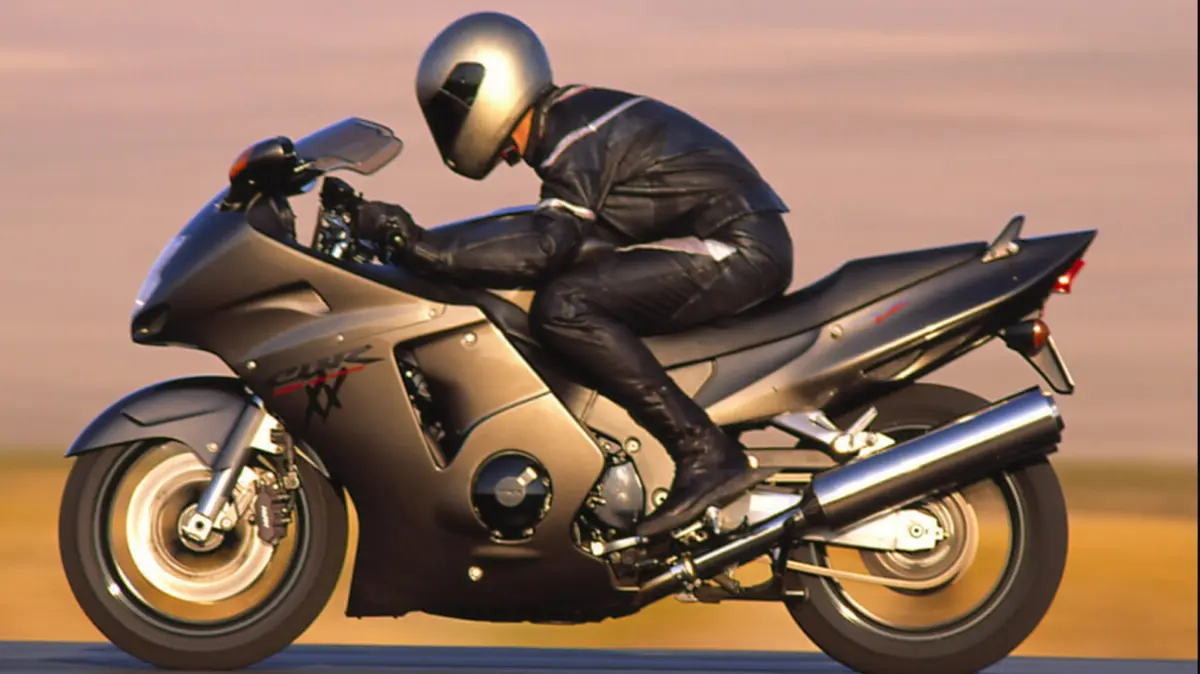
Propelled by a 1,137cc four-cylinder engine generating 149 horsepower, Honda’s flagship speed machine possessed all the necessary hardware to travel exceptionally fast within a sleek, stable aerodynamic package. At the time of its debut, it stood not only as the fastest production motorcycle available on the market, but also as the fastest vehicle Honda had ever offered to the general public. In fact, its top speed exceeded that of Honda’s contemporary NSX sports car by 10 miles per hour. Very few sports cars of that era could outpace the Blackbird, and all of them commanded significantly higher price tags.
It would take several years for the Blackbird’s benchmark top speed to be genuinely challenged, and remarkably few motorcycles have possessed the raw power required to eclipse it in the three decades since its introduction. For a period, the industry operated under an unofficial "gentleman’s agreement" among major manufacturers to tone down the escalating top speed arms race, largely driven by fears of impending speed limiter legislation from nervous regulators. Despite this informal treaty, a select few motorcycles eventually shattered the boundary, with some even managing to breach the elusive 200-mph barrier in factory stock condition.
1999 Suzuki Hayabusa – 194 MPH
Just three years after Honda unveiled the Super Blackbird, Suzuki escalated the competition by introducing an even faster and more powerful 1.3-liter motorcycle: the GSX-1300R Hayabusa. The name itself is the Japanese term for the peregrine falcon, a predatory bird known for hunting blackbirds. Equipped with a formidable 175 horsepower and exceptionally smooth, fluid aerodynamics, the Hayabusa was engineered explicitly for top-speed dominance and successfully commanded that crown for nearly two decades. The machine was capable of a stunningly fast, manufacturer-claimed top speed of 194 miles per hour.
Writing for Cycle World, automotive journalist Mark Hoyer captured the otherworldly aura surrounding the machine, observing that while Suzuki’s soul drew its divine light from the GSX-R series, the Hayabusa represented an instance where engineering managed to put supernatural powers, complete with working headlights and a license plate, directly into the hands of ordinary riders.
The Hayabusa proved so overwhelmingly fast that global motorcycle manufacturers began to grow genuinely concerned that the top speed arms race was spiraling completely out of control. The industry recognized the writing on the wall, particularly as European lawmakers increasingly voiced concerns regarding the inherent dangers associated with progressively faster superbikes. Collectively, Japan’s prominent manufacturers decided to rein in their competitive impulses, establishing a voluntary, self-imposed cap on motorcycle top speeds set at 300 kilometers per hour, which translates to roughly 186 miles per hour. Industry executives at Honda, Yamaha, Suzuki, and Kawasaki ultimately concluded that it was far wiser to police themselves than to wait for external governments to impose strict legal limits.
To this day, the fastest street-legal motorcycles originating from Japan remain artificially restricted to top speeds just under that 300 kph threshold. Following its initial 1999 launch, Suzuki adjusted the gearing and electronics of the phenomenal Hayabusa to limit its top speed to precisely 300 kph, though this restriction was implemented without any reduction in engine power or displacement. The iconic Japanese superbike remains electronically governed to this day.
2007 MV Agusta F4 R 312 – 194 MPH
MV Agusta became the very first European motorcycle manufacturer to openly break the industry’s gentleman’s agreement regarding top speed. Seven years after the pact was established, the Italian boutique brand released the 2007 F4 R 312. In this specific nomenclature, the numerical designation denoted the exact number of kilometers per hour the motorcycle could achieve at wide-open throttle. That figure converted to 194 miles per hour, perfectly matching the blistering numbers previously posted by Suzuki’s Hayabusa. To MV Agusta’s credit, the company had never been a party to the original agreement and had never indicated that it intended to abide by the self-imposed limits adopted by the major Japanese firms.
Carrying a steep retail price tag of $24,995 upon its debut, the 312 was an expensive proposition for showroom buyers. However, given MV Agusta’s exclusive boutique status, the prestige of holding the world’s fastest production bragging rights, and a wealth of hand-assembled components, many enthusiasts considered the cost justified, even though total sales volumes remained modest. The pre-existing F4 1000 R model provided the foundational architecture for the 312, sacrificing a small amount of low-end torque in exchange for a nine-horsepower boost achieved through the implementation of titanium valves, larger throttle bodies, and shortened intake trumpets. Beyond the heavily revised powerplant, the 312 shared virtually all of its mechanical components with its F4 1000 R siblings, including the chassis, suspension forks, high-performance braking systems, and the breathtaking industrial design sculpted by Massimo Tamburini.
Boasting a claimed 183 horsepower and a dry weight of just 423 pounds, the Italian machine was both more powerful and significantly lighter than the Hayabusa it was sparring with at the summit of the performance hierarchy. Furthermore, the Italian flyhead was widely praised for its striking visual aesthetics, standing in stark contrast to the Hayabusa, which Cycle World memorably described as resembling a copper-colored cosmic suppository. Of course, the Suzuki maintained a massive advantage in terms of affordability.
2021 BMW M 1000 RR – 195 MPH
Prior to the introduction of the M 1000 RR, BMW Motorrad and the company’s high-performance M division had never previously collaborated toward a shared automotive development goal. Serving as an aggressive evolution of the already exceptionally fast S 1000 RR, BMW engineers managed to shave the motorcycle’s dry weight down to 423 pounds through the strategic application of carbon fiber wheels and a lightweight Akrapovič exhaust system. Simultaneously, they elevated the output of the four-cylinder engine to an astonishing 218 horsepower—up from the standard 205 ponies—by incorporating lighter pistons, titanium connecting rods, and updated variable valve timing technology known as ShiftCam. That high-revving engine proved capable of spinning smoothly past 15,000 revolutions per minute.
Unlike the majority of machines previously discussed, the M 1000 RR was developed explicitly for race homologation purposes. BMW was not necessarily consumed by the pursuit of raising the top speed ceiling for its fastest motorcycle, but the breathtaking velocity served as a natural byproduct of reduced weight and substantially increased power. While the standard S 1000 RR was already fully capable of reaching the regulated 300-kilometer-per-hour limit, the M-tuned variant leapfrogged past MV Agusta’s historical figure, pushing onward to 314 kph, or just over 195 miles per hour.
While this was not the absolute first motorcycle to exceed the performance boundaries set by the 1999 Hayabusa, by the year 2020 the historical gentleman’s agreement had largely faded into the rearview mirror of motorcycling history. Nevertheless, it marked a definitive milestone as the first time BMW had officially crossed the traditional 300 kph threshold from the factory floor. Interestingly, units destined for the United States market were restricted to a top speed of 189 mph due to throttle limitations integrated to comply with stringent federal noise and emissions regulations.
2019 Ducati Panigale V4 R – 197 MPH
It is difficult to argue that Ducati’s Panigale V4 series represents anything short of engineering excess wrapped in Italian styling. Shortly after BMW unveiled its updated K67-generation S 1000 RR, Ducati tasked its factory race department with developing an even more formidable track weapon originating from Borgo Panigale. Serving as another World Superbike homologation special, the Panigale V4 R represents the absolute highest echelon of street-legal performance offered by the iconic brand.
Outfitted with a detuned street version of the company’s race-bred Desmosedici Stradale R engine, the V4 R generates a staggering 221 horsepower alongside 83 pound-feet of torque. Additionally, the R variant managed to shed roughly ten pounds compared to the standard Panigale V4. This machine stands as arguably the fastest street-legal motorcycle equipped with a proper license plate, boasting a factory-claimed top speed of 197 miles per hour.
Ducati was ultimately unsatisfied with stopping just short of the coveted double-ton benchmark. Buyers who ordered a Panigale V4 R had the option to check a box for a factory-developed racing kit that included a specialized, lightweight Akrapovič exhaust system. Because this specific exhaust system does not conform to standard street noise and emissions regulations, it is not strictly street-legal for public road use. When that kit is installed, the motorcycle’s output surges to an incredible 239 horsepower while shedding more than ten pounds from the chassis. With the racing kit fully operational, the top speed of the Panigale V4 R climbs to an astonishing 205 miles per hour.
Prior to the arrival of the V4 R, no production street-legal motorcycle had ever successfully pierced the 200-mph barrier in stock trim. While the Ducati remains available in a compliant street configuration, and few practical barriers stop adventurous owners from utilizing the racing kit on public asphalt, the factory stock configuration still sits just a fraction shy of that historic goal.
2015 Kawasaki Ninja H2R – 248.5 MPH
While the rest of the global motorcycle industry remained focused on refining traditional naturally aspirated superbikes, Kawasaki made a bold leap directly into the hyperbike arena with the introduction of the Ninja H2. The street-legal variant of the Ninja H2 was already exceptionally fast, featuring a 240-horsepower, 998cc supercharged inline-four engine paired with the standard 186-mph electronic limiter utilized by competing manufacturers. However, if the factory governor is removed, the standard H2 proves more than capable of achieving speeds exceeding 200 miles per hour. Because Kawasaki declines to sell the motorcycle in an unrestricted configuration to the general public, modified variants cannot fairly be counted as official factory speed champions.
Much like Ducati, however, Kawasaki offers a dedicated, non-street-legal track iteration of its most powerful creation for a limited window each year. Retailing for upwards of $62,000, the track-only Ninja H2 R unleashes a colossal peak output of 322 horsepower and an even more staggering 121.5 pound-feet of torque. This uncompromising machine carries a slightly heavier footprint than the lightweight European homologation specials, tipping the scales at 476 pounds in ready-to-ride track specification.
Any motorcycle producing well north of 300 horsepower is bound to deliver blistering acceleration. With WorldSSP Challenge rider Kenan Sofuoğlu in the saddle, a factory-prepared H2 R managed to achieve an unprecedented top speed of 400 kilometers per hour—equivalent to 248.5 miles per hour—across the span of the Izmit Bay Bridge in Turkey. While Kawasaki officially maintains that the stock version of the machine tops out near 380 kph, Sofuoğlu asserted that he made only minor aerodynamic adjustments while leaving the fundamental mechanical architecture of the motorcycle unmodified. Operating a production-based machine at a hair’s breadth from 250 miles per hour represents an extraordinary pinnacle of speed, regardless of whether the motorcycle is legally permitted to cruise down a public highway.