
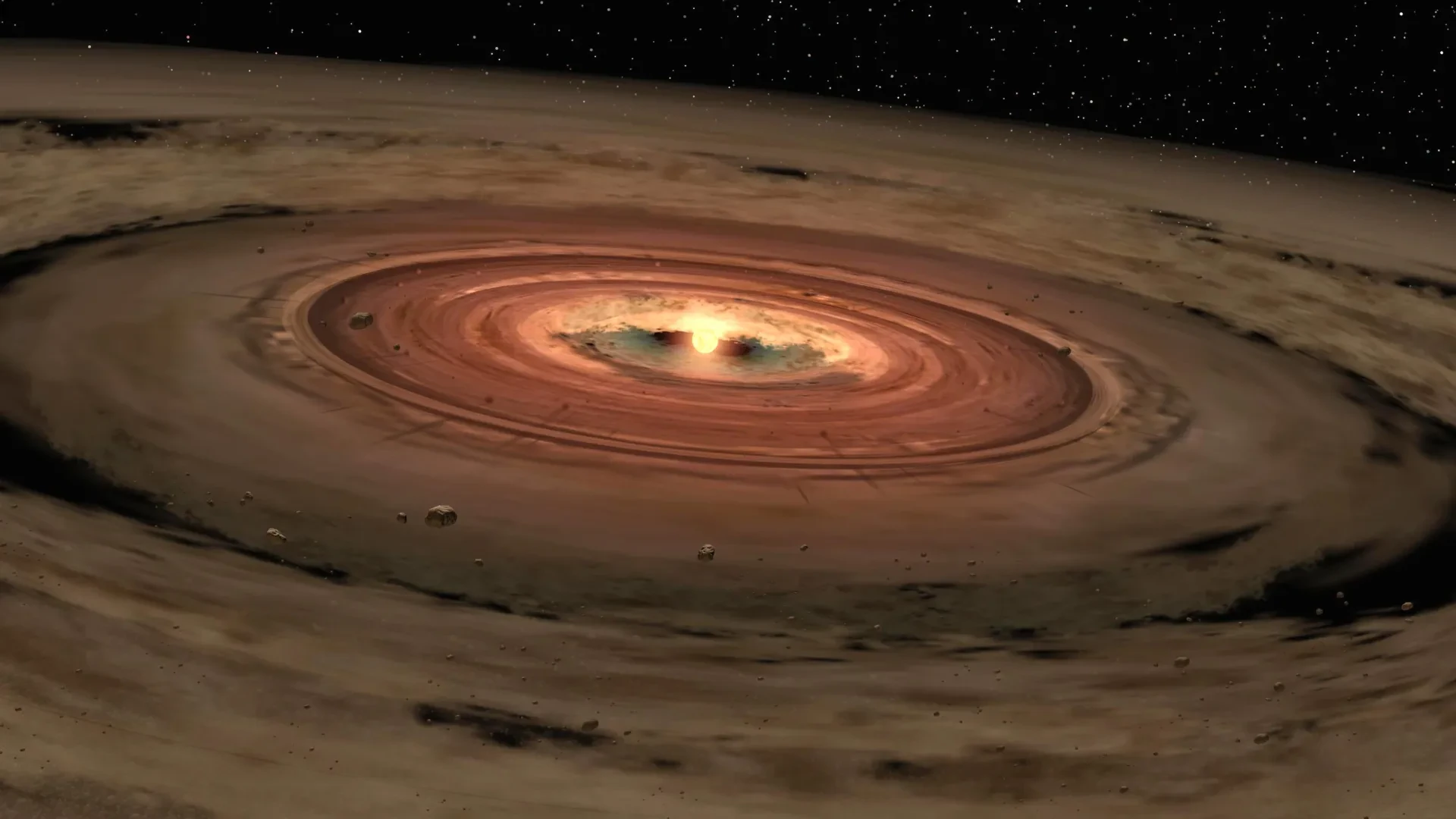
The earliest chapters of planetary assembly in our Solar System may have operated with a degree of structural selectivity that planetary scientists previously failed to appreciate. When the young Sun was surrounded by a swirling protoplanetary disk of gas and dust, it began forging the solid objects that would eventually evolve into full-fledged planets, moons, and protoplanets. According to a new study, this formative process relied on two primary classes of building blocks, but favored one over the other with surprising speed and efficiency.
One primary component available in the primordial disk consisted of chondrules—millimeter-sized spheres of rock that formed under intense high-temperature conditions. The other was matrix, a cold, fine-grained dust rich in water ice and organic molecules.
New research spearheaded by scientists at Yale University has revealed that the Solar System heavily favored the heat-formed rocky material almost immediately after solid bodies began to condense. Published on September 18 in the scientific journal Nature Astronomy, the study provides the first direct geochemical evidence demonstrating that chondrules were already being preferentially swept up and incorporated into solid bodies during the very first million years of the Solar System’s existence. Until this breakthrough, researchers had only been able to document this specific type of material sorting in meteorite parent bodies that formed two to four million years after the Solar System’s genesis.
The Solar System Was Selective From the Start
"Our work shows that this assembly process was remarkably selective from the very beginning," said Damanveer Grewal, an assistant professor of Earth and planetary sciences in Yale’s Faculty of Arts and Sciences, and the lead author of the study. "The earliest bodies in the outer Solar System were built from 83% to 92% chondrules, with very little of the icy, volatile-rich dust that dominates later-forming objects."
Chondrules are small, glassy to crystalline rocky spheres found embedded inside chondrites, which are classified among the most primitive meteorites preserved in geological collections worldwide. These tiny structures serve as physical time capsules, offering modern scientists a direct physical bridge to the chaotic and energetic dawn of the Solar System more than 4.5 billion years ago.
"You can hold them in your hand and know that they began as part of a process that started billions of years ago," Grewal noted, reflecting on the profound timescales involved in cosmochemistry. "It’s a timescale that’s hard to wrap your head around."
For decades, planetary scientists have understood that carbonaceous chondrites—primitive, stony meteorites carrying organic compounds and water trapped within their silicate minerals from the outer reaches of the Solar System—display a distinct pattern tied to their chronological age. Older examples of these meteorites consistently tend to contain a greater proportion of chondrules coupled with a lower volume of matrix material. Conversely, younger carbonaceous chondrites contain significantly higher concentrations of the cold, volatile-rich dust.
This established pattern strongly implied that the specific spatial regions where the first solid objects, known scientifically as planetesimals, were actively forming must have favored heat-formed chondrules while systematically excluding much of the surrounding icy dust. However, proving this hypothesis for the absolute earliest epoch of the Solar System remained a major challenge for researchers.
Searching for Evidence From the First Million Years
Confirming the exact sequence of events that transpired during the Solar System’s inaugural million years has long frustrated researchers because no pristine, undifferentiated bodies from that specific window of time survive intact today. Without surviving ancient remnants, scientists lacked a direct empirical method to measure the original balance between chondrules and matrix in those earliest generations of solid bodies.
To circumvent this roadblock, Grewal and his academic collaborators adopted an innovative approach, examining chemical clues preserved deep within iron meteorites that originated in the outer Solar System.
The parent bodies represented by these iron meteorites originally contained such high concentrations of radioactive aluminum-26 that the heat generated by its radioactive decay caused them to melt completely. That profound thermal event erased the traditional physical structures, textures, and mineral arrangements that normally reveal what ancient planetesimals originally contained.
Even though the physical architecture was wiped clean, their fundamental chemistry managed to preserve vital information. The researchers identified two independent chemical tracers closely associated with matrix material. The first tracer was sulfur, an element that occurs in high concentrations within the fine-grained matrix. The second tracer was the oxidation state of iron, which acts as a reliable chemical proxy indicating how much water ice and oxidized dust had been successfully incorporated into the original parent body when it first coalesced.
Meteorites Reveal a Chondrule-Rich Beginning
Armed with these two distinct chemical tracers, the research team successfully reconstructed the bulk compositions of the ancient parent bodies. Their calculations revealed that matrix material accounted for a mere 8% to 17% of the original material making up these bodies—a significantly smaller proportion than has ever been measured in any known chondrite meteorite.
This startlingly low percentage meant that the remaining bulk of the material was overwhelmingly dominated by chondrules.
"Both tracers independently tell the same story: these early planetesimals were remarkably matrix-poor," Grewal explained. "That convergence is what makes the result robust."
These striking findings may also provide a neat solution to a long-standing mystery within the meteorite record. Despite appearing to have been abundant during the earliest history of the Solar System, very old chondrules are surprisingly uncommon in samples found today. According to Grewal’s analysis, many of those ancient chondrules were likely gobbled up and locked away inside the very first generation of planetesimals. Because those early bodies subsequently melted due to radioactive decay, their original physical structures were destroyed, rendering the oldest surviving chondrules much harder to isolate and identify in contemporary meteorite collections.
Reconstructing the Birth of Planetary Bodies
The new data indicate that the complex astrophysical process of separating, sorting, and selecting planetary building blocks began almost the exact moment solid bodies started to condense from the solar nebula. Rather than blending chondrules and icy dust together in an even, homogeneous mix, the young Solar System actively favored chondrules in some of its earliest-forming planetesimals.
"These ubiquitous little beads of rock are the basic building blocks from which the planets themselves were eventually assembled," Grewal concluded. "And now we know they were already being sorted and incorporated into the first generation of solid bodies from the very start."
The study was conducted in collaboration with co-authors Zhongtian Zhang of Princeton University and Joanna Drążkowska of the Max Planck Institute for Solar System Research in Germany. Financial support for the research was provided by Yale University.